“Not One-Drop” of African Blood Rule

Listen on Apple Podcasts Spotify YouTube Download MP3
About this episode
In this new series on Mormon Leadership, historian Matt Harris discusses Mormonism’s early racism, focusing on the priesthood and temple ban for Black members. He explores the church’s opposition to civil rights, the experiences of Black Latter-day Saints like Jane Manning James and Elijah Abel, and the evolving theology around race. Harris challenges misconceptions about prophetic revelation and the origins of the ban, shedding light on this complex and painful history.
We are thrilled to announce that we have reached our donation goal to compensate Dr. Matt Harris for his contributions to this series. We sincerely thank everyone who supported this effort. While the goal to pay Matt has been met, producing this series incurred significant costs for the Open Stories Foundation. If you find value in this content and want to help cover these expenses and support future productions, we encourage you to donate at mormonstories.org/donate. Your generosity makes a difference—thank you!
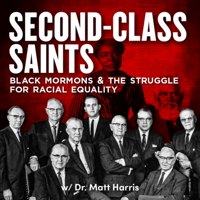
Purchase Matt Harris’ book here: Second-Class Saints: Black Mormons and the Struggle for Racial Equality: Harris, Matthew L.
Thumbnail Credits: Image of Brigham Young by Charles William Carter (public domain); Image of Amanda Leggroan in the public domain.
Originally published on mormonstories.org.
Transcript
Machine-generated and lightly edited. Click any timestamp to jump the audio to that moment. The audio is authoritative; please check it before quoting.
Introducing the Second-Class Saints Series
John Dehlin Hello everyone and welcome to another edition of Mormon Stories podcast. It is June 3, 2024 and I could not be more excited for a brand new project podcast series that we are hoping to kick off today. You know, depending on your support and listenership as viewers and listeners, the impetus for today is this ground, what I believe is a groundbreaking new book entitled Second Class Black Mormons and the Struggle for racial equality by Dr. Matthew Harris. Please pause your podcast right now. Go to Amazon or Benchmark Books. Buy this book every single paragraph. So far I've highlighted something or put a big red star by it because to me it's earth shattering and I've been reading Mormon history books for 20 to 30 years depending on how you start counting.
John Dehlin But those of you who follow Mormon Stories podcast will know that we just recently have been, you know, 50 episodes into an independent podcast series on Mormon stories that's part of Mormon Stories but it's also its own project and that's the LDS discussion series that has been highly, highly successful both on Mormon Stories and as its own podcast. And we are excited to announce the soft launch, the draft launch, the beta launch of a new possible podcast series with Dr. Matthew Harris. Now you will, if those of you have been following Mormon Stories podcast for years, will remember Matt Harris. We had him on to talk about Ezra Taft Benson and his role in the Mormon church in the 20th century.
John Dehlin And we've also had him on to talk about the gospel topics, essays and possibly other things. But as far as I'm concerned, this is my opinion, Matt Harris is one of, if not the most important historians right now alive doing work on the Mormon Church specifically related to the 20th and 21st centuries, how the Church works, and for me, how the Church works on the inside.
John Dehlin So that's my view of Matt and my view of this book is I honestly don't know of a more important book other than no Man Knows My History. For someone who wants to understand Mormon history or the Mormon Church and specifically as it relates obviously to the priesthood and temple ban on Black Latter day Saints for 150 plus years. But if you wanna understand how the Mormon Church works, there's, you know, David O. McKay's and the rise of Modern Mormonism. There are a couple other books, but for me there's no better book for understanding how Mormon Church leaders make decisions, how power works within the Mormon Church, and it applies to so many contemporary issues than this book, Second Class Saints, Black Mormons and the Struggle for Racial Equality.
John Dehlin So I'm excited to bring back on Mormon stories, Dr. Matt Harris and of course, Gerardo is helping out today and likely into the future as well. So, Matt Harris, I'm sure as an academic, there are all sorts of things that made you uncomfortable about that introduction. But welcome back to Mormon Stories and to this exciting, hopefully new project. And Matt, I'll give you a chance to talk, to remind our audience who you are, what you do, and a correct edit or add to anything I said about you. Matt.
Meet Dr. Matt Harris and His Research
Matt Harris Well, thanks, John. Appreciate you having me back on. And Gerardo, it's nice to have you on today to meet you. Let's see. I teach history at Colorado State University, Pueblo. I teach race and religion, civil rights. I teach American legal history, the Constitution, so I like to say all the controversial subjects.
Matt Harris And I also direct their legal studies program there. We have 100% placement rate in law schools for our students. So yay. Shout out for that. Let's see. And I've been writing about Mormon history for. Oh, let's see. At least been researching it since probably 2012. 2011, 2012 or so. And then publishing in the field since then. But before that, I was an early Americanist. Most of my work was in the Founding fathers and religion. And somehow, I don't know, 2011, 2012, I caught the Mormon history bug.
Matt Harris And it's like quicksand. Once you're in, you can't get out. So here I am, stuck in the quicksand over a dozen years later. But I'm delighted to be back on the program again, John.
John Dehlin Okay, well, it's great to have you, Gerardo. You're the one who introduced me to Matt Harris and his work. I'm sure Rick Bennett. And Rick Bennett was a part of that. Do you want to talk anything about kind of why you care so much about this topic and your role in all this?
Matt Harris Yeah.
Gerardo Sumano So if I remember right, I saw an episode with Rick Bennett that Matt did, and I was just blown away by all the information he had on Ezra Taft Benson and all, all of the dealings he was doing when he was an apostle and, and the struggles he was getting with, with the other brethren. And it was just fascinating, all the information he had. So I, I told John, john, you need to have Matt on and cover his book. So that's how it all started. And well, Matt, I, I hope you never get out of the quicksand because all your work is fantastic. I finished reading the book a couple weeks ago and I'm just.
Gerardo Sumano I was blown away the entire time. I had to literally pause every couple. Every couple Paragraphs just to take it in because it was just so much and I don't know, it was just taking a lot and to just find out all this stuff that I was just, I don't know, I was just impressed and blown away. It's like, how can he know all this? And while you talk on the preface about how you, how you got these documents, where all this information come from, and it's just fascinating. But something I also wanted to say, something that's different to me from other books like The David O.
Gerardo Sumano McKay book or Leonard Arrington books or even Matt, your other books about Ezra Taft Benson, is that this book covers a long period of time. Right. Like you go all the way back to Bring Him Young to the present and you're covering multiple leaders, multiple apostles, prophets, what they're thinking, what they're saying, their debate, the debates between them, they're like, you're literally quoting them as they're like talking about these topics in between themselves. And it's just fascinating to just learn about all of these figures in Mormon history and how basically the sausage is made. And I don't know, I think that's why it's groundbreaking to me.
John Dehlin Yeah, that could be a subtitle. How the Mormon Sausage gets Made. Anyway, yeah. So really quickly I'm just going to say I really do believe, dear viewers and listeners, that this book is game changing and you will love every page. So what we're doing is we are paying Matt for his participation in this series because scholars deserve support. And books, I'll just leave it at that. Scholars deserve support. So what we're doing is we're setting up a donor box campaign link. You can go to donorbox.org Matt Harris, or I'll have Julia include the link in the description, the show notes of these episodes. But what we just are hoping to do is have a hundred of you sign up.
Supporting Mormon Stories and This Project
John Dehlin 10 bucks a month, 20 bucks a month, 50 bucks a month, 100 bucks a month, whatever you can afford. And what I can commit to you is 100% of your donations for this project will go to Matt. So that's just a way for you, as you realize how important this book is, to sign up and this series continues. We envision that this book is definitely worth at least 10 episodes. It could be as much as 20.
John Dehlin So please sign up to become a donor and let's make this series happen. Just like LDS discussions, but maybe even much, much bigger. And again, please buy this book. Okay, so Matt, what we're gonna do is I don't know. I think that we carved out about 15 to 20 pages of the book to focus on today. What I think we should do is give our audience an introduction.
Overview and Goals of the Series
John Dehlin We want this to be interesting not just to our progressive Mormon, Mormon studies, Mormon crowd. We want it to be also very interested to orthodox believing Mormons, ex Mormons, but also the world who's just interested in Mormonism or good history or good scholarship. So the main topic is going to be the Mormon Church priesthood and temple ban on black people racism, and then Mormon Church leadership dynamics and how they interact. And so that's kind of what we're going to do today, is we're going to kind of give an introduction to the main topics and then we're going to talk about the background all the way up through kind of Joseph Fielding Smith, and we're going to stop right before Joseph Feeling Smith. So we've got a lot to cover today. Matt so where do you want to begin, boy?
The Priesthood and Temple Ban Explained
Matt Harris Let's talk about maybe the overview of the ban and its place in church history. So the priesthood and temple ban, when it was lifted In June of 1978, it was the second most important event ever to occur in the Church of Jesus Christ of Latter Day Saints. The first, of course, would be the end of polygamy in 1890 and then with subsequent manifestos in the early 20th century.
Matt Harris And the reason why the ban is so important is because it had barred persons of African ancestry full participation in the church. And for years it was known as a temple or a priesthood ban, rather, or priesthood restriction.
Matt Harris But it's really more than that. It's also a temple ban. And over the years, some black Latter Day Saints could go to the temple and do proxy work for their deceased ancestors, but that was it. They couldn't receive their endowment. They couldn't be sealed in the temple. They couldn't have their children sealed to them.
Matt Harris And in the course of the 20th century, the black Latter Day Saints and biracial Latter Day Saints, I'm sure we'll talk about race construction as we go along. How do you tell who's black or biracial or how that works? But they also couldn't give talks. They couldn't sit with white Latter Day Saints. There was no official policy. But in some local buildings, the bishop would assign what few black Latter Day Saints there were out into the foyer to sit and listen. They couldn't give blessings of any sort to their family, blessings of comfort. They couldn't bless a newborn.
Matt Harris They couldn't serve church missions. So there was a host of restrictions that black people experienced. And what I noticed with the book is that even Today in the 21st century, the pain, the trauma still lingers. And when I use the word pain and trauma, those aren't my words. Those are words that other Latter Day Saints used.
Matt Harris I want to just share a quick story or a poem that a black Latter Day Saint woman named Alice Birch wrote. And it's called Without. And it really speaks to this, this idea of the pain that black Latter Day Saints experience for. For being denied entry into the temple. So just going to read a few lines of it to give you a sense of her. Her anguish.
Matt Harris She says, there it was, towering before us, your spiritual ancestors, the temple of God housed therein was total truth and revelation. And the ordinances for exaltation, ordinances that bound husband to wife in chosen love, ordinances that kept children and parents for eternity, ordinances that were just for the children of God. Are we too, not children of God?
Matt Harris And this is playing off a rift from 19th century slaves who would ask, aren't I a brother? Aren't I a sister? Speaking to their common humanity as black people? And so, anyway, there's been a lot of pain and trauma. And what I learned is that when I reviewed the manuals of the church, when I looked at general authority biographies, when I looked at other literature the church had put out over the years, there was remarkably little said about the ban, how it came about, how it was lifted. It was just. If you look at church manuals, it was just something that happened. President Kimball went to the temple on June 1, 1978.
Matt Harris He had a revelation. It was changed. The church could now go into sub Saharan Africa and other places where they were denied entry because of the racial ban. But the truth is, it was so much more than that.
Matt Harris And there were a lot of people, including even those in church leadership, who were agonizing over the ban and who pushed to have the band lifted. And the book is really a larger commentary about these multiple voices to push to have the band lifted. These aren't just church leaders, but they're also civil rights groups. They're also practicing Latter Day Saints, disaffected Latter Day Saints. And so there's a range of people who are really highlighting the church's racial policies that unfairly benefit one particular group of people. Those are, of course, people of African descent. I think another thing I want to just say quickly as we begin today, is that these policies just affected.
Matt Harris They were just applied to black people and other people of color. If you were a very dark skinned Fijian, let's say, or from the Solomon Islands. And you were considered dark skinned or you were, and you were from the outback, you were an aborigines in Australia.
Matt Harris Typically, even though you had dark skin, it wasn't seen or viewed that you were, you had ancestry from Africa. And so those people could hold the priesthood. So it's possible that you could have a very dark skin and hold the priesthood because you didn't have ancestors from Africa. And it's also paradoxically possible that you could have light skin and have an African ancestor in your ancestral line and be denied the priesthood. So it was really.
John Dehlin Or granted. Or granted the priesthood.
Matt Harris Or granted or granted. And one of the chapters we'll talk about is race passing how light skinned biracial Latter Day Saints passed below the color line as it's known, to receive their temple and priesthood privileges. So anyway, I wanted to look at this story because the church hasn't told it that well and frankly the records to tell the story have not been available. And. And so I was fortunate enough to get access to Spencer W. Kimball's papers. I forged a relationship with his late son, Edward Kimball, and also he was his father's biographer. Ed wrote two wonderful books on his father, that Deseret book published.
Matt Harris And so I earned Edwards trust and he facilitated my access to see his father's not just diaries but private papers at the church history library. I've seen the Joseph Fielding Smith papers, Hubie Brown's papers, a whole score of papers. Also first presidency in quorum of the 12 meeting minutes that illustrate key episodes of this story.
Matt Harris And so I was able to get those sources to tell this story. And the book that John was talking about, Second Class Saints, is the result of my efforts. It's taken me 15 years to tell this story. And Gerardo, you were talking about these moments where, you know, you were stopping and reflecting and you too, John, and I had those moments too where questions that were unresolved. You know, how do they determine who was black? And how did a biracial person fit into all of this? And how did this affect black people and biracial people? How did it affect white people or brown people? Right.
Matt Harris It affects everybody in the church in different ways. Particularly the people most affected would of course be black and biracial people who were banned from the church's rights. How did it also affect the general authorities? One of the things I learned from reading Spencer Kimball's diaries is that it's one thing to produce a policy and Quite another to see how it affects people.
Matt Harris Spencer Kimball was profoundly affected by the policy, as were other general authorities. We'll talk more about this as we dive into the book. I also wanted to look at how it affected the church. This is a church that has positioned itself to be a global one, but yet they couldn't missionize into a big chunk of the world because a part of that world was in sub Saharan Africa, and the church had tried unsuccessfully to bring white missionaries in to run black churches, and it was a disaster. So they recognized that the ban was thwarting the progress of the church by making it impossible to expand with this odious band.
The Church, Civil Rights, and Personal Questions
Matt Harris So anyway, had all of these questions circling about and why was the church opposed to civil rights? That was always bothersome to me. You know, this is the church that teaches that all are like unto God. How is it possible that the state of Utah and the Brethren would not support racial equality? So I wanted to look into that, and I also wanted to look into the stuff on the Internet that we read. The IRS pressured the church to lift the ban. So I wanted to look into that. Was there any substance to that? And I have some really good answers for that based on my careful research that I've done.
Matt Harris How did it affect the church's or BYU status with the priesthood ban? And there's a whole chapter where I talk about the federal government that they're poised to shut down BYU because of alleged violations of the Civil Rights act of 1964. So these are all new stories that sort of came into existence as I was researching. And I learned right away that this was a book more than just the priesthood and temple ban.
Matt Harris I also wanted to look at how President Kimball lifted the ban, because President McKay certainly didn't like the ban either and would have lifted it in 1954 if he could have, but he didn't have support among the Brethren, those in the Quorum of the Twelve, in the First Presidency.
Matt Harris So I wanted to see, how did Spencer Kimball do it? Because it was quite a Herculean task to get the rest of the Brethren to come on board to lift this policy, this doctrine, this ban. And that President Kimball was able to do it when his predecessors couldn't, really speaks to his remarkable leadership. And then finally, I wanted to look at how did the ban affect the church? How did it affect black and white people worshiping together in pews, going to the temple, serving in church positions? How did it affect the doctrine of the Church? This is a church that had been teaching that black people were Cursed and less valiant for decades.
Matt Harris And how did that lingering racial residue, as I put it, how did that affect people in the pews as they worship? And finally, I wanted to look at how the church had to create new doctrine to accommodate these sweeping changes.
Matt Harris And these doctrines are still playing out today in the pews. So, anyway, that's a brief overview of the book. I'm taking readers behind the scenes, behind the curtains, Based on the First Presidency and Quorum of the 12 meeting minutes, the diaries of influential church presidents, and I'm really creating a narrative that, frankly, Latter Day Saint readers have never seen before.
John Dehlin Yeah. And I'll just say, from a personal standpoint, when I think about how the LDS Church sort of can impact large amounts of people, you know, I think we all agree that there's so much good that the LDS Church has done and can do for people, but there's also times when it can actually cause problems or do harm, unfortunately. And I think of, you know, when I think about sort of four big times that affected me personally, there's polygamy. You know, my grandmother was the daughter of a polygamous family. There's this priesthood and temple ban on black members.
John Dehlin When I was born, Black Mormons were not. I was born in 1969. Black Mormons were not able to, you know, men were not able to hold the priesthood. Men and women were not able to have their temple blessings go to the temple. And then I also think about women's rights, you know, equal Equal Rights Amendment, ordain women, that sort of thing. And then I think one of the modern struggles is, you know, obviously, really kind of almost an existential issue for the church is how it deals with LGBTQ members.
John Dehlin But this book would help you understand any of those issues and more, because it, again, peels back the COVID and shows through one issue in particular, detailed information about, again, how the sausage does and doesn't get made. And so that's what's so powerful about this for me. Gerardo, anything from you before we have Matt kind of dive in?
Gerardo Sumano Yeah. Something I just wanted to bring up, Matt, because I think whenever growing up in the church, as a member of the church, every time I heard about the priesthood ban being lifted, you always had this picture of President Kimball, you know, as a. As a superhero who went, and. And I was the first one to ask God if this is something that should be done. And then God said, of course. And then. And then the PR was lifted. And, of course, there's a lot more nuance to that. Right. And. And that you cover in the book that I, as I said, I was blown away by.
Gerardo Sumano And some of those nuances are also their private. The brethren's private thoughts and feelings about black people. What. What they thought, which, of course, was shaped by the place where they. Most of them were raised, which is. Was Utah. Likely not knowing a lot of black people, but just, you know, hearing. For example, you have a quote in the book that I was just struck by. This was after the priesthood band was lifted. And this is Spencer Kimball talking about how he was worried about the rapid growth of the church. And I just want to read it really quick just because I was just blown away by it.
Gerardo Sumano And I know we're going to cover it in detail later, but he said he was talking to the International Mission president and he said that he hoped that. That we would not fill up the church with black people.
Gerardo Sumano He said, don't go baptize a lot of black people. We will turn into the assembly of God church. We want leaders. We want the church to be a white church. So that's.
John Dehlin Wait, that's supposed to be kibble after the band was lifted?
Gerardo Sumano Yes.
John Dehlin Okay.
Matt Harris Yeah.
John Dehlin Yeah.
Gerardo Sumano So that's. I don't know, just. Just some of those nuances that you were like, wow. So it's not all like, you know, just the beautiful talk of like, oh, Spencer Kimball loved black people. But. But then you also have these moments in the book where, like, he is getting off the plane in Brazil and sees a choir of. Of Brazilians singing a hymn about. About the prophet and seeing black people in. In the choir and how that struck him. Right. And that was one of the struggles he was having with the priesthood band was feeling how these people didn't have the opportunity to have the priesthood. So I don't know. A lot of those really interesting stories. I. I hope we're gonna able to share and in great detail, and I think it's going to be really interesting to just hear about them all.
John Dehlin Yeah. Yeah. And that's just. That's one example. Gerardo's Julia wrote gasp in the text behind the scenes. That's just like the type of thing. Every page, every single paragraph of this book has these gasp moments for good and bad. There's so many heroes, unsung heroes in this book, like Larry Nelson. Right. And so many others that played crucial roles. And most of us have never heard their names before. So anyway, if I could just say
Matt Harris something about heroes that I want to just do a shout out. There are so many heroes. I agree. And I want to acknowledge for the first time the heroes that helped me, that over the years I've been able to forge relationships with the children of general authorities.
Matt Harris And people ask me frequently, where do you get your sources? And I'm a historian, so I visit archives. We get. So what we do, we read other people's mail. We read their private stuff. But anyway, that's what historians do. We go to archives and we read unpublished material.
Matt Harris But in the archives that I visited for this book and other books that I've written are all over the United States. And in this book in particular, all the way from the east coast to archives back there to multiple archives in Utah, including the best archive, which, of course, is the church history library. But anyway, the heroes I want to shout out to are the children of general authorities who have shared their papers, their loved ones, their father's private papers with me, diaries, letters. And that is not just included with Ed Kimball, but also others like Marion D. Hanks, his son William Grant Bangerter, influential general authority 70 back in the day, and others.
Matt Harris And the Gerardo, the quote that you just read about the white church. And we'll talk more about the context of that, what that means. But the woman who shared that with me was a mission president's wife in Brazil. I interviewed, and I'm. The way that I do business is I never share material that's been given to me privately. Never, ever.
Matt Harris And that's why I get stuff, is because people trust me, and I. I seek to maintain that trust. And I would never, ever want to violate that trust. If they just share those diaries with me, it stops with me.
Matt Harris But anyway, so she. This woman, she and her husband were mission presidents in Brazil when the revelation hit. And I interviewed her a few years ago in Boise, Idaho. And of course, the interview was great, but I'm asking her to reconstruct, you know, decades of memory. And I said, do you have diary entries? I want stuff in real time.
Matt Harris And she said, sure. And so she sent me her diary entries that dealt with. That dealt with the revelation, the challenge of teaching Brazilian saints who are biracial. And so she sent me a batch of her diaries, and those are sacred to me, you know.
Matt Harris And then a week later, she sent me another batch, and she said, you know, I really felt badly about not including this in the first batch, but you can. When you read them, you're going to know why. And in that quote where President Kimball, she talks about going to a meeting where she learned that President Kimball, she and her husband went to a mission President seminar meeting, where they learned that President Kimball wanted it to be a white church. And this is after the revelation was lifted, so you can see why that was sensitive to her. And she said, please treat this sensitively, but this is something that needs to be in your book.
Matt Harris And so, of course, I thanked her. And. And also when she sent that diary entry to me, I have the manuscript record from Grant Bangerter, who was the general authority in charge of Brazil at the time. And that was also in that, the manuscript history that Bangerter had recorded. So President Kimball told Bangerter that he only wanted a white church. He put it in the manuscript and talked to the mission presidents about that. And then this good sister wrote it down in her diary and shared it with me. So, anyway, those are heroes to me because there are so many people, I can't even begin to think of relationships I formed over the years with the children of general authorities.
Matt Harris And they know this is a tough story. And I don't ever sugarcoat things like this, because I don't think you can and nor should you. Racism and racial theology is really a tough thing, and especially in the 21st century, as the church is trying to move beyond its racial past, and the only way to do that is to come to a reckoning with it. And so one of the other things I hope my book does is that I hope it does lead to racial reconciliation for a number of people who've been harmed by the ban.
John Dehlin I love it. I love it. Okay,
Origins of the Priesthood Ban
Gerardo Sumano so
John Dehlin I think the place to begin is kind of at whatever we think is the beginning. And, you know, one of the big questions your book tackles is to what extent is Joseph Smith to blame for what becomes this priesthood ban? But there's probably some Christian context that even predates Joseph Smith that might be worth touching on. But, Matt, we can start wherever you think it makes sense. And by the way, that stuff you just shared, Matt, gives people a sense for what we want this podcast series to be. We want it to be stuff that Matt didn't include in the book. Insider stuff, kind of like a director's cut of the book.
John Dehlin We're gonna tell the story, but we're also gonna get a lot of cool additional information that either didn't make the book or that just Matt wants to share as a part of the podcast. So, anyway, Matt, where should we begin in terms of the history?
What Revelation Means in LDS Context
Matt Harris Well, let's talk about. I think, before we go further, let's just set some ground rules about what revelation is, because I think that a lot of Latter Day Saints don't really have a sense of how institutional revelation works.
Matt Harris And I know that the Church has long talked about in its literature and books and sermons by the brethren, the Church has talked about revelation being, you know, the Scriptures talk about this too, but revelation being the Holy Spirit pricking your heart, or as Joseph Smith said it so wonderfully, sudden strokes of ideas enter into your mind, as he once said. So I like that, and that works. But in this sense, institutional revelation works on a more pragmatic basis. And I'm just going to read a small little quote from Hubie Brown that I think is really critical because it's how the work, the church works today, and it certainly was not necessarily how the Church worked in the 19th century.
Matt Harris The way that the Church produced doctrine in the 19th century is far different from today. But anyway, Hubie Brown said something insightful, and this is in my book. He said, when a question arises today, we, the general authorities, or the the 15, the quorum of the 12 apostles and the first presidency, the two highest quorums of the Church. When a question arises today, we work over the details and come up with an idea. It is submitted to the First Presidency in the 12, thrashed out, discussed and rediscussed until it seems right. Then, kneeling together in a circle in the temple, they seek divine guidance. And the President says, I feel to say that this is the will of the Lord that becomes a revelation.
Matt Harris It is usually not thought necessary to publish or proclaim it as such, but this is the way it happens. So it's not as there's not a thunderbolt, there's not God appearing to them or something miraculous. It's just something as simple as, there's a problem, we've got to change something.
Matt Harris And in the Doctrine and Covenants, it talks about a consensus. And so this is really the sticky point with how revelation or new doctrine is produced, that it has to be behind the unified front of the first presidency of the Quorum of the twelve. And of course, the big issue is how do you get these 15 men from different walks of life on the same page to implement a new policy or doctrine? And that is not always an easy thing. And in the 20th and 21st centuries, this is how the Church works. And this is oftentimes why the Church is so slow to make changes, is because they can't get all of the apostles on board.
Matt Harris And when we get to the priesthood, revelation chapter, I will tell you this is like a little teaser, but I'll tell you a little strategy that President Kimball used to get around the unanimity requirement. It was a way for him to make changes that he felt that needed to be made immediately, especially when there was one or two holdouts among the church leaders who didn't want to support him, and that includes the priesthood band. All right, so maybe let's go back
John Dehlin with a. Matt, can I just say one thing?
Matt Harris Yeah.
John Dehlin So one cultural thing that I think never Mormons, you know, the never Mormon audience of this podcast, what they need to understand is whether you were raised in the church, the LDS Church, or you're an investigator and end up converting to the Mormon Church, what you're taught about how prophets work. Because there is a huge discrepancy between how Mormons are raised to think prophetic decisions or prophecy or church doctrine happens or how investigators are taught, you know, prophets work with God. And then what you just outlined, which is how it actually happens. And I don't know if you want me to describe that or if you want to describe that, but that difference is one of the most important things for me and for Gerardo and for why Mormons would care so much about this book. Do you want to describe that? Because I think that's important to highlight.
Matt Harris Describe how the church is, how church members usually perceive their leaders to receive revelation.
John Dehlin Do you mean how we're taught prophets and God work? Or how when someone sits in front of the two missionaries, how they're taught revelation happens?
Matt Harris Well, I think so. There's two competing things going on here. One is the church leaders would say that, hey, we receive revelation for ourselves in the church, the same way that you do, through just prayer, study, and meditation. The Holy Spirit speaks to us. The still small voice, as it's called in the Scriptures, or as, again, Joseph Smith put it, we have sudden strokes of ideas that come into our mind. That's God speaking to us. So on the one hand, leaders have always said that revelation occurs that way. But I think that the confusion is that when leaders present themselves as receiving revelation, as some of the biblical prophets of old.
Matt Harris So, for example, somebody asked President Kimball once, this is just impromptu on the street. They said it was a media person. And how do you receive revelation? President Kimball and he said, just like Moses. And I sort of cringe when I read that because I'm certain that the. The media person asking that question had an image in his mind about how Moses in the Bible receives revelation. Right. He sees God's face, or there's some kind of physical manifestation where God appears to Moses, maybe, and that's clearly not the case with President Kimball. And he acknowledges that. Right. And one of the things in my book that really, really rankles President Kimball is that when two senior apostles, elder Bruce R.
Matt Harris McConkey and his good friend Boyd K. Packer, another apostle, when they start to talk about the priesthood revelation, when they lifted the ban and they talked about hearing God's voice or. And seeing Joseph Smith there, seeing God there, and President Kimball was just furious, asked them to not say that. We'll talk more about this in detail, but. But ask them to not say it. Because the way that President Kimball wanted the revelation to be shared was it was just simply the still small voice speaking to the leadership of the church to change this former doctrine and policy. So I think that's the confusion is that sometimes the church leaders present themselves as having these other world visitations, and sometimes in church literature there is.
Matt Harris There is discussion about Jesus appearing to a certain church president. But more often than not, that's not the case. And that's not how it's presented typically. But sometimes, you know, there is that confused message that they receive revelations just like Moses, when that's just simply not the case.
John Dehlin Yeah. Yeah. Were you gonna say something, Herdo?
Gerardo Sumano Well, John, I think you often describe really well how culturally Mormons will. Will watch when prophets are speaking. Well, the brethren are speaking in general conference to try to see if there, there's some double sense on their, on their words, if they're trying to say that they have talked to God personally. Oh, like culturally, Mormons will always try to really try to figure out which apostle has seen God because culturally that's, that's what the belief is, you know, that these prophets and apostles talk to God personally, just like Moses did, just like Joseph Smith did. When in reality, I mean, just reading Matt's book is clearly that that's not how they talk about it among. Amongst themselves.
John Dehlin Yeah, there's a, There's a scripture. I think it's a doctrine of covenants, which is core Mormon scripture, where it basically says whether by mine voice, and this is in Jesus's voice, Jesus is talking, whether by my voice or by the voice of my servants. It is the same. So Mormons are taught when the prophets speak, they're speaking for and in behalf of Jesus and God, full stop. And then the only other thing I guess I'd say is there are all sorts of quotes like when the prophet has spoken, the thinking has been done that I would have been raised with where it's just like prophets speak for God.
John Dehlin So you Just sign up and obey, end of story. And so I think that's one of the main core values of this book is whatever does or doesn't happen with God, between God and prophets, this is how, this is how actually the decisions get made. Yeah, go ahead Matt.
Gerardo Sumano I just wanted to say one. Oh yes, really quick. Just I, I think something that was, has been really influential for Mormons has been brought Bruce Herman Conkey's. His last talk that he gave in general conference right before he died where he said some words along the lines of once I die and I see Jesus, I won't know better than I know now that he's my savior. Which has led a lot, a lot of Mormons to believe that, that Bruce Armaconkey had seen Jesus right before he, he died. And then hearing on Matt's book that Bruce R. Would, would say that the priesthood ban revelation was he's the most powerful experience that him and, and most if not all of the brethren had had was like wow, that, that.
Gerardo Sumano And then just hearing how in the book how you describe in detail what actually happened in temple that day. I don't know, it's just, it's just hike. I don't know. Very different from what most Mormons will believe. But yeah.
Early Black Latter-day Saints and the Church
John Dehlin All right Matt, where should we go next?
Matt Harris Well, let's talk about, should we, we jump into black Latter Day Saints and where they fit in Mormon theology and, and then just sort of start with Joseph and Brigham. Does that sound all right?
John Dehlin Yeah. And I'm also just wondering whether there were myths or legends or folklore in general Biblical Christianity in the 18th and early 19th century that likely had an influence on Joseph Smith, even pre the formation of the Mormon Church in 1830.
Matt Harris Absolutely. There's, I've said this in public many times and I've written various things over the years about this too, which is there's really not a lot that's new with Mormon racial theology in the 19th century. Mormons are accepting uncritically Protestant and Jewish and Islamic thought about curses and the curse of Cain for slaying his brother and also the curse of Ham for mocking his father Noah and also this idea that Ham's posterity through Canaan would be cursed and also servants to the non cursed lineages, which is a biblical justification for slavery. So Latter Day Saints accept this language and they also, more importantly they, or just as important they accept this nomenclature or this binary that white is purity and that black or darkness is sin and savagery.
Matt Harris And so what that means is if you are cursed You've done something to disprove, to anger God, and in order to make it right and to reconcile and to atone with him, you have to lose that curse. And so Mormons accepted this larger racial ideology from the Protestant Atlantic world, in which if you found Jesus and you were baptized and you lived, repented of your sins, that you could slowly, over time, lose your curse and become white again.
Matt Harris So the notion was that everybody was white, the entire human family. Some people had sinned and were cursed with black and brown skins, and that those who inherited those curses would have to overcome them, either in mortality or in the resurrection, because only white people, that trope, that stands for light and truth, only white people could abide God's presence again. And that's something in Mormon racial theology I talk about in the book. And that's something that a lot of Latter Day Saint writers who talk about race in the church, they don't talk about that racial fluidity, but it's a real thing. And the Book of Mormon talks about it right, becoming white and delightsome.
Matt Harris And so the Mormons inherited that racial fluidity. They inherit the biblical curses. And Joseph Smith is, like many of Christian clergymen from his era, he's reading these kinds of things. They're published in newspapers, they're published in magazines. And of course, a lot of early Latter Day Saint leaders are from Protestant backgrounds. So they're bringing all of this racial baggage into the Church of Jesus Christ of Latter Day Saints when they become full members.
Matt Harris And Joseph Smith didn't really. He refers to them as the sons of Cain or the seed of Cain in his writings. But you really don't see a lot about the prophet, the founding prophet, I'll call him, with race, but you see a lot with Lamanites. And those are, of course, the ancestors of Native Americans, Latter Day Saints believe.
Matt Harris And with Lamanites or Native Americans, they occupied a special privilege in Mormon scripture. And that is the Doctrine and Covenants, one of the four books of Mormon scripture. It says that they shall blossom as a rose in the last days.
Matt Harris And so the Book of Mormon talks about privileging them for redemption. And by redemption, that simply means that the goal is to make them white again. They had a curse, they have to lose that curse. And that's why most of the early missions among church leaders are sent to preach, to reservations, to call these Lamanites to repentance, to bring them into the fold and to make them white again. And what's interesting about that is that black people don't experience that sort of privilege. They're not targeted for redemption and whiteness like Native Americans are, or Lamanites. And the policy for years was always, we won't turn black people away or biracial people away if they want the priesthood or not priesthood, if they want a baptism, but we won't seek them out either.
Matt Harris And in 1853, Brigham Young tried something that had never been tried before, as far as I can tell is that he sent missionaries from Utah, white missionaries from Utah to Jamaica. And so this is a Black country in 1853. The ban had only been in existence for a year at that point, but anyway, sent them to Jamaica. And it was an experiment. You know, how well will these people, these dark skinned Jamaicans, inherit our gospel or our theology? How will they accept it?
Matt Harris And after, I think a little over a year, the missionaries came back and they said something like, Jamaica was not a very good place for our doctrine. So, you know, they're thinking a little bit about black people, but that's about as far as it gets. They're sort of on the margins of Mormon theology in the 19th century, unlike Lamanites, who are privileged for whiteness and redemption.
John Dehlin So, and Matt, really quickly, the way I kind of make sense of the history a tiny bit is you don't have Book of Mormon or Doctrine of Covenants talking about LGBT issues, you don't have them talking about women's issues, and you don't have them talking about black people, because that's not what was on. You know, in my view, that's not always on the mind of a religious person.
John Dehlin In the 1820s, there was this mound builder myth that was going around trying to figure out because they were living amongst Native Americans. Native Americans obviously had been displaced in many ways, and everyone's trying to figure out where the Native Americans came from. And then there was this myth, the mound builder myth, that goes around basically saying that Native Americans came from Israel as Jews and they were somehow mixed in with an idea of being the lost 12 tribes of Israel. And so that was on Joseph Smith's mind. And so when he creates the Book of Mormon, sort of as an extension of both the Bible and his understanding of the mound builder myth, much like that book, the view of the Hebrews, it's Native Americans are front and center because that's what was front and center on people's minds at the time.
John Dehlin Not so much these other things. And that's why the Book of Mormon is pretty much silent, right? About people, you know, people that we understand to be Africans or of African descent. And so it's not until the issue becomes an issue with Mormonism, you know, into Brigham Young's time and after, once the war starts, civil war and other things starts happening, that there's a reason for Mormons to start thinking about black people. Is there anything accurate about that or did I butcher that? I just.
Matt Harris No, no, no, you just added some nice texture. There's a huge push in American history In the early 19th century, the time when Joseph Smith's coming of age. And the push is people are asking themselves, you know, where did Native Americans come from? Where did African or black people come from? Where did white people come from?
Matt Harris And Native Americans, there's a number of people groups, religious and otherwise, who start to link them to the Middle east and claim that they have Jewish ancestry. And Latter Day Saints pick up on these tropes. There's no doubt about it. There's some good scholarship written on this as well. And we now know from the Human Genome Project that Native Americans do not claim ancestry through the Middle East. But anyway, they didn't know that in the early 19th century there's also a big push among Protestant Christian missionary societies to Christianize Native Americans to go to the reservation to lift them out of their savagery, as they would put it.
Matt Harris And so Latter Day Saints are just following along this well trod path in reaching out to Native Americans. And of course they're applying redemption to Native Americans with respect to this new theology that they're still developing in Mormonism. So there's no question about that. I've often said that, that there's really, really nothing new about Mormon racial theology except for one thing, and that is this whole pre existence that I want to get into. Not at this moment, but maybe a few minutes we'll talk about that. But the idea that black people had made poor decisions in a pre earth life that affected their ability to get a body and to hold the priesthood and to enjoy all the privileges of the temple.
Racial Theology and Curses in Mormon Doctrine
Matt Harris That is uniquely Mormon. But in terms of curses and the racial fluidity and all of that, that is something that the church leaders had inherited from a larger Protestant Atlantic world.
Gerardo Sumano Matt, would you agree that that Latter Day Saints did codified the, the cursings a little bit more plainly in their scriptures like, like the book of Abraham and book of Moses that wouldn't this curses are not as explicit in as to what they actually mean in the Bible, but they're a little bit, there's a little bit more information in Latter Day Saint scripture and therefore making It a little harder from. For Latter Day Saints to depart from those ideas for. For longer.
Matt Harris Yeah, that's a. That's a good point. It's a really good point, Gerardo, because in the, In Genesis, in the Old Testament, where it talks about these curses, I think it's like, what, chapters four and nine, that's all pretty standard stuff. And it's not. It says nothing about black people. The curses are not applied to black people. It just says a curse. Right. Obviously, Protestant Christians and Muslims and Jews would apply those curses to black people. But in terms of the Old Testament, it's racially neutral, whereas in the Book of Moses, it is not racially neutral. It does apply blackness to the Scriptures, and it also applies it to segregation.
Matt Harris It says that the seed of Abraham should be segregated or separate from the seed of Cain. And that's certainly something that the brethren will rely on in the 20th century when they oppose efforts to end segregation. They're looking at this uniquely Mormon scripture in Moses that tells them that black and white people ought to be separate and really quick.
John Dehlin If our never Mormons have no idea what we're talking about. After Joseph Smith created the Book of Mormon and started the Mormon Church in 1830, a few years later, he produced additional scripture. One book is called the Book of Moses. Another book is called the Book of Abraham. And, you know, he claimed that they were both translations from ancient texts.
Matt Harris And.
John Dehlin And, you know, I'm sure we'll be fitting that in, but I just want to make sure people understand what you're talking about there, because even, even Jews aren't going to understand what we mean by the Book of Moses. Right.
Matt Harris Wow. Well, so thank you for making me think about a broader audience. I'll do better that way. Sometimes we just speak to Mormon audiences. But yeah, there are four books of scripture in the Mormon canon for folks who may not be lds. One would be the Bible, the Book of Mormon, the Doctrine and Covenants. And then the fourth would be the Pearl of Great Price, which is comprised of the Book of Moses and the Book of Abraham. And just real quick to add what John said. The Book of Moses is a Joseph Smith's revision of the Bible. He undertook a task to revise the Bible.
Matt Harris He thought that there were some issues with the King James Version. So as he was praying about certain verses, he had a series of epiphanies where it needed to be amended. And so part of that change resulted in a uniquely Book of Mormon scripture called the Book of Moses, which is part of the Pearl of Great Price. And the other one is the Book of Abraham, which is a series of scrolls that Joseph Smith had purchased from somebody selling them. And they were purportedly from Egyptian papyri and Joseph Smith had translated them. And from those translations resulted in a second book that comprises the pearl of great price called the Book of Abraham.
Matt Harris And the second book is critical to the priesthood racial story as well because it's in that second book, it's in chapter two of Abraham where Mormons will find a proof text for the priesthood and temple band. And the proof text would be that we can get into this in just a second, but it would be tying the priesthood ban into a pre earth life, something that black people had allegedly done before they came to earth. And the Book of Abraham talks about that. So Mormons use four books of scripture.
Matt Harris And I think, Gerardo, you're spot on. It's the Book of Moses that really highlights blackness and ties that into curses, whereas the Bible does not do that and the Book of Mormon does not do that. It just talks about curses within the framework of Native Americans or Lamanites. And black people who read the, the Book of Mormon, of course they, they recognize right away that if it could apply to a Lamanite, a dark skinned Native American, it could also apply to them. And they would frequently ask questions over the years of that, they'd ask the missionaries questions that how do these curses affect me as a black man or a black woman?
Matt Harris And missionaries would of course often struggle to answer those questions because those, that racialized language, that racialized framework is still in Mormon scripture today.
Gerardo Sumano Right, right. Something I, I just wanted to ask really quickly. It was my, I'm a little bit rusty on the details, but it was my understanding that also in the Book of Abraham, Joseph Smith figured out a way to make the curse of Cain survive the flood. And, and he adds a new character there, Egyptus. And it's through her that, that the curse of Cain survives the flood and then is passed to people of African descent. Am I, am I correct about that? That's not in the Bible.
Matt Harris Yeah, that's correct. And John Taylor argued, he's the third LDS Church president, he succeeds Brigham Young. But John Taylor argued that after the flood, the devil had to have representation on earth. And he found that representation through Negroes. And I mean that is about as offensive as one could ever imagine. But that's something that John Taylor had said and something that some, some, I'm going to be careful here, but something that some members of the church education system, that is LDS educators who teach LDS youth. Some church educators have quoted that over the years to their students and to fellow faculty members. John Taylor's quote that that black people were representatives of the devil immortality, which is really a tough thing to swallow.
Gerardo Sumano Yeah.
Matt Harris I'm wondering if we ought to go back and just start with Joseph Smith for a moment and talk about, you know, sort of about how black people fared in the church under him and then transition to Brigham Young. Would that be okay?
John Dehlin Yeah, that's great. Yeah.
Gerardo Sumano Yeah. I was wondering when was the first time that he starts grappling with this issue. So I'm sure that's what you want.
John Dehlin And just to provide a little bit of context for those who've never been Mormon, like when I was raised in the church, and I'm a sixth generation Mormon, my ancestors would go all the way back to the pioneers. You're raised in the Mormon Church with the understanding historically that the priesthood ban was always. So there was never any discussion of black members having a different status in the church prior to what it was prior to 1978. And that 1978 would have marked the first time that black members of the church would have either received the priesthood or temple blessings. There would be no discussion of anything else.
John Dehlin And I think that's just an important context because the truth is they're, you know. Well, what you're about to tell us, Matt, is what the truth is. But it's very different than what orthodox Mormons are ever really taught or led to believe. So I just wanted to make sure I stated that.
Matt Harris Yeah, no, that's. Context is always good. It's a tough subject to talk about because the church, it's always been a controversial topic, banning a certain group, a particular racial and ethnic group from your parts of your worship practice.
Matt Harris And the church is always taking criticism from that, from both insiders and outsiders. And so it's just not something that's been talked about in the church, as John pointed out, other than just to follow the church leaders they know best.
Matt Harris And even today, the church still has a hard time talking about the ban because they're trying to look forward, not backward. But of course, you can't look, you can't look forward unless you can deal with the pain and the trauma caused by this band.
Joseph Smith, Brigham Young, and Race
Matt Harris Let's go back to Joseph Smith now and how he looked at black people. And I want to talk about he and Brigham and how they're similar and yet different. And so when Joseph Smith founded the Church of Jesus Christ of Latter day Saints in 1830, there was no revelation that was given from God that said that black people should be banned the priesthood and also from the temple. When the temples were built, they weren't quite built in 1830. Took a little while, but anyway.
Matt Harris So Joseph Smith did really have. He wasn't talking about black people, but yet he did preach a universalist gospel, which meant that the gospel was for everybody. And it also meant that the gospel had to be preached to every kindred nation and tongue, which meant the world.
Matt Harris And so Joseph Smith almost immediately created this proselytizing religion where missionaries and leaders of the church would be sent out all over the world to preach the good word. And as the church started to grow under Joseph Smith's tutelage, black people came in contact with missionaries. And so some of them started to get baptized, and they came into the church.
Matt Harris And one of the people that I want to talk about just for a moment is a woman named Jane Manning James, who was baptized in the early 1840s. She belonged to the New Canaan Congregationalist Church in Connecticut and came in contact with the missionaries. Hers was an evangelical tradition. She was enamored with speaking in tongues, with miraculous healings, and all of the things of that sort. And when she found that Joseph Smith and the Mormons were indeed practicing those same very things, albeit with a priesthood authority that she thought her own faith tradition lacked, she decided to baptize. And she and her family made the trek to Nauvoo, Illinois, which was the headquarters of the church at the time.
Matt Harris And there she met Joseph Smith and absolutely became enamored with the prophet. And so much so that he invited her to live in his house to work as his laundress. And so she developed this strong conviction that he was who he said he was, that he had seen God the Father and his son Jesus Christ. This is what Mormons call the first vision, which is where God and his son Jesus instructed this young seeker named Joseph Smith to found his own church and also to restore ancient records resulting in sacred scripture.
Matt Harris And so she's living in the Smith household, and she is not quite sure her status yet. Where does she fit? This is all being developed. But anyway, she comes across the prophet in the most intimate moments. And I don't mean sexually. I mean that she's doing his laundry, and she comes across his temple robes.
Matt Harris And temple robes are special priesthood robes that members of the church wear as they worship in the temple. And they're only robes to be worn for those who gain admittance. And in order to gain admittance, you have to pass certain worthiness standards. You can't do certain things like you can't be an adulterer, a liar, a cheater and things of that nature.
Matt Harris So anyway, she handles his priesthood robes and she's really struck by these sacred robes, which is sacred to Mormons. And she has this spiritual prompting that the robes correspond to a new name. That is when you go through the temple, you get this name that would be your sacred name, that would be known only to a certain few people and it would be a name by which you'd be known in the hereafter, the afterlife. Anyway, so she has the Holy Spirit whisper this to her.
Matt Harris And the other thing in the prophet's home is that he brings her into his confidence. He shows her what's called the Urim and Thummim, the special instrument that Smith used to translate the Book of Mormon. And it's just an object that he used that he shared with her. And so all of these things lead to her conviction. Also she sees the Saints speaking in tongues and performing miraculous healings. And if you know anything about Nauvoo, Illinois, you'll know why that's necessary. It's a swamp land, people get sick. And so anyway, so she's, she absolutely falls in love with the prophet in his message. I don't mean physically, but falls in love with the prophet in his message.
Matt Harris And throughout her life she, after smith's murder in 1844, mom murders him at Carthage, Illinois and she's sort of in limbo and she develops a relationship with Brigham Young who would replace, by 1847, Young would replace Smith as the new church's president. They had two and a half year period where they couldn't figure out who ought to be Smith's successor. But ultimately Brigham Young would, would win and lead the Saints west to the Great Basin. And in the meantime, Jane Manning James, this black woman, she's dark skinned, as John just showed on the screen, she is petitioning for her temple ordinances. She wants to be part of the Saints.
Matt Harris And it's during those petitionings when she realizes that she's different. She's told in a special blessing called a patriarchal blessing. It's a special rite that every good Mormon of standing is privileged to enjoy. And the blessing is given by a church patriarch. It's somebody whose job it is to give a blessing that talks about your life, it talks about your potential, maybe perhaps the person you may marry, maybe your employment, and it also talks about your lineage, where you descend from.
Matt Harris And Jane Manning James received her patriarchal blessing, and was told that she is from the lineage of Ham. So this is a cursed lineage. It's not a lineage where most Latter Day saints receive theirs from, which is from one of the tribes of the House of Israel. She's told that she's given a lineage outside of the house of Israel, that of Ham, a cursed lineage. And so she knows that she's different because most of the leaders of the or most of the members of the church with whom she associates receive the lineage of Ephraim or Manasseh. And Ephraim is sort of what I would call a lineage, where your main goal, if you're from Ephraim, your responsibility as a descendant of Ephraim is to lead the church and its presiding councils.
Matt Harris You may be a bishop one day, a high councilor, a stake president, or maybe even a general authority, one of the top leaders of the church. And so she knows she's different because she receives this curse lineage, which is really a strange thing, right? The blessings are supposed to give guidance to your life. They're supposed to give you comfort, they're supposed to give you joy. And all of a sudden you're told that you're from this counter biblical figure, right? This person who did something wrong to earn God's disfavor. So she knows she's different. But nonetheless, she petitions church leaders. She writes Brigham Young, or asks Brigham Young to receive her temple ordinances, her endowment, which is a special temple ritual that will prepare one for the afterlife.
Matt Harris Every Mormon who inherits the highest degree of the afterlife, they have to have this special endowment where those priesthood robes are worn anyway. So she asks Brigham Young, he says, no, you're cursed. Cursed people can't go to the temple.
Matt Harris And she asked John Taylor, and Taylor says the same thing. And then she says, well, can I be sealed to the prophet? Then Joseph Smith, as a member of his family and the scholar once said that she was asking to be sealed as a plural wife. And I thought, that's nonsense.
Matt Harris I can imagine a world in which, you know, the church leaders would allow a black woman to be sealed. To Joseph Smith, that's just, you know, interracial marriages is so frowned upon in the 19th century and also for much of the 20th. But anyway, so she asked to be sealed as his child.
Matt Harris As his child. And they deny that. And she asked. So they throw her a couple of bones, if you will, or I don't like that term. They make a couple of concessions to her. The one concession is in 1875, they tell her that you can go to the temple, but you can only do a lesser temple ordinance called Baptisms for the Dead. That is, you can stand in as a proxy for one of your deceased ancestors who were never baptized Mormons. And you can do that in the endowment house, is what they called it, which is in Salt Lake City.
Matt Harris But Brigham Young authorize that. But what's interesting about that is he said that you can go, Jane and some of the other black saints who made it west to the Great Basin, you can go to the endowment house and do this, but you have to keep a separate temple record. And on that temple record, it will say seat of Cain. So they didn't want the temple work to be mixed in with the work, the paperwork that would be done by white people.
Matt Harris And so that's 1875. And in the early 20th century, just a couple of years before she dies, she petitions the church president, Joseph F. Smith. Actually, this is a little earlier, the late 19th century. She petitions apostle Joseph F. Smith, and she says, again, can I be sealed to the prophet Joseph Smith? And some of your listeners may be wondering, why is this so important to Jane Manning James? Well, the Saints in the 19th century, they were really, really connected to connecting the human family. And the way that you connect the human family is through a web of relationships that would be solenized in special temple rituals called sealings.
Matt Harris And so husbands would be sealed to wives, and wives to husbands, and children would be sealed to their. Their parents, but also families would be sealed to families. And for people who don't know the doctrine of polygamy, this explains it that Joseph Smith, when they practice polygamy, the saints, it wasn't just to procreate, to have sex, to produce children, to grow the church. It was also to bind themselves to single women who had never, ever been married so that they could take part of this community of family relationships. So Jane Manning James had been hearing these sermons over the years and had longed to participate herself.
Matt Harris So she's reaching out. She wanted to be sealed to her husband in the temple. They said no because black people couldn't do that higher ordinance. So she wanted to be sealed to Joseph Smith as his child. They said no.
Matt Harris And so they threw two concessions. One was the lesser temple ritual in 1875, and the other one was in the 1880s, I believe, in which they sealed Jane Manning James by proxy. So she couldn't be in the temple to be there herself. She had to be outside of the temple. But Joseph F. Smith and I think Susan B. Young, was Standing in for Jane Manning James. But anyway, they sealed her as a servant to Joseph's sister Smith that she would be his servant in the eternities.
Matt Harris And so the church has never ever done, as far as I know, have never ever done that ritual again. But that was the concession they made to Jane Manning James is that you could be sealed to the prophet, but not as his child, but as his servant. So these doctrines are being worked out and I think it's really important to go back for a moment and talk about the priesthood.
Black Men Who Held the Early Priesthood
Matt Harris There's only a handful of people that we think held the priesthood, black men who held the priesthood in the early days of the prophet. And there's really conclusive evidence for three of those men. The other two or three, it's a little shaky. They come from secondhand sources, we're not quite sure. But the top, the first three we do have strong records. One is named Elijah Abel Q. Walker Lewis and a guy named Joseph Ball who was light skinned. His father was from Jamaica and he likely passed as white, although we don't know that for sure. But anyway, Elijah Abel is, is a really, probably the African, an African American Latter Day Saint of whom we know the most in terms of records.
Matt Harris He was ordained a member of the 70, which is not a general authority position as it is today. A general authority position today is there are quorums of 70 and they're among the top leaders of the church today. But in the 19th century, if you were a 70, that was a missionary calling and that was the calling within the high priest group quorum, another calling in the priesthood. And so Elijah Abel was sent on several missions and he was a loyal follower of Joseph Smith. He was ordained to the priesthood. He was not given a cursed designation in his patriarchal blessing, unlike Jane Manning James.
Matt Harris But it did say that he would be light in eternity one day, I'm paraphrasing. So that his soul would be light. I don't know if that references to his skin or just his soul. But he was a good Latter Day Saint church, remember? He also, when they got the temples up and running, or at least one of the temples, he also was able to experience lesser temple rituals like baptisms for the dead. But later on he would, he too would be denied the sealing right. To be sealed to his wife, to be sealed to his children.
John Dehlin After Joseph, you know, after Joseph, after,
Matt Harris yes, after the prophet's death. So anyway, for years I think this is really important for listeners to know and that is for years the church had taught that the ban had started with Joseph Smith. And it really made logical sense to say that even though there was no revelation to that effect, even though Joseph Smith had never said from a firsthand account that he started the ban, but he was the founding prophet. He was the prophet, as Latter Day Saints like to say, of this dispensation. And his job was to produce new doctrine. And so the logical assumption from his successors over the years was that he started the ban because he started just about everything else. But there's a big problem with that, and that is that some black men were ordained to the priesthood during his founding, including Elijah Abel.
John Dehlin And so just to jump in, let me just make sure I want to drive this point home. He wasn't just given the priesthood. He was given at least part of the endowment ceremony in the Kirtland Temple, his washings and, and anointings, if I'm right about that.
John Dehlin And he was a 70, which in modern Mormon church parlance can mean a relatively high level leader in the church, kind of a priesthood leader in the church. So just to really put a fine point on it, Joseph Smith ordained somewhere between one and three black men to the priesthood. So there's no way that the priesthood ban could have originated with him.
John Dehlin And add to that the fact that most modern members of the Church of Jesus Christ of Latter Day Saints have never likely heard the name Elijah Abel, nor do they know today that Joseph Smith ordained likely at least three black men to the priesthood. And that's a real, real problem for anyone who's trying to make sense of the priesthood ban and its ultimate lifting. Sorry, I just had to.
Matt Harris No, that's all good. I appreciate that. The. So it's scandalous in the 20th century. It's scandalous when this gets out because it's one thing to say, oh, the prophet made a mistake, there's a little footnote. You know, only one guy was ordained, but you can't argue a footnote when you've got two and three and four and maybe five. Right, right. And so in 1920, the assistant church historian, a guy named Andrew Jensen, he produces a five volume series called Latter Day Saint Biography.
Matt Harris And in that Latter Day Saint bias, it was five volumes. It's pretty substantive. And in that five volumes, he has an entry on Elijah Abel. And this is arguably the first time where Latter Day Saints will read that a black man was ordained to the priesthood during Joseph Smith's tenure as church leader.
Matt Harris And oh my goodness, when that gets out and the Saints are reading that, guess what they do? They do what you would think they would do. They would write letters to the Office of the First Presidency and just read Jensen's Latter Day Saint biography. Read about this Elijah Abel guy. Is it true he held the priesthood? And of course, the brethren are flummoxed by this. They don't know what to say. What year was this? This would be 1920.
Gerardo Sumano Okay, okay.
John Dehlin Because one thing that we'll talk about later with Joseph Fielding Smith, but one of the things I read from your book was that as early as 1907, I believe Joseph Fielding Smith, we know Joseph Fielding Smith himself, who was a what? Nephew to the prophet Joseph Smith. Was he the son or the grandson of Joseph? Okay, it's Hyrum Smith's son was Joseph F. Smith. Whose son was Joseph Fielding Smith. Both Joseph F. Smith and Joseph Fielding Smith were prophets. We know that Joseph Field Fielding smith by like 1907 knew about Elijah Abel. Correct?
Matt Harris I don't know. I don't know if there's evidence by 1907.
John Dehlin I thought I read that in your book. So maybe I'm wrong.
Matt Harris Yeah. No, I don't know. It wouldn't be from 1907, but Joseph Fielding Smith is ordained to the quorum of the Twelve Apostles in 1910. He's 32 years of age. His father, Joseph F. Smith, is the church president. And one of Joseph Fielding Smith's jobs as a member of the Quorum of the Twelve Apostles was to be the church historian.
Matt Harris So he's the boss of a man much older than him, Andrew Jensen. And so it'd be hard to imagine that Joseph Hilling Smith did not know what was going into those five volumes. I presume he would have read them.
Matt Harris But I will tell you this, that when the saints read them, I've got a slew of letters from the 1930s and 40s and into the 50s from Joseph Fielding Smith, David O. McKay, a whole bunch of church apostles in which the saints are writing them. Letters saying, tell me about Elijah Abel. Did he hold the priesthood? And Joseph Fielding Smith is just frustrated by this. He said to a letter to a friend, Joseph Fielding said that Andrew Brother Jensen's disclosure of Elijah Abel's ordination has given us more fits than anything I can think of.
Matt Harris And so Joseph Filling doesn't know what to do about it. One lady from Logan, Utah, writes him, and he writes back, and he says, well, there are actually two Elijah Abel's in Nauvoo. One was white and one was black.
Matt Harris I'm like, joseph, where are you getting this from? I mean, you know, this is just there's no evidence that there are two Elijah Abels on Nauvoo, but that's what he says. A year later, he gives an entirely different answer. He says to another Latter Day Saint, he says, yeah, it's true, it happened, but it was a mistake. He shouldn't have happened. It should have happened. And Joseph Smith, meaning his, his great uncle Joseph Smith, when he found out that there was a mistake, he put a stop to the ordination.
Matt Harris And that's not true. There's no evidence for that. And in fact. But it's true though, that by the late 19th century or the early 20th century, just few years after Elijah Abel died, the brethren are just, they're bothered by this idea that a black man would have been ordained to the priesthood in the early days of the church. And so they go into this fact finding mission, if you will.
Matt Harris They're in Provo, they're holding church meetings in Provo. Zebedee Coltrane is the person who's behind it and he's interviewing various church leaders and they're trying to figure out, you know, is there a revelation? Can we tie the band to Joseph Smith? And, and then you get really second, third hand accounts from some of the church leaders. They would say, well, I heard from a person who heard that Joseph Smith said that black people should be banned. And then somebody else said, well, Brigham Young probably wouldn't have done the ban because there's no way everything that's been restored in the church comes from Joseph Smith. That's the kind of logic they're using.
Matt Harris And so they make, they talk about, they come up with this idea that Joseph Smith had rescinded the priesthood ordination when he found out that Elijah Abel was cursed, which is, there's no evidence for this. I might add that Elijah Abel, his, he was a, he was either a. They called him mulattoes in those days, we never use that horrific term today. But a mulatto was essentially a biracial person who's, who had one black and one white parent. Or he could have been an octoroon, which meant one eighth he could have had a grandparent that was one black grandparent and the rest white. So they weren't quite sure.
Matt Harris In the 1850 census, Elijah Abel was listed as a mulatto, but the evidence isn't quite clear. But anyway, so he was lighter skinned and they created this fiction that Joseph Smith had undone his ordination. And again, there's no evidence for that. And I might add that just a handful of years ago, the great historians at the Time Church History Library in Salt Lake. They found, after all these years, they found his priesthood ordination. And that's in my book. But that's just a recent thing, which is pretty cool to see how history sort of unfolds anyway.
Matt Harris So the idea would be that they're really worried about Elijah Abel. And because they don't, they're fearful of what it might mean if word gets out that a black man was ordained. And that's why they were upset with Andrew Jensen. That's why they were trying to rescind the ordination and tell Latter Day Saints it was a mistake. The prophet rescinded it when there was no evidence for it.
Matt Harris And later on, when we get to the 1950s chapter, I'll talk about J. Reuben Clark, a Mormon leader. He wants to give a talk in General Conference in which he discloses that there were a handful of early colored people as, as he put it, who held the priesthood. But those were exceptions to the rule, he writes. And Anyway, David O. McKay prevented him from giving the address, thinking it was too controversial. So the narrative is, is that Joseph Smith was the creator of the band and that that people ought not to tamper with that. And it's not until later, later, later on, for the first time in 2013, where the church will go on record and acknowledge that the band began with Brigham Young. So for all these years, in spite of having no evidence, the church clung to this narrative.
John Dehlin And Matt, if I could just read from your book where I It wasn't Joseph Fielding Smith. Just to clarify. So on page nine of your book, it says, In 1908, Joseph F. Smith declared, without evidence, that Abel was ordained to the priesthood by mistake, and that when the founding prophet learned about it, he nullified the ordination. And I just for me, what's important about that, I had this idea for a long, long time that maybe just the churches, that Elijah Abel went down the memory hole and that apostles and prophets in the 20th century didn't learn about Elijah Abel until the good work of who's the dialogue article in 1973. I always forget his name. Lester.
Matt Harris Lester Bush.
John Dehlin Lester Bush. The narrative I was always told as a progressive Mormon was that thanks to Lester bush and the 1973 dialogue article, Spencer W. Kimball was made aware of Elijah Abel. And that was an important piece of information that led to the 1978 Priesthood and Temple ban being lifted. But what's important to me about your book is that it shows that as early as 1908, Joseph F. Smith, who was the prophet, the dad of Joseph Fielding Smith, he was not only aware of Elijah Abel explicitly, but then he was trying to make up unfounded explanations for that problem.
John Dehlin So the brethren knew about the high level church leaders knew about Elijah Abel early, early, early in the 20th century. And instead of dealing with it like you argue in the book, made up unfounded sort of apologetic explanations as sort of disaster like attempts at dealing with an unpleasant piece of knowledge that could be catastrophic for the church. I don't know how best to say it, but that's important to me.
Matt Harris Well, I think the fear is, of course, if word gets out that early black members were ordained, of course that means that people are going to challenge the priesthood ban and the temple ban. And that's really, really what they're worried about. The person. I would give two people, well, three people I suppose ought to be given credit for disclosing Abel. One would be Andrew Jensen for obvious reasons. The second one is Gerald and Sandra Tanner in 1963. These are queer. These are Mormons. Gerald Tanner, his ancestry goes all the way back to church founder Joseph Smith and his wife, Sandra Tanner, who's still living. Daryl passed years ago, but Sandra's still living.
Matt Harris She's in her 80s, a delightful woman with a great sense of humor. Anyway, Sandra is, her royal lineage comes through Brigham Young. She's the great, great great granddaughter of Brigham Young. Anyway, so Gerald and Sandra had a faith crisis in the late 50s, just about the time they were marrying. And they decided to make it their, their cause in life to inform Latter Day Saints and others about the truth claims of the church. And one of the earliest things that they took on was the race issue.
Matt Harris And in, and they were indefatigable researchers for not being formally trained in history. They were really quite remarkable in their energy and dedication and efforts. Anyway, they went to the Church History library in the 19, early 1960s called the Church Archives. It was called Archives then, Church History Library today.
Matt Harris But anyway, they went to the Church History Library in the early 1960s and they found proof that Elijah Abel was ordained and also that of his son and grandson, which is absolutely extraordinary. They're the, and they, they took copies of the ordination records of the when they were ordained to the priesthood. And when I first saw the records years ago, it was perplexed. And the perplexion was that the bishop who ordained the son and grandson, I think they were both done in Logan, Utah.
Matt Harris I thought there's no way in the early 20th century was the son, Elijah Abel's son. And then the grandson might have been the 1930s. I thought there's no way that a bishop and Logan would have gone rogue and, you know, ordained them. And the truth is he probably didn't. They passed as white. But anyway, the brethren, so they knew about it. And Gerald and Sandra Tanner produced the priesthood ordination certificates in 1963 in an article they published. And so the saints who are starting to read their literature are apprised of Elijah Abel then. And there's a character in my book called Gene Orr, one of the early founders of the Genesis group and a black support group, and this would have been 1969, he learned about the Elijah Abel story.
Matt Harris And so this is before Lester Bush's work. So one can assume that it was either from Andrew Jensen or from the Tanner's work. But anyway, this black Latter Day Saint learned about Elijah Abel and he confronted church leaders. He said, Gordon Hinckley Jr. Apostle, he said, elder Hinckley, how is it that he could hold the priesthood and not me? And that was their worst fear, that when word got out that Elijah Abel was ordained, that people would start asking hard questions.
John Dehlin Yeah, okay. All right. Well, that's fascinating and it's a really important part of these puzzles that Joseph Smith, not only we have no evidence that he initiated the priesthood ban and the temple ban, but that he actually ordained three to five men to the priesthood, including Elijah Abel, who was in the third quorum of the 70. I just made sure I confirmed that. So, I mean, that's a high level position to Mormons today and that's highly significant. Okay, so anything else about Joseph Smith and race? Before we talk, I would love to just introduce Brigham Young's views, worldviews and views around race just as context, because really this stuff starts to heat up with Brigham Young and so any other thing we want to say about Joseph Smith before we move on to Brigham Young?
Brigham Young Codifies the Racial Restriction
Matt Harris Yeah, Joseph Smith was, I'm always really careful to say that he appears really progressive on race when you link him up or align him next to bring him young. But Joseph Smith, his views were different. It wasn't just that he allowed, you know, a black woman to live in his home and share some sacred artifacts from church history with her. But also he opposed slavery. He didn't like slavery. He wasn't an abolitionist. That's a whole. You can be anti slavery and not be an abolitionist. And I, I'm going to just be professorial for a quick moment about abolition, about what it means to be an anti slavery person.
Matt Harris In the early 19th century, there are a couple of main anti slavery efforts in the 19th century one would be somebody who supports the idea that black people should be colonized back to Africa. That is, they ought to have freedom, their freedom ought to be purchased. And then gradually, when you raise funds to purchase their freedom, then you can move them back to their ancestral lands. And of course, it matters not that they've never been to Africa, at least people who are second and third generation American at this point. But that was the idea that black and white people couldn't coexist, colonize them, buy their freedom, send them to Africa.
Matt Harris Joseph Smith was a colonizer. And the second one was abolitionism, which is that it was driven by this idea called moral suasion, that it was a sin to own slaves, and then it was odious in God's eyes and that slavery ought to end immediately. You don't need to buy their freedom. Just follow the good book, follow the Bible and free them.
Matt Harris And obviously abolitionists were controversial because in the law, slavery was classified as a chattel, which movable property. So that meant that you're giving away somebody's property if you're an abolitionist. And the Saints were not abolitionists. In fact, they abhorred abolitionism because they came with a lot of baggage. But anyway, the Prophet took a safer route, following Henry Clay, Abraham Lincoln, James Madison, Thomas Jefferson. And part of the Prophet's 1844 presidential platform was colonization.
Matt Harris So anyway, he had different views on slavery than Brigham Young, who thought that slavery was a divine institution, as he once told a newspaper editor. And when the Saints when Utah became a territory in 1850, as part of the Compromise of 1850, the Saints had the opportunity, like other territories, to decide for themselves whether or not to be slave or free.
Matt Harris And Brigham Young and others, not just him but Brigham Young, decided as both a church leader and as the territorial governor, so he wore two hats. There was no such thing as the separation of church and state in 19th century Utah.
Matt Harris One would argue it might be true today too. But Brigham Young told the territorial legislature that slavery ought to be permitted. They're bringing in Saints from the south who are becoming converted, and they're bringing their slaves with them into the new Utah territory. And so there is a small but growing number of slaves in the territory of Utah early on.
Matt Harris And there are some differences with slavery in Utah. I want to make this clear that one difference would be that the children of slaves would eventually be emancipated. Also that Brigham Young taught that slaves ought to be able to learn to read and write, which was strictly for bottom in the slaveholding south, the idea would be literacy would lead to rebelliousness. And of course, Southerners didn't want that.
Matt Harris So anyway, Brigham Young tolerated slavery where Joseph Smith didn't. And Brigham Young was never racially friendly towards black people. But he did have some moments. And I want to just take a moment and talk about how the ban became about. And I think that's really critical to understand how the ban occurred when Joseph Smith had ordained black men, or at least allowed them to be ordained by other people under his leadership.
Matt Harris So there are two things that happened to Brigham Young that absolutely just startled him and changed everything, frankly. And they deal with two black Latter Day Saint men that in their behavior that deals with interracial marriage and interracial sex.
Matt Harris And the first account deals with this guy named. He's an interesting character in history. His name is William McCary. He identified as part Native American, part African. He's a former slave and he had joined the church. And there is inconclusive, or at least the evidence is not conclusive that he was ordained to the priesthood. Some scholars think that he was, but we just don't have a smoking gun to say that he was. But anyway, he became baptized and he spent some time in Ohio, a little bit in Pennsylvania, and married a white woman.
Matt Harris And so that's a little scandalous for the 19th century. A black man, darker skinned man, wearing a. Marrying a white woman. Anyway, it wasn't just that he would marry a white woman. He sought a following of Latter Day Saints, that is a faction within the church in which he would preach his own sort of doctrine and have people follow him. And he was preaching a number of things that Brigham Young would later find out about. That was greatly disturbing. One that was that William Macary said that he was Adam, the ancient of days, you know, as of Adam and Eve.
Matt Harris So I can't imagine, you know, what it's like going to a sermon, hearing William Makary speak, and he says, oh, by the way, I'm Adam, you know, the Bible, that guy me. So I'm sure that was startling to some people.
Matt Harris But he also talked about that the Godhead wasn't just God the Father, God the Son, God the Holy Ghost. It was also, there was also God the Mother in there. He also said that people could be reincarnated. That's not a Mormon doctrine. And then finally he advanced this special doctrine he called spiritual wifery, or it's just a form of plural marriage, but in order to be sealed, which of course he couldn't do because of his skin color. He couldn't get to the temple, and the temples were still in flux at that point. The Saints were moving west because of persecution. This is 1847, as the first Vanguard companies are moving into Salt Lake City, or Salt.
Matt Harris What would become Salt Lake City, anyway, so he's talking to women, and he tells the women and some of their husbands, he says, we got to separate. Well, not the husbands, but they were single women. But separate the men and the women. And I need to preach just to the women.
Matt Harris And Lucy was there, his white wife, and he was telling these women that God had wanted them to become his plural wives and that in order to solidify this marriage, that they had to have intimate relations with him.
Matt Harris So he's having sex with these women and pretending that they're his plural wives, which is at this point in Mormon history has not been openly announced, but it's been an open secret for a long time that the Saints had been practicing polygamy, that God required that of them to build up a seed unto him, as it says in the Scriptures. And so William Macary wanted in on this practice. It was generally reserved for white people, not black people.
Matt Harris And so in the meantime, there were a number of Latter Day Saints who treated William Macary badly because of the things he was teaching. He was also a charismatic guy. He loved to play the various musical instruments. He loved to dance with his wife and sort of put on entertainment shows for Saints. So he was an interesting figure that way. Anyway, some of the Saints were pushing back on his teachings and they were treating him badly and they were calling him names. They called him the Negro preacher, the Lamanite preacher, the half breed. I mean, they created a whole assortment of names they called him.
Matt Harris So it hurt his feelings. And he sought a meeting with Brigham Young in March of 1847 in winter quarters, Nebraska. This is sort of the halfway station out to the Great Basin. So this is where the Saints were located that winter before they made their final push into what would become Salt Lake.
Matt Harris And anyway, so he saw a meeting and he told Brigham Young, he said, this is what the Saints are saying about me, and my feelings are hurt and I don't like the racism. And there are other apostles there too, by the way. There were eight other. I think there were eight apostles there in total. So this is really an extraordinary gathering of a, of a man and his wife talking to eight high ranking church leaders about racism. Imagine this, 1847 talking about racism when 4 million Africans are enslaved in the United States.
Matt Harris Anyway, Brigham Young was weirdly sympathetic and he said, you know, your skin color matters not. You appear to be a preacher of Christ and of his cross. And so William McCary is heartened by what Brigham Young says to him. He also says something interesting. He said, we have a fine Negro elder in Massachusetts and we don't basically discriminate based on priesthood distribution. We don't make distinctions between black people or white people. And William Makary is just heartened again by hearing all of this stuff. Well, it's not too, too much later or too long later where word gets back to Brigham Young that William Macary is not who he claims to be.
Matt Harris He's not this faithful preacher of the gospel. He's actually taking women as his spiritual wives and he's preaching all kinds of strange and weird doctrines, as Brigham Young put it. And so they excommunicate him when they find out that he's taking white wives as women. And so this is in the spring of 1847. In the meantime, as the Saints, I want to share one last story. As the Saints are moving west, Brigham Young calls a missionary named William Appleby. He's like a mission president, we would say today, although they didn't have that formal designation in 1847. But he told Appleby, he said, a good friend of Brigham Young's, he said, I want you to check on the Saints back east.
Matt Harris Go around to the branches and see how they're doing and give me a report. So William Appleby, in about the same time that William Makary is talking to Brigham Young and the apostles and all of that, he's back visiting these various branches, including one in Lowell, Massachusetts, and he meets black elder named Quack Walker Lewis. He goes by Q. Walker Lewis. That's the same elder that Brigham Young had referenced to William Macary. We've got this fine elder in Massachusetts. Well, anyway, Appleby meets Lewis's son, a 22 year old young man named Enoch Walker Lewis, and he goes over to Enoch's house, he meets him and he sees a 22 year old white woman with, as he Appleby writes in his journal with blushy red cheeks.
Matt Harris So he's calling her attractive. And he's horrified to learn that they're married. He's even more horrified to learn that there's a crying baby in the next room. So Appleby writes Brigham Young, he said, what is the doctrine of the church? Are people able to marry of a different race and can they hold the priesthood? And Appleby is clearly skeptical of these claims.
Matt Harris And By December of 1847, Appleby makes his way to Salt Lake. After touring the missions for several months, he lands in Salt Lake in December of 1847. Brigham Young's already there. And they. He. They have a meeting. Appleby and Bream Young and I think nine of the apostles, they have a meeting.
Matt Harris And he tells them all about this interracial encounter he had with this couple. And they stay up until the wee hours of the morning fleshing this out. And it's after that meeting, or at least shortly thereafter, where Brigham Young. When I say shortly thereafter, a year and a half, two years later, Brigham Young will announce something that he had been talking about publicly for a long time, and that is that there ought to be a ban of African Americans or persons of African ancestry from the priesthood. But he goes further. When he announces this in 1852. He says that people who marry interracially are subject to blood atonement.
Matt Harris And let me read you what I write in my book, he says. This is Brigham Young talking about interracial relationships. He says if any man mingles his seed with the seed of Cain, the only way he could get rid of it or have salvation would be to come forward and have his head cut off and spill his blood upon the ground.
Matt Harris One can imagine Joseph Smith talking about such a thing. Another sermon that Brigham Young gives in the. I think the Salt Lake Tabernacle not long after is that he talks about black people becoming eunuchs. And the castration would mean, of course, that they wouldn't be a threat to white women. And when Brigham Young talks about black people, the only way they can go to the temple is by becoming a eunuch. He said is the context is that in Kansas and other unorganized territories at that point, there were laws stating that if black men made sexual advances against white women, they would be castrated. So Brigham Young is swept up into this violent rhetoric, and he argues that the sin of racial pollution was so intense that it ought to require the life of the black man and woman who engaged in these interracial relationships. I'm gonna stop there. I know you guys probably have some questions.
John Dehlin Well, I'm just gonna say that I didn't. I love it. I love it that in this podcast series, we're attempting to be as historically based as possible. We're not trying to, you know, damage or attack or criticize the Mormon church leaders. We're. We're also not trying to be apologetic or, you know, we're just trying to talk about the history. And I love that. And in that spirit, the last thing I thought you were gonna do when we introduced the topic of Brigham Young, Matt, was to talk about even remotely kind or compassionate comments that Brigham Young had for black people. So I'm glad you did, because that's the type of nuanced, thoughtful conversation that we wanna have on this series.
Brigham Young's Statements on Race and Violence
John Dehlin What I have outlined is some quotes that you have on page five of your book in the first chapter called From Policy to Doctrine. And if it's okay, Matt, I'm just gonna read a paragraph. Is that okay?
Matt Harris Sure.
John Dehlin Okay. So you're talking about Brigham Young here. And you write Young attributed their plight to biology, meaning black people and the curse of Cain. You go on to write, he called them, quote. And this is very offensive language, super offensive language. And I'm just gonna kind of give that disclaimer up front. So Brigham Young, according to your book and the history, called black people, quote, black, uncouth, uncomely, disagreeable and low in their habits, wild and seemingly deprived of nearly all the blessings of the intelligence that is genuinely bestowed upon mankind. Matt, you go on to write, quote. His views about interracial marriage weren't any kinder.
John Dehlin He said that if white of black people married, it would lead to, quote, death on the spot. Close quote. Most notably, while Smith opposed slavery, Young called it, quote, divine institution. Close quote. In further contrast to Smith, Young audaciously claimed that God's curse on black people, people made them fit only to be servants to white people. In another sermon, Young called about the, quote, superior wisdom of white people, quote, to the descendants of Cain.
John Dehlin He go on to write, nor did he support interracial marriage. Quote, this is Brigham Young. Had I anything to do with the Negro. Oh, sorry, this is Smith. So Smith writes that Smith didn't support interracial marriage. Is that right? You have him saying, had I anything to do with the Negro, Smith said, I would confine them by strict law to their own species. So that's Joseph Smith saying he's against interracial marriage. Is that right?
Matt Harris Yeah. Yeah. That's probably the only agreement that he and Young had in terms of interracial marriage. Smith didn't talk about that if they marry interracially, they ought to be killed. I mean, that's just another whole level. But. But yeah, when, in fact, when Smith was the mayor of Nauvoo, he had fined a couple of black men money for marrying white women. And so in that. At that point, I think it's important to note that he was upholding an Illinois law that prevented interracial unions.
John Dehlin Okay. And then just the last quote I'm going to read and I'm intentionally being. I'm reading some shocking quotes. And I'm doing it because for me personally, when I stumbled on these quotes in the Journal of Discourses right before my mission or right after my mission as a 18 to 23 year old Mormon kid who was just like trying to make sense of stuff that I had always kind of put on the shelf and kind of forgotten about, these quotes from Brigham Young blew me away. So I'm just gonna read one more quote.
John Dehlin What was from you in your book, what was challenging about a black man taking a white woman for a plural wife was that the practice appeared to confine mostly to white members. You write, we don't know all the details of Makary's interracial relationship, but shortly after Young learned of it, he told the legislature that, quote, if any man mingles his seed with the seed of Cain, the only way he could get rid of it or have salvation would be to come forward and have his head cut off and spill his blood upon the ground.
John Dehlin So that's just some of the types of things that Brigham Young would go on to say about black people, which makes him, in my mind, and I'm not informed, like even for his day, super extraordinarily 99th percentile type racist in his rhetoric. Now, you know the history, Matt, you could tell us whether that was what everyone thought back in the 1840s or in 50s, or whether he reaches some higher percentile for racist rhetoric.
Matt Harris You know, I think, you know, boy, this is a interesting one. I've had lots of conversations with my Mormon history colleagues about this, and I think it's pretty clear by now that I'm a pretty transparent guy. I always want to be respectful, but I think it's important and I always want to contextualize, you know, where the Saints are similar, where they're different. I want to treat the Latter Day Saint experience like I would treat any other experience, you know, respectfully, honestly, ethically.
Matt Harris And the idea with Brigham Young and violence is really, really tough because that's what we're talking about here. When you're talking about spilling somebody's blood, you're talking about violence. And I think there are two ways to understand this. One is that the 19th century has different rules than we have today. Also the frontier, this is the frontier. This isn't, you know, New York City. This isn't Denver, Colorado, near where I live. This is the, you know, this is the frontier. And they did things in the frontier that, you know, we didn't, we would never think of doing today. And I think that what's frustrating to me as a scholar is I oftentimes sometimes see Mormon scholars, they'll talk about violence in the 19th century as, oh, that's just what the Danites did.
Matt Harris They were just on their own. They were lone actors, or they might say, yeah, there was violence, but they were just isolated incidents of people who were sort of going rogue. And what they don't talk about is that sometimes, unfortunately, the leaders were responsible for the violence. And this is a classic case of Brigham Young exemplifying violence towards black people. There's a story in 1866, I'm just going to read it quickly.
Matt Harris There's a story told about a black man in Utah who, his name was Thomas Colburn, former slave, and he was also an employee of Brigham Young at one point. And he was found murdered in 1866 in a remote part of Salt Lake City. And when the authorities discovered his body, his throat was slit and there was a note placed on his body that sued, quote, notice to all ends. I don't want to say that word. Notice to all ends, warning, leave white women alone.
Matt Harris And, you know, it would be remiss to argue that our, the sort of rhetoric that we use doesn't have consequences, even if unintended consequences. And this is one of those classic cases of some vigilante who probably got upset at Thomas Colburn, a former slave, making an overture at a white woman, and decided to take matters into his own hands. And there's also, I'm reminded of another story of a young man in Manti, Utah, an Irish, Welsh, immigrant, Mormon, 22 years of age, who was castrated by his bishop. Can you imagine this castrated by his bishop and a couple of other leaders? Because this was a young man who gotten a couple of brushes with the law, but also made an overture at a single white woman whom the bishop had been eyeing as a plural wife.
Matt Harris And so they castrated him. And obviously, you know, if you're castrated, you know, you're off the table when it comes to dating and marriage. Anyway, so. So this is, this is a Brigham Young that we don't often hear about. And I'm going to go off script just for a quick second if that's okay, that in 2012 there was a wonderful award winning book called Brigham Young Pioneer Prophet. And it was written by a great scholar named John Turner, who's not a latter day Saint, he's a professor of history and religious Studies at George Mason University in Fairfax, Virginia.
Matt Harris John was the first scholar outside of the Church history department to get access to the Brigham Young papers. And I asked him once, you know, how much did you get access to? And he said, most of the things I asked for, which is really extraordinary because the only people to really see those sources over the years were Leonard Arrington and those who worked with him in the Church history office back in the 1980s. So anyway, there was a long process to give access to this non Latter Day Saint scholar, but they gave access.
Matt Harris And so the basis for John's book that Harvard published in 2012 was based on these previously restricted papers. And really, what's interesting is you see a Brigham Young in there you've never seen before, somebody who's. Who cusses, who's crude, who's crass, who's violent. And John's a good scholar. You know, he obviously talked about Brigham's other parts of him where he was tender, he could show compassion towards his family, his children, saints who were impoverished. So there was a balance of his life. But unmistakably, when I read the book, I thought, oh, my goodness, this is a Brigham Young we've never, ever seen before. And it's one based on the papers that one would expect to see if one were to write a book on Brigham Young.
Matt Harris And I know for a fact, after talking to several Latter Day Saints who read that book, they were jarred by it that a prophet could be so stilted, could be so crass and crude. And also, Brigham Young did not order the castration of this young man in Manti, but he knew about it, and he didn't penalize the bishop and his accomplices. In fact, the bishop remained the bishop after this young man was castrated.
Matt Harris And anyway, so it's a violent. It's. It's a. The frontier is violent. And sometimes in the church, when we tell these kinds of stories, we. We sort of, you know, it's gone rogue or we deflect attention from the leaders. But the truth is, is that the leaders were human and they regrettably participated in some of these acts of violence.
John Dehlin Yeah, well, and that's. And that's really important context, Matt. And I'm just. It's just one of the many reasons why this book is so important and why we wanted to do this podcast series, because you could provide this color that even the book can't necessarily provide because you had a page limit. I mean, there are always page constraints. So Brigham Young, I think you argue in the book that Brigham Young is, is the author of the Priesthood Band. And so I think, you know, we've talked about kind of where that likely originated from. I'll just add one of my favorite books of all time is the Autobiography of Malcolm X, I Believe by Alex Haley, if that's right.
John Dehlin And I also watched the movie, and I just remember this quote that nothing makes a white man more nervous or angry than a black man sleeping with a white woman. And it's interesting to see that sentiment that I remember reading from, like a seminal civil rights text appearing in Brigham Young's history, because it's clearly something that was triggering to him. According to your research, does it make sense to talk about the one drop rule? Because that ends up becoming 100 year VEX or 150 year VEX on the church, right?
The One-Drop Rule and Mormon Racial Identity
Matt Harris Oh, my goodness. I'm glad you asked because I think, you know, it's interesting. There's been so many good books Talking about the 19th century and the priesthood ban. Paul Reeve, a scholar at the University of Utah, has done remarkable work.
Matt Harris Lester Bush, you mentioned him earlier. But anyway, the racial construction is really important because Mormons in the 19th century are struggling to figure out who's black. And in the 1830s and into the 1840s, Americans, especially those in the slave holding south, they come up with this one drop rule.
Matt Harris And it's just what you think it means. It means, you know, you know, water, and you've got dye, and you put a little pinch of dye into your water, it darkens the water. Well, so now we've changed, you know, clear water to dark water. Well, in plain English, it means that if you have 100 ancestors, 99 of whom are white and 1 is black, that means that you would be classified as black. I'll say that again. The one drop rule means that if you have a hundred ancestors and one of them is black, you would be identified as black if you came through that line.
Matt Harris And now that's really bizarre to think the whole one drop rule was created in the first place in the 30s and 1830s and 40s to prevent interracial sex on plantations. So this is just this racial concoction that slaveholders and slave lawmakers, slaveholding lawmakers, made in the antebellum America to differentiate between who was black and who was not, who was slavery and who was not. And so they didn't want interracial sex at all, which is strange because a lot of that happened anyway after the American Civil War, they decide to complicate these racial designations. Where there's now a free black population. And so the states decide that they have to devise a way to identify black people so that of course they could suppress them.
Matt Harris So that's the whole premise behind racial construction, is that you can use it as an engine of racism. You can say, black people go to school here, white people go to school there. Black people can shop at that store, white people at that store, you know, things of that sort. And so each state had its own ways of doing it. If you lived in South Carolina, there might be, you know, you could be classified black. If you had white 1 32nd African American ancestry, the next state over, it could be 1/16 or 1/4 or 1drop.
Matt Harris Utah followed the 1 drop rule for a while and they changed it to a fraction. But think about this for a moment. You've got lawmakers in these states in the south and in the west and elsewhere, they're creating these fractions to determine one's racial identity. It's absurd, but that's what they do.
Matt Harris They don't have the knowledge that we have today. The Human Genome Project that started in the early 1990s, it was about a 12 or 13 year project, ended in the early 21st century. They were able to trace human genomes from around the world. And scientists today, research, geneticists today, will argue that each of us has African American ancestry. We can trace ourselves back to sub Saharan Africa.
Matt Harris And in fact, one scholar I read said that if each of us goes back, what did he say, 10 generations or 200 years? So 10 generations or 200 years, each of us has at least one African ancestor and one indigenous or Native American ancestor. That's not very long, 200 years.
John Dehlin If I could just add, like all of us have Neanderthal, I mean, forget African DNA. We all have a certain percentage of Neanderthal DNA. So the idea that all of us have, all of us have drops of African blood in our bloodstream, just to put it plainly, am I wrong?
Matt Harris That's correct. That's right. That's where this is going. Is that the whole idea that there's a one drop rule that would taint a bloodline, a pure bloodline? There was never such a thing as a pure bloodline.
John Dehlin Right.
Matt Harris So that's the fiction of all this. And we all have drops of different racial and ethnic ancestry. But this is what they believe. In the 19th century, Americans believe this. And when Brigham Young gave his speech to the territorial legislature on February 4, 1852, talking about his support for slavery and also the priesthood ban that he Sort of linked together in that same talk.
Matt Harris Apostle Wilford Woodruff was in the audience and he wrote in his diary, it's the first time that I know of and that scholars in general know of where the one drop rule is used in Mormon parlance. And so Apostle Woodruff writes in his diary that he heard Brigham Young say that if anybody had one drop of African blood, they would be denied the priesthood.
Matt Harris And that whole one drop thing would become the standard in the United States in 1930 as part of the U.S. census. So this is how incoherent, how it's the right word, this is how uneven in fluctuating racial construction is in the 19th, early 20th century. And that is on the census form that they would ask you to fill out, you would be considered a Negro if you had one drop of African ancestry.
Matt Harris And no matter that you identified as white, your friends are white, maybe you married someone who's white. If you had one drop, you would, you would say that you were, you'd be classified by your, your government as a Negro, which is just really beyond the pill. But that's, but that's what they did. The church followed these rules. And I'm sure we'll get into it in chapter two when we talk about when the church starts to globalize. You know, how do you tell who's black? That becomes the million dollar question of the day. If you've got a light skinned person in say Brazil or South Africa, two countries with a huge African population, how do you know who bears the blood and who doesn't?
Matt Harris And Latter Day Saints were really, really fixated on blood. They use that term a lot. The blood of prophets flow through Melvin J. The late Melvin J. Ballard once said, meaning that his ancestors were Joseph Smith and Hyrum. And so the idea would be that everybody had pure blood. Just to recap, and that if you married a black or even brown person, your blood could be sullied, it could be tarnished, it could be soiled.
Matt Harris And that's the whole idea scientifically, is that there was pure blood. And the pure blood meant that you ought to marry somebody else with pure blood and somebody else with cursed blood ought to marry somebody with cursed blood. That's why the church leaders and Americans in general were so fearful of interracial marriage and sex is because it would taint the chosen bloodline.
John Dehlin Yeah, and I'll just. The only two things I'll add is that obviously what I understand from geneticists and anthropologists these days, they basically are saying that race is just a construct there's no really such thing as races, but those are just constructs. That's your understanding, right, Matt?
Matt Harris Absolutely.
John Dehlin Nobody's a member of a specific race. We all are just mixed of all sorts of things. And humans create groups to categorize people in, largely for sociopolitical purposes, right?
Matt Harris Yeah. Yes, that's correct. And in a different question I should just note or comment, I should note is that when did Americans in general start to realize. When did church leaders start to realize that this may not be true? Right. That we're all a mixture of different races?
Matt Harris And there's an anthropologist at Columbia University named France Boaz. He's the guy, sort of the father of anthropology. And he and his students had spent years working on racial construction, writing and publishing and speaking to government leaders. I'm not certain that Mormon leaders are reading Franz Boas, but I can tell you Mormon intellectuals are. And those Mormon intellectuals like Hugh Nibley and Lowell Bennion, they're sharing that work with the brother and behind closed doors.
Matt Harris And, you know, by that point in the mid 20th century, when Nibley and Lowell Bennion are talking about Franz Boas to the Brethren, the priesthood and temple ban had been in place since 1852, and nobody was inclined to change it, even though they knew that there was no such thing as a pure white race.
John Dehlin Yeah. The only other thing I'll just say is if you read the Book of Mormon, if we're going to talk about the Mormon Church's emphasis on pure bloodlines, ra race, I have a hard time not beginning with the Book of Mormon, because the Book of Mormon's all about the blood of Israel, the pure blood of Israel, the lineage of the Israelites. There's the whole Jacob Chapter 5, I believe, where it's talking about the vines and the vineyard and the orchard and the pruning, and it's just all about, you know, the pure blood of Israel being represented in the Native Americans. And then the white people come over and we're Gentiles, but we're, you know, somehow we, as Mormon white Americans are responsible for helping reconvert the pure blood of Israel or the Native American Jews back to Christianity and then helping that, you know, throughout the world.
Christian Israelism and White Racial Theology
John Dehlin But there's also this idea. What is it? Israel. You talk about it in your book, Christian Israelism or something that somehow even makes white people the pure blood of Israel. It's a weird. You know what I'm talking about?
Matt Harris Yeah, yeah, it's called British Israelism. It's a fringe view that started in England in the late 19th century. And it argued that the lost tribes of Israel are. They stem from Scandinavian countries, countries in northern Europe. And church leaders argue that the chosen lineage of Ephraim, this is the. The lineage that one would receive in one's patriarchal blessing. This is the lineage from the house of Israel that would lead the church and its councils.
Matt Harris And the. Those from Ephraim, their ancestry stem from Scandinavian countries, northern Europe. So they were. Early Mormon leaders bought into this Israelism idea that the lost tribes are from northern Europe. And I mean, think about what that means, right? If you're from the lineage of Ephraim, and if your ancestors derive from northern Europe, it's white people are going to run the church. That's really what it means. And so it's a controversial thing. The church does not teach that today, but they did well into the 20th century or well into the mid 20th century in literature, in sermons. It was all over the place. They're quoting it in books that they would publish.
Matt Harris So Latter Day Saints are caught up in this theory that derives from Great Britain. And I want to go back just for a moment, if I may, John, to Brigham Young, because I think in the church, there's this idea that when the prophet speaks, the debate is over. I mean, I definitely heard that growing up, and you heard it and others have heard it, but I always like to nuance and talk about that. History is sometimes more complicated than we're led to believe. And I always like to highlight people who are different. And there is a person named Orson Pratt. He's one of the Mormonism's best intellectuals.
Matt Harris He's a. He's independent, he's smart, he's well read. He dabbles in philosophy and science and literature. And he's also a member of the quorum of the 12. So he's in the same quorum, the same leadership quorum as Brigham Young.
Matt Harris And he never liked Brigham Young, and Brigham Young never liked him. And Orson Pratt, when Brigham Young in 1852 talked about legalizing slavery and black people being cursed, Orson Pratt thought this was crazy. He thought that. Why would you ever curse anybody for somebody's murder or somebody's mistake? This is a generational curse that makes no sense. And not to mention it contradicts the Articles of Faith. The second article, right? Or the last, Whatever one, I guess. I can't remember. But you'll be punished for your own sins and not for Adam's transgression, right?
John Dehlin Yeah, absolutely.
Matt Harris That's a paradox. Orson Pratt argued that it's just bad theology. And then he had some thoughts to say about. About voting rights. Let black people free and enslaved in the territory vote. And Brigham Young was just hardcore about it. Orson Pratt also pushed back on a bunch of other things that Brigham Young taught. Brigham Young taught that Adam was God and that God had progressed in knowledge. And Apostle Pratt said that's just ludicrous. How could you say that God's omniscient if you're claiming that he is progressing in knowledge?
Matt Harris And so I can't imagine. Just let that sink in for a moment that you've got Apostle Pratt criticizing openly the church president, Brigham Young, who was very much a very aggressive, domineering, sort of authoritarian figure. And you have an apostle challenging his authority publicly in things that he's saying through sermons and also things that he's writing. It'd be like the church president today, Russell Nelson giving a sermon in General Conference and then the next speaker who gets up as Elder Holland of the quorum of the 12, who just rebuts everything. The church president just said, you would never see that today. But that's what's going on with Orson Pratt and also Brigham Young.
Matt Harris One can imagine that Brigham Young didn't take this too lightly, which he didn't. And he suspends or kicks Pratt out of the quorum of the 12 for a short while before he comes back in. But anyway, there's a lot of tension going on over this idea that black people are cursed, at least with Orson Pratt. And by 1845 or so, when Young is starting to talk about the curse and all of that, and it's not officially out in the open until 1852. But by 1845, Orson Pratt and another apostle, a guy named Orson Hyde, they're the first two Mormon leaders who will create new theology that's not really accepted by the church body yet.
Matt Harris And they argue that there was something in a pre earth existence that black people did that made them neutral. That is when there was a great war between Jesus and Satan, black people didn't take sides. They were astride the fence. They just sat there on the fence, neutral, not following Jesus or not following Satan. And when Apostles Hyde and Pratt were teaching this in 1845, Brigham Young was just furious. He argued that's not good doctrine.
Matt Harris And he clung to this idea from Genesis that black people were cursed. So he follows this idea that they're cursed in the mid 19th century, and it's not until 1880 when the book of Abraham is canonized. This is the book of Scripture. Upon which Hyde and Pratt had read this pre earth theory that they came up with. It's not until 1880 when this pre earth rationale for the priesthood band becomes popular. It starts to coexist alongside of the curse ideology that Young and others had been advancing for so many years by that point. And keep in mind that Brigham Young dies in 1877, so he doesn't live to see the book of Abraham canonized.
Matt Harris But other people will push that thesis forward, including a young general authority named B.H. roberts. Brigham H. Roberts, who's a prolific writer, one of the earliest theologians of the church, and he starts to popularize this idea that black people did something in a pre earth existence. And I want to let me just say one other thing about that is that the early apostles had talked about black people being neutral, which stymied their ability to receive the priesthood and to attend the temple when they came into mortality.
Matt Harris But there was another view that had popped up in the late 19th century that Brigham Young or that B.H. roberts had advanced. So it wasn't that they were neutral. BH Roberts argued that they were less valiant. They had actually followed Satan in his plan in the pre existence and were therefore being punished with a black body. So he tied the curse and the punishment with their less valiance. And so for much of the 20th century, as I argue in the first chapter, this idea that black people were cursed and that they were less valiant or neutral in the pre existence became the common rationalizations for black priesthood denial all the way up until well through much of the 20th century.
The Pre-existence and Racial Justifications
John Dehlin All right, well that's really, really important background. So what I'm hearing is that just to summarize, as I think we're reaching sort of the conclusion for this first inaugural episode of the series, the latter part of this discussion, we're learning that Joseph Smith ordained several black men to the priesthood. That it was Brigham Young who became uncomfortable with that.
John Dehlin It was with Brigham Young who originated both the priesthood ban and the one drop rule that caused so many problems. And then it's these two Hyde characters who started theorizing about tying the pre existence and the spirit existence before we were all here tying these thoughts about worthiness in the preexistence which Mormons will know very well, never Mormons will have never heard about this. It was these two Hyde characters that were responsible for starting to theorize around worthiness in the preexistence and frankly, how black people were either fence sitters or neutral or less valiant or following Satan in the preexistence. As a way to justify the priesthood ban.
John Dehlin That's all really important, fascinating stuff. And I'm so loving this series so far. Gerardo, you've been kind of quiet. Anything you want to say or maybe have Matt touch on before we wrap up this first episode? Episode?
Gerardo Sumano No, I think, I think we've covered it very thoroughly. And yes, I, I just had a question about. Just a clarification. So it sounds from what you said that Orson Pratt and
John Dehlin they.
Gerardo Sumano They were. When they were coming up with this idea, the.
John Dehlin I said the hides. It's. It's the Orsons, right? Yeah.
Gerardo Sumano Is it Orson Hyde and Orson Pratt?
John Dehlin Yeah, that's right.
Gerardo Sumano Okay. When they were coming up with these ideas, are they coming up with them to explain the priesthood ban or were they coming up with it just independently as just like a doctrine just to explain their black. Their black skin?
Matt Harris Do we know? Yeah, that's a good nuance. The ban. They. They're not. Even though Orson Pratt argued that black people should be able to vote, they should have certain rights in the territory, there's no evidence that I can find that he was supportive of them holding the priesthood. And so he, he's. Keep in mind that this is 1847. They just require. Acquired these Egyptian scrolls in 1834 and 5, so just a little over a decade earlier. So they're reading what the prophet had translated and they're tying in Abraham chapter two, which talks about the pre existence and they're connecting it to the priesthood band. And it's.
Matt Harris I mentioned a minute ago that Mormons don't really offer anything unique in terms of the rationales and their teachings about race than most Protestant groups. This is the exception because they're looking at the trajectory of black skin through a pre earth existence and no other group that I can think of has done this.
Matt Harris And when they start talking about the pre existence, of course it doesn't just set the tone for how they'll view black people and why they're prohibited from the priesthood and temple. It also in some ways allows them to look at why people are born into say countries that are with high mortality rates, disease, poverty, that somehow they weren't as valiant as people born into countries with lower mortality rates. Also there's a church leader, Harold B. Lee. He's the only one I can see that did this. But he also talked about disabled people, people with physical limitations, that they had done something in the pre existence to merit their physical conditions in the 21st or the immortality.
Matt Harris The church doesn't teach the stuff today, but These are, these are new teachings that really had the potential to go in any number of directions. And I know as we close today, I want to just share one thing. So black people are hearing about this in church publications and white people too for that matter. But non Mormons are hearing about it as well. And the New York Amsterdam News, February 29, 1928, a black writer named William Pickens wrote an article called Even the Mormons. And sadly this got cut out of my book. But when he learned about the, the less valiant position or the neutral position, he, he just thought it was just comical.
Matt Harris He said, quote, the white people promptly, excuse me, I'm gonna start again. Quote According to the Mormons, God must have been pretty hard pressed for he sought volunteers and allies from every quarter of the known universe. The white people promptly sided with God. But the over cautious colored brother, while not siding with Satan proclaimed, as Bert Williams used to put it, I am neutral. And that was in newspaper article.
John Dehlin Wow.
Matt Harris Clearly he's taking exception to this idea that he and those of his race were done something, had done something wrong in a pre earth existence. It just didn't make sense to them.
Preview of Coming Episodes and Closing Thoughts
John Dehlin Well, that's a really good preview because our next episode we're going to pick up with sort of post Brigham Young and we're gonna talk about early 20th century, late 19th and early 20th century grapplings with the priesthood, ban the one drop rule, et cetera, as it starts to cause problems in the 20th century church. And we're gonna talk about Beach Roberts. We're gonna talk about, you know, eventually we're gonna talk about Joseph Billing Smith, Joseph F. Smith and Brigham Young's is it daughter or granddaughter? What's her name? We're going to be talking about her attempts.
Matt Harris Yeah, Susie Young Gates.
John Dehlin Susie Young Gates and her attempts to contribute to this question as well. But part two is basically going to be about how early 20th century church leaders tried to make sense of, grapple with, justify and explain this legacy that Joseph Smith, but mostly Brigham Young left with the church. Right.
Gerardo Sumano Not only that, but also learning that they knew there was no revelation, not written revelation, and then trying to figure out how are we going to explain this to the membership?
John Dehlin And for me, one of the most important questions of all this is who knew what, when, what did early church leaders know and when did they know it? For me, that's probably one of the most important questions. So Matt, what a great kickoff episode.
John Dehlin I'm really excited for, you know, this is kind of a pilot. I'm hoping that this can Take off that, Matt. You'll like it, Gerardo. That you're liking it, but most importantly, that our viewers and listeners are liking it and it's something that they want to see us do. Let's just say a minimum 10 episode series, potentially as many as 20 episodes on this thing.
John Dehlin If you do value this and if you do want to see it continue. Viewers and listeners, we have a donor box link set up especially for this series. You can go to donorbox.org Matt Harris or you can click on the links that are in the description. And we're just going to ask for enough monthly contributions. Let's just say if 100 of you give 10 bucks a month, it's gonna be easy for us to carry this series all the way through to its completion. Even if 50 of you do $10 a month, we absolutely can do this. So I'm gonna ask you now if you want to see this series continue.
John Dehlin And I just want to say this book, Second class saints by Dr. Matthew Harris, subtitled Black Mormons and the Struggle for Racial Equality, as far as I'm concerned, is one of the top three most important books in the history of Mormonism written by a historian. Please pause. Please buy this book right now. Buy it from Amazon. Buy it from Benchmark Books.
John Dehlin If you're listening before it's available, please promise me you're gonna buy this book. Please read it. Please buy it for friends. Let's make this not just a bestseller within Mormon history, but let's make it nationwide. New York Times bestseller. Is that too. Is that too ambitious, Matt?
Matt Harris No.
John Dehlin Okay, all right, all right. But let's buy the heck out of this book and please become a subscriber, a donor to this series. And we're gonna. We're gonna release this series not just in the Mormon Stories podcast feed, on YouTube and on Spotify and on Apple Podcasts. We're gonna create a separate dedicated feed for this podcast that we're potentially titling Inside Mormon the Struggle for Racial Equality.
John Dehlin We're gonna release this as its own podcast series both on Spotify and on Apple Podcasts, so that those who don't want to filter through the Mormon Stories catalog can just binge watch and listen to Matt and his brilliance. We also are hoping to consider bringing on maybe occasionally a guest panelist to provide additional reaction. Maybe, you know, obviously other people of color and or women would be wonderful additions to these panels as we go forward. Always with the tone of professionalism, of balanced discussion, with the goal to be constructive. Matt, any final words before we sign out for today.
Matt Harris No, I appreciate having this discussion because my work is my work. And I try to be as honest and respectful and careful, powerful and sensitive. Race is a. Talking about race is a. Is a very sensitive issue and can be. And. But on the other hand, you know, I spent my entire adult life thinking about race and trying to make the world a better place and trying to overcome, you know, hardships for people in marginalized communities. And this is really one of my efforts to do that is to produce this book.
John Dehlin Did you tell our viewers and listeners what classes you teach as your. Your role as a professor already?
Matt Harris I don't think so. I teach several classes, but most of my research aligns with my scholarship. And I think I'm a great teacher because I'm a great scholar. Try to be a great scholar and great teacher. And so I teach religion and politics. I teach, which is a lot of. It's church and state, and I teach civil rights, African American history. I teach American legal history, and also the American Constitution. So all the controversial stuff.
John Dehlin That's great stuff. Yeah.
Matt Harris Yeah.
John Dehlin Gerardo, anything you want to add before we sign off for today's episode?
Gerardo Sumano No, just I'm loving it and I really hope this continues.
John Dehlin All right, well, Gerardo, we couldn't have done it without you, so thanks for making this happen. Thanks again, Matt Harris. We hope to see you again super soon. Good luck with this amazing book. You've given us all a very important gift. So thank you.
Matt Harris Thank you.
John Dehlin All right, and thanks, everyone, for joining us today on Mormon Stories. Please support this project. Thanks to Julia and Maven and Gerardo and Brooklyn and all those at the Ober Surge foundation that make all this possible, along with our board. We'd love your feedback if you have ideas for this series, if you have feedback about it, how to make it better. Obviously, today's episode went two and a half hours. Normally, we try and keep things under two, preferably under one. If you have other ideas, if you want more, Matt, more discussion, smaller episodes, other panelists. If you've got feedback, we wanna hear it. Whatever will make this a great series, Please share.
John Dehlin Be good to each other. Be kind to each other. Buy this book, Second class saints by Dr. Matthew Harris. Share it with all your friends and family. Buy lots of copies for Father's Day, Mother's Day, Christmas, birthdays, et cetera. And we'll see you all again soon on another episode of Mormon Stories podcast. Take care, everybody.
Transcript © 2026 John P. Dehlin. All rights reserved. Brief quotations are welcome with attribution and a link to mormonstories.org; all other use requires written permission.