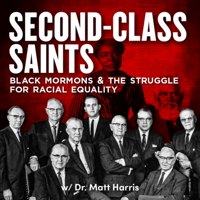
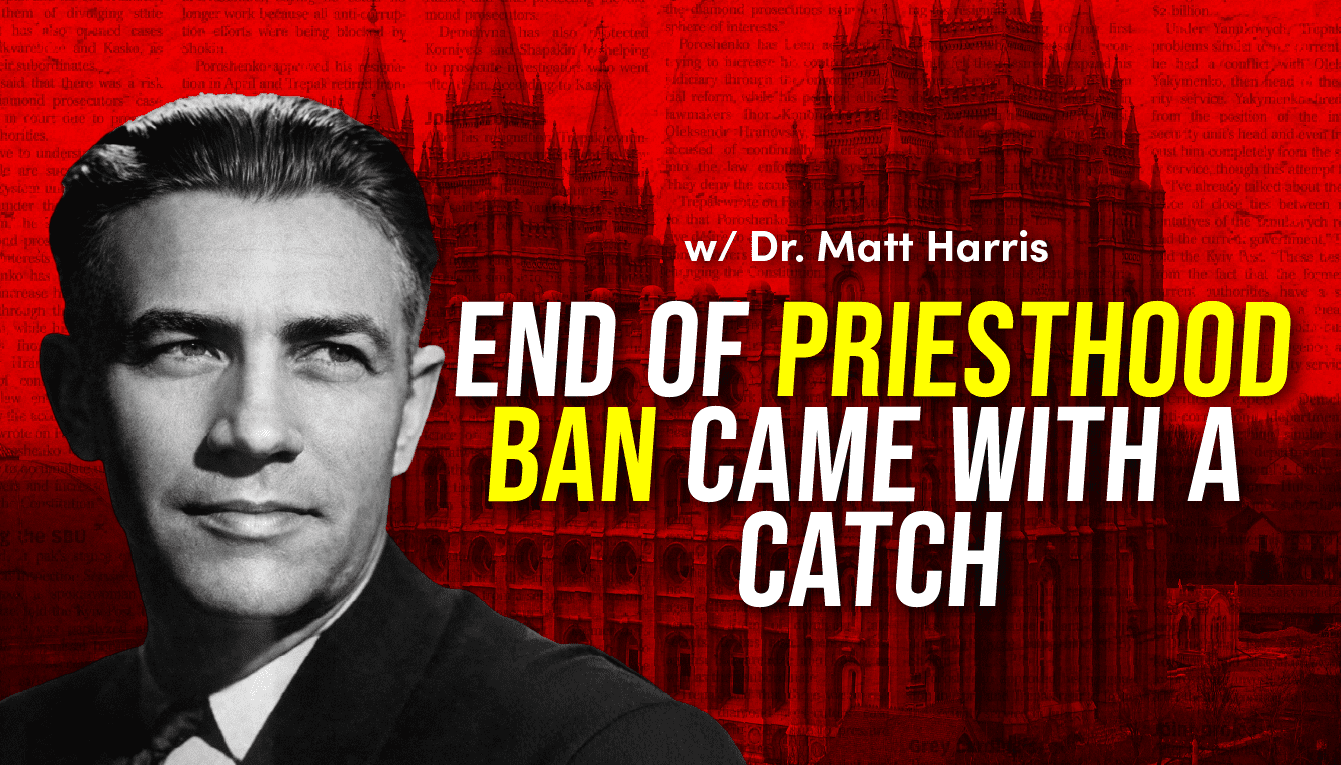
The End of the Priesthood and Temple Ban Came with a Catch
Listen on Apple Podcasts Spotify YouTube Download MP3
About this episode
The priesthood and temple ban began when Brigham Young learned that Black Saints were marrying white women, fearing interracial marriage. When the ban was finally lifted it was only with the caveat that they continued to warn the members against interracial marriage. Church members have received mixed messages since then, with warnings against interracial marriage still found on the Church’s website and in manuals. How should members make sense of these conflicting messages? Today, we’re joined by Matt Harris and Summur-Rayn to discuss this topic.
We are thrilled to announce that we have reached our donation goal to compensate Dr. Matt Harris for his contributions to this series. We sincerely thank everyone who supported this effort. While the goal to pay Matt has been met, producing this series incurred significant costs for the Open Stories Foundation. If you find value in this content and want to help cover these expenses and support future productions, we encourage you to donate at https://www.mormonstories.org/donate/ Your generosity makes a difference—thank you!
Thumbnail Credits: Main image of Mark E. Petersen from the public domain; Background image of the Salt Lake Temple from William Henry Jackson in the public domain
Originally published on mormonstories.org.
Transcript
Machine-generated and lightly edited. Click any timestamp to jump the audio to that moment. The audio is authoritative; please check it before quoting.
Introduction to the Series and Today's Episode
John Dehlin Hi everyone, this is Dr. John Dehlin of Mormon Stories podcast. I want to thank you for joining us today on this epic 17 part series featuring Dr. Matthew Harris and his amazing book, Second Class Black Mormons and the Struggle for Racial Equality. This series has been groundbreaking. We've never had the response so far that we've had in terms of people really valuing our in depth coverage. This groundbreaking book that's talking about the Mormon Church's priesthood and temple ban against black people and then the dynamics, the inner workings, the political machinations of how the sausage gets made in terms of lifting the priesthood ban in the aftermath. So we have some good news and bad news about this series. The good news is thanks to the generous donations of those who have been watching it so far, we've been able to, I believe, more than generously compensate Dr. Harris for his contributions. That's the good news. The bad news is, you know, because we made the promise that 100% of the donations would go to Matt, we have not received any compensation for about the $20,000 of production costs that we incurred to produce this series and that that sort of imbalance would make it so we wouldn't be able to produce series like this going forward. So, so if you value this series, if you want to see the Open Stories foundation also be compensated for its production cost for this series and if you want to see series like this with Matt and with other people continue, we kind of need you to step up and donate to cover our production costs. And it's really easy to do that. All you have to do is go to mormonstories.org donate or go to mormorstories.org and click on the donate button and you can do a one time donation, a recurring donation, and if you want to, you can type Second Class Saints or Matt Harris in the description and that will hopefully allow us to cover our production costs for this epic series. Regardless, we want to thank Dr. Matt Harris for his generosity in doing this series. We want to thank all of you who have supported us. Please go buy this book, Second Class Saints, Black Mormons and the Struggle for Racial Equality. And again, if you're wanting, if you're grateful for this series and you haven't donated and you want to see it continue, please, please donate to Mormon Stories Podcast. Thanks again to everyone who donated to make the series possible. Thanks to Matt and we hope you enjoy this next episode in the series. Take care. Hello everyone and welcome to another edition of Mormon Stories Podcast. I'm your host, John Dehlin. It's July 17, 2024. And today we are going to be talking about interracial marriage within a Mormon context and specifically the Mormon Church's opposition to denunciation of, and it appears repulsion surrounding interracial marriage that begins with Brigham Young, its founder, and continues to last week, I mean, all the way through to modern Mormon history. I think you could argue that interracial marriage has been one of the things that Mormon church leaders has feared more than anything else. And this episode on interracial marriage is part of a series that we are in the middle of on this amazing book, Second Class Saints by Matthew Harris. The subtitle is Black Mormons and the Struggle for Racial Equality. And I just want to make a super exciting announcement that I think all of you will be really excited to hear. We just found out today that second I'm showing here the Amazon page for those who are listening that Second Class Saints is now number one on Amazon in history. So for the best sellers in history sort of status, Second Class Saints has vaulted to number one. And if that weren't enough, it has vaulted to number two in Christianity between the Bible, the Catholic study Bible, there's two versions of it, and it's sandwiched in between the two in Christianity. And weirdly for Mormonism, it's number three behind Heather Gay's new book, Good Time Girl. I didn't even know that book was released yet. And then second is the perennial favorite, under the Banner of Heaven by John Krakauer. He must have, he must have made $10 million on that book. And then, you know, Mormon authors that I talk to are always thrilled to see that when their book is ahead of the Book of Mormon. And in fact the Book of Mormon holds the fourth and the, the sixth spot. But what an amazing, wonderful day. What great news. Matt Harris, we're here with you and we're also excited to have back Gerardo Simano and Summer Rain. Hey, Summer Rain.
Summer Rain Hello.
John Dehlin Hello. Hey, Gerardo.
Matt Harris Hi.
Gerardo Sumano Hi, John. I, I, I do want to say a correction, John. I think there is some one kind of that the brother and fear more than interracial marriage. And I, I would say same sex marriage.
John Dehlin I don't know, man. I don't know. You don't have a century and a half maybe today, Gerardo, but I don't know, maybe that's a good point.
Summer Rain We can say they both keep the leaders up at night, both of those marriages. We can safely say that. Yeah.
Dr. Harris's Book Reaches Number One in History
John Dehlin So Matt, I just have to ask, how does it feel to see your book number one in History,
Matt Harris it's different. I, I, you know, my wife would frequently ask me, have you been checking your book sales? And she would say, I just checked. And so then I would check. And so yesterday I just checked randomly, and it was number one on, in history. So there are different categories in Amazon. They break them down. So there's history, there's African American history, which is a separate category, Social science, Christianity. And then, of course, Mormonism has its own subset, and I've been ranking at the top of all of those categories. And then number one in history, which is incredible. And I knew that this story would appeal to Latter Day Saints, but I had no idea that it would reach an audience outside of the church. So that pleases me to think that people are interested in our shared past.
John Dehlin And I know you worked on this book for 15 years, is that right? Matt, you and I have talked about it many times over the years. It's something you've been plotting along at for a long, long time.
Matt Harris Yeah, it's, it's a story that's just been in the back of my mind for years. And for as much as that's in this book, there is more that was left out of the book just because of space constraints and other reasons. But it's one of these days I'm going to donate my papers to an archive where people can get access to all the stuff that I've accumulated over the years.
John Dehlin Well, that's amazing. So this is part 1415, if you count the three panel review of the first three chapters that summer and Nate Bird and Darren Smith were on. But today we decided to do something a little bit different. And what we're going to do today is we're going to be covering interracial marriage, but we think there's room to do just a single episode on interracial marriage, and it will be incorporating lots of stories and facts from this book. But it's also just going to be a primer. Matt, you felt like it would be important to sort of do a primer on interracial marriage in Mormonism, so take it away. Matt, where do you want to start?
The Church's Early Teachings Against Interracial Marriage
Matt Harris Well, I want to go back to the church's founding, at least with its second prophet, president, Brigham Young. And we've covered this in an earlier podcast, so I'm not going to go into great detail like we did in this earlier podcast, but I do want to sort of set the stage a little bit. And for our purposes today, I want to talk about what interracial marriage looks like in the 20th century. How it's different among church leaders and how this idea persists in Mormon theology even after the priesthood ban was lifted in 1978. So that's kind of where I want to go today. And so 1852 is when the priesthood ban started. And it was, it had begun under Brigham Young, the second prophet president. And what was undergirding this ban was the idea that black Latter Latter Day Saint men were having sex and marrying polygamously white Latter Day Saint women. And when word trickled back to Brigham Young that this was going on, that was the context upon which he put the ban into effect. So there was a time from 1847, 1852 where he was okay with black priesthood holders. He knew about Joseph Ball in Boston. He knew about Elijah Abel, another black priesthood holder, a light skinned black man. But yet when William Makary and another black man were marrying white women polygamously, that was too much for old brother Brigham. And that's where he decided to institute this ban. And also Latter Day Saint listeners and persons who have been in the church for years, they'll know this quote, but some of you who are not as familiar with LDS theology might not know this. But Brigham Young said, he said, quote, if any man mingles his seed with the seed of Cain, the only way he could get rid of it or have salvation would be to come forward and to have his head cut off and to spill his blood upon the ground. It's a close quote. And what Brigham Young was meaning by that is that it was so offensive in God's eyes to pollute the racially pure bloodlines. The idea would be, of course, white would be pure, dark skinned would be impure. And if the two were to marry and have sex, those bloodlines would be polluted. So much so that it was something for which Jesus would not cover in his holy atonement. And so the result would be that the interracial couple would have to spill their own blood, kill themselves, and in order to atone with God to make it right. And in LDS theology, that's called blood atonement. That is, there are some sins that even Jesus Christ's atonement can't cover. And so you have to atone yourself by ending your own life. That is something that was taught by at least four church presidents in the late, the mid to late 19th century. That is a doctrine that the church, today's church, has thoroughly repudiated. But in the 19th century, that was the idea that it was such a grievous sin to pollute these bloodlines that you would have to kill yourself in order to make amends with God. And by the 20th century.
John Dehlin Hey, Matt, can I just be clear? I don't think they've specifically repudiated that specific doctrine. They've just sort of, with the gospel topics essay, Race in the Priesthood tried to say all that stuff that was said in the past, you can forget about.
Matt Harris They've repudiated in the 1970s, Spencer Kimball repudiated blood atonement. And that would cover, you know, having to kill yourself if you married interracially.
John Dehlin But just so that our audience doesn't misunderstand, I don't think that was denounced because of its racial component. It would have been announced because had implications for like, violence. And, and I think the church was trying to distance itself from doctrines that might be seen as violent, not because the church was distancing itself from its opposition to interracial marriage.
Matt Harris No, no, that's correct. That's a fine point. Yeah, that's a fine point.
John Dehlin Okay.
Matt Harris And they. We'll get to when the church denounces interracial marriage or repudiates past teachings. We'll talk about that today.
John Dehlin But really quick, is it. We've talked about this in a past episode, but it's. It's true, correct. That Joseph Smith was fine ordaining black men to the priesthood and Brigham Young was fine sort of tolerating that. And it wasn't until he learned that a black man wanted to engage in polygamy with a white woman that he freaked out and implemented the, you know, his teachings around the priesthood ban and interracial marriage. Correct. That was the.
Matt Harris That's correct. And sometimes I think we. When you set up the founding prophet, Joseph Smith, from the second prophet, President Brigham Young, sometimes we sort of create this false dichotomy that one is really, really progressive on marriage and race and the other one's not. That's not true. I mean, Brigham Young certainly holds a. Is in a league of his own when it comes to his anti black racism. So that's true even for his contemporaries in the United States. I mean, I, I've yet to see anybody who argues that an interracial couple ought to kill themselves because they found disfavor with God. I have, I'm sure it exists. But I mean, Brigham Young's racism is just off the charts. Let's just be brutally honest. Today, Joseph Smith, like people in his generation, particularly Protestants and Catholics, he didn't agree with interracial marriage either. In fact, when he was the mayor in Nauvoo, the hub of church headquarters in the early 1840s, Joseph Smith, had fined an interracial couple when he discovered that they had married. So he wasn't racially progressive. But finding them because you had violated a stricture in the community is far different than asking for them to kill themselves. And so for your listeners, I want to illustrate that Brigham Young had some really draconian views of interracial marriage that few people in the 19th century have. And I teach us history, and I've read a lot of diaries and letters from southern plantation holders to a lot of other people. And most Americans at the time would call interracial marriage a sin because of the polluted bloodlines that we've been talking about. But again, asking for them to end their lives, to reconcile with God would be something completely different. And just to say a quick word about what you said a minute ago, in the 1970s, when Spencer Kimball had denounced this idea of blood atonement, you're right, John. It wasn't about interracial marriage. He was denouncing. He was denouncing this idea that it's hard to teach that the atonement's infinite if there are some finite things that it doesn't account for. And so the theology didn't work out that in the late 20th century, the church leaders are talking about Jesus atonement being infinite, but yet there are some things it doesn't cover. Wow, that's a. That's a logical. That's a paradox, right? If it's infinite, it covers everything. But. So that was the impetus behind the change. All right, so this idea of polluted bloodlines, it's everywhere in the literature, in the 19th century, in magazines and everywhere. They're talking about interracial marriage. After the American Civil War, that was a huge fear that if you have a free black population, there were 4 million Africans enslaved in this country in the mid-19th century. The fear was these former slaves would then find favor with white people. And so most of the states in the country, including the Utah Territory, implement interracial marriage laws that would prevent black people from marrying white people, but also different racial and ethnic groups from marrying. And the idea was they ought to marry within themselves. And by the early 20th century, there was a lot of talk about polluted bloodlines. This is outside of Mormonism, and this is where we get into the eugenics movement, where we want to have racially pure bloodlines. This is where we get into the Nazis in the mid 20th century. Right? They don't want Jews marrying non Jews. And so there are a whole bunch of laws in Germany to keep the races in their place. So this is the idea upon which J. Reuben Clark, of the governing First Presidency, he published an article to the young women of the church. And audiences are always interesting. These are young women who are coming of age in the church to marry, which is hugely important in the LDS culture because it places an emphasis on eternal families. And Reuben Clark published this address. He actually gave it first, then it was published, and it was addressed to the young women of the church in which J. Reuben Clark called interracial marriage, quote, a wicked virus. And in private, as I noted my book in private, Reuben Clark is meeting with a doctor, an LDS doctor named Albin Matson, and they're trying to find scientific ways to determine bloodlines. They don't want the races to mix seed. And so if you have a segregated blood bank and somebody needs a blood transfusion during the Korean War, the idea would be that you would go to a white blood bank if you were white, and you would go to a colored blood bank, to use their term, if you were black. And so that's the idea. It was always about bloodlines for Reuben Clark and most leaders. And then after the Second World War, there's a prescriptive marital literature that sort of emerges, that people are talking of people, experts, psychologists and marriage and family counselors. They're publishing literature from their experiences, counseling couples. In this literature, they would promote the what makes the best marriages in what they said was that if you want the most harmonious marriage, a white person should marry a white person, a black person should marry a black person, middle class should marry middle class, Mormon should marry Mormon, Catholic, Catholic and so on. And Mormon leaders like Spencer W. Kimball will read this prescriptive literature and that becomes the basis upon which they would preach against interracial marriage. By the mid to later part of the 20th century, they were talking less about polluting bloodlines like they once did. And there's this national discourse where the discussion revolves more around this prescriptive literature and what makes a good marriage. Let me say something about this that I think is important, and that is that my sister in the 1980s, she had married a Peruvian man she met at Ricks College, and he was dark skinned. And the family was thrilled about the marriage. We thought highly of her marriage partner. And I remember asking my father one day, this would have been 1986, just before they married, I said, why is it that that Becky's my sister's name. Why is it that Becky can marry Javier but she can't marry a black man? What's the difference? And my dad said, well, we just the church counsels against marrying people outside of your race and your culture. And, well, Javier's from Peru. She grew up in Maine. And so my dad couldn't give me an answer about why it was okay to marry Javier from Per but not a black man from wherever. And certainly this is rooted, deeply rooted in racism, because in my father is not aware of these kinds of things. But when you target a certain group of people for exclusion, that is the quintessential nature of racism. And my father did not see the irony of my sister marrying somebody from a different culture. But somehow Javier got privilege, whereas an African American would not have gotten privilege with my father. My two brothers have since married black women. My father, I'm happy to say, is he's come around. He's enlightened. He recognizes these were racist views he once held, which is great because it shows that people can change and they can learn, they can broaden their experience. And certainly when you're around people of color, you learn, enlarges your perspective and hopefully makes you rethink your racial assumptions.
Introducing Guest Summer Rain and Her Story
John Dehlin Okay, but before we jump on Summer Rain, I probably should have had you mention this at the beginning, but there's many reasons why we're having you on today, and most of which is this. You're smart and wise and a thoughtful panelist, but you've also got some personal reasons about why this particular chapter means so much to you. Do you want to go ahead and share that just so that people know a little bit about that context? Is there anything you want to share about that?
Summer Rain Well, my I was married in the bountiful temple in 2012 and my husband is white LDS member of the church. He his parents come from pioneer stock, so he pretty much grew up in Utah. Utah culture. We met in New York, but I had no idea about the views of the church. I known some things that were said as I was growing up in the 90s, what Matt was just describing where I'd heard people say things like, well, you should stay, marry within the same faith, the same race, because it makes it easier for your children. But it was more it was never talked about as a church doctrine or church understanding. But it was very prevalent Even in the 90s when I was growing up on the East Coast. So when I met my husband, I didn't know that there were any views like this that were taught. My husband, he was an only child, he grew up inactive. He obviously did not share these views at all that interracial marriage was a sin or that there's anything wrong with it, because he married me. And after we got married, I'd heard that President Kimball had some views but never looked deep into it. So reading this book, Second Class Saints, and seeing how these views from Brigham Young's time, and I know, Matt, you talked about Joseph Smith and Brigham Young and how different they were, but also similar, because in the book, let me read this really fast on page five, you see, say, Joseph Smith had said, had I anything to do with the Negro? Smith said, I would confine them by strict law to their own species. So there wasn't a hard line in the early mentions of the church, but it premiated throughout the 20th century, the 21st century. So that's why Twice holds a personal meaning to me learning about this and understanding why. When we moved to Utah, I got so many looks and, and it wasn't as comfortable, but not really understanding why this kind of explained that, that it wasn't just a culture thing and where it came from.
John Dehlin Well, we're really grateful that you would join us, especially because this is a painful topic. I was like, I was like, summer Rain, you may cry when you read chapter eight and that won't be the first chapter that made you cry. Is that right, Summer Rain?
Summer Rain No, that's not the first chapter. But I do appreciate you sent me a text the day before I got to chapter eight and said, have you read chapter eight yet? It's a rough one. And I said, actually, I just finished seven. I'm reading eight tomorrow. And it was a rough one. And that's what we're going to talk about today. Just not just the teaching, but the effects it had on black members to be told that this is, this is something that the church holds to, that they should stay within their race.
John Dehlin So, Matt, why are you making some rain cry?
Matt Harris Well, that's my goal, John. I, you know, it's not lost to me, jokes aside, Summer Rain and others, it's not lost on me that this is a painful story for some people. It could be triggering even. And I've heard from black and biracial men and women in the church who have shared their stories with me via email and Facebook and so forth. And it's, I'm, you know, I'm sensitive to these things and, and I, you know, but I'm telling this story and race and anti black racism is never, never easy. And I say this as A person who gets privilege as a white man. So, anyway, I'm really sensitive to this. I teach civil rights. I teach African American history. I frequently have black and biracial kids in my class. Believe it or not, the stories I hear in the Latter Day Saint community with anti black racism is not unlike stories I hear in class. And it just, it. It never is easy to hear these stories because it pains me. And this is, people ask me, why have you done this, this book for 15 years? And why did you do another book on blacks and Mormons before that? And why have you done articles? I spent my entire adult life fighting anti black racism. And here we are. All right, so before we go forward, I just want to say something about the doctrinal underpinnings of this, because I think it's really important. There are really three ways to think about interracial marriage in the church. One would be the culture. Brigham Young, as I mentioned, was not like most people who's calling for the death of interracial couples. So he's sort of extreme. But Joseph Smith would have been more common to his Protestant neighbors about his views on interracial marriage. And what some arrange. Just read would be, you could read something similar from Catholic and Protestant clergy. And some of your listeners may think, I expect more from Mormon leaders. Well, that's fine. Those are faith questions. But for my angle as a scholar, I look at Mormon thinking in a larger cultural and social context, and that's my interest. I leave faith questions to folks in the pews.
Responding to Claims of Apologetics and Bias
John Dehlin I just want to speak up on your behalf. I've had people write me and say, Matt's an apologist. He just wants to make excuses for church leaders. And I have to explain to them, secular historians have to assess people within the context of their time. And so to say that Joseph Smith or Brigham Young weren't unique in their racism, although Brigham Young may have been a little unique, which you say, Matt. But just to say to state somebody's sort of order or the normative nature of their positions within a historical context is not to say that they're not responsible or to try and make the church look good or to try and even promote faith. People need to stop confusing those things you say, Matt, with their desires to engage in interfaith warfare.
Matt Harris Thank you, John. Well said. I mean, that's just. I don't look at. I've said this before in this podcast series. I don't bring faith commitments to this enterprise. I don't try to apologize for the church's racism, nor Do I try to tear it down? I'm a historian. I have to look at culture and context, and I try to be as fair as I can, and so people will judge me on the merits. But I also have had people tell me that, yeah, I've been an apologist for the church. That's always a fun one for me. And then another one is, apologists wouldn't
Gerardo Sumano be putting this out there.
Summer Rain That's just something I was gonna say. Matt's a terrible apologist. The church is putting out there.
Matt Harris It's not a really good one compliment I've heard today. Summer rain. I mean, you know, I'm just trying to be fair as a scholar. I don't. I don't look at these. These questions through a faith lens like some of the folks who listen. And I say that with all due respect. I don't. You know, I know that Desert Book just published a book last year. You know, prophets see around corners. I, you know, I'm not here to say, oh, they missed the corner on this one. That's just not what I do. I don't. That's irrelevant to me. For me, as a scholar, I'm treating this topic like I would if I were to write about Catholics in race or Protestants or evangelicals. And you want to be as fair to those groups and their leaders as well. That's how I'm trying to operate.
John Dehlin Totally.
Matt Harris And. And I'm trying to contextualize where the Mormons are similar and where they're different. And, you know, I think that sometimes people just want to have this skewed reality that they're prophets. They should be progressive on race. And my response to that is Joseph Fielding Smith was born in 1876, just after the American Civil War ended. Why do you think he's going to be progressive on race? He grew up in the Utah Territory where there were no black people around. Why would you think he'd be progressive on race? That's a secular approach. Right. I don't take the religion approach. He's a prophet. He should know better. That's not what I do. So people can make their own conclusions.
Gerardo Sumano Totally.
John Dehlin Okay.
Matt Harris Okay. So the culture would be the first one that the Latter Day Saint leaders are deriving their views about interracial marriage from the larger American culture. The second one would be they're deriving these views from Scripture. This would be from the Bible. And just to give your listeners a sense, again, of where this fits with Mormons, and that is that if you look back at Mormon teachings about God's, covenant lineages, the House of Israel, as Mormons called it. If you look at Abraham, Isaac and Jacob, if you look at Noah and his sons, there are always these favored lineages. Latter Day Saints would argue and that the favored lineages had to remain pure in their bloodlines. That is, they couldn't marry people outside of the covenant lineage. So if you were, let's say, Ham, who and his son Canaan, who became a cursed lineage, you couldn't marry them if you were part of the covenant that God had made through which his blessings of the temple and the priesthood would flow. So there's always been this dichotomy between the favored lineages, the covenant lineages, and the non favored lineages, which would be in Mormon nomenclature, the cursed lineages of Cain, Ham and Canaan. That's how they read the Scriptures and the Mormon scriptures talked about this as well, where the Book of Mormon and the Book of Moses, which is part of the Pearl of Great Price, these are both canonical scriptures. They talk about skins of blackness and that God had used rays to separate the persons who had sinned against God from persons who were in God's favorite. And that that one ought not to marry if one were white. One ought not to marry somebody who had been cursed with a skin of blackness. So they're using it. Mormon scripture to derive all of this. Yeah. So in the 20th century, Mormon leaders are. They're reading literature at large in the popular press from Time and Newsweek and all other magazines. And they're. Americans are fearful. Americans at large are fearful of interracial marriage. They're talking bloodlines. They're talking that the races, to achieve their destiny, ought to remain separate. And here's something that Spencer Kimball and others are reading. They're reading a literature that ties interracial marriage into civil rights. I'm thinking of a 1948 Presbyterian minister that Spencer Kimball was reading. And this minister, the name of the pamphlet was called, it was something like if you segregate, he said, non segregation will lead to interracial marriage. So non segregation will lead to interracial marriage. This is a pamphlet that a Presbyterian minister had published in 1948 that, that Spencer W. Kimmel and other church leaders were reading. So what that meant was that if you get rid of Jim Crow segregation, then the fear would be it would lead to interracial marriage. Because now people can integrate, they can work together and so on. So all of these things are combining to influence their views on interracial marriage. And we talked a minute ago about the prescriptive marital literature that pops up after the Second World War that Kimball and others are reading. And so the Church is really, really careful about this, of course, as part of the theology that if a black man and a white woman marry, then this idea that their seed would be cursed, their children would bear the curse, they would pass this on generationally. And by 1978, when the priesthood ban was lifted, as we've talked about in earlier episodes, that the church was still concerned about interracial marriage. And Elder Markey Peterson, who had long opposed interracial marriage, he insisted that when they published the announcement, official Declaration number two, as the church leaders called it, that when they published it in the Deseret News, that next to it would be a disclaimer that interracial marriage was still frowned upon. And for. I remember at byu, they have this wonderful oral history. They used to call it the Afro American oral history, and when Afro fell out of favor, they changed it to African American oral history. Back in the 80s, it was acceptable to use the word Afro American with hyphens. Today we don't do that. But so BYU has this wonderful African American collection that was done by a black Latter Day Saint named Alan Cherry, who just passed away last week. Rest in Peace. And Jesse Embry, who worked at byu. So Alan Cherry was just a community member in a local ward, Black man. And Jesse Embry was leading, or was part of her responsibilities at BYU is to interview people in the form of an oral history. So Jesse and Alan had undertaken this wonderful, heroic service in the 80s, interviewing as many black Latter Day Saint men and women as they could find. And it's when I learned that there was this rich archive that had never been utilized at byu. I thought, man, this is a treasure trove because it allows you to capture the voices and attitudes of black saints. And at least in the 1980s. And what I noticed by reading some of them was that they were really upset with Bruce McConkey's Mormon Doctrine, part of which had some hard words to say about interracial marriage, including calling it, quote, racial degeneration. And the other part was they were confused about the Deseret News and how it had still discouraged interracial marriage by by posting an old sermon that President Kimball had given. And they were bothered by that. If we can go to the temple now, then why can't we go to the temple with anybody of our choice, including white people? Our bloodlines are no longer cursed. At least that was the thinking. But the truth is that when the brethren lifted the ban in 1978, their racial attitudes and assumptions didn't just magically disappear. The this is what's hard to hear from some Latter Day Saints is that somehow the ban has been lifted and everybody's racially progressive. That's not true at all. When you have racial assumptions and anti black views and you've held them for decades, it's not going to be instantly eradicated with the announcement of a new racial policy. So that's how it works with interracial marriage. And what's really interesting about that is that there's the. The brother. They're not all unified on their opposition to interracial marriage. One of them is a general authority named Marion Hanks that we've talked about in earlier episodes. And one of it deals with a black man named Robert Stevenson, who was the first African American student body president BYU in the mid-70s. And imagine this, one of the handful of, you know, black students at byu, they fall in love with a white woman. I mean, really, there's not a huge black population. So he met against the strictures of the university leadership. He met and began dating a white woman named Susan Bevins. And he wanted to get the approval of the church leaders. And about the time that he had done that or met Susan Bevins, Boyd K. Packer had given this sermon in 1977 at BYU in the form of a devotional assembly address. And he told the students, including Robert Stevenson, who would have been in the room that day if he attended, he said that God doesn't want you to marry interracially. And this is 1977. So Stevenson sought Elder Packer for counsel on his falling in love with this white woman. And also for reasons I can't quite explain, Marion Hanks shows up to the meeting too. And I'm certain I don't know this to be true, but I'm certain that Stevenson probably wanted a little cover, knowing that Hanks would support his position and Packer wouldn't. And so they met in Packer's office at church headquarters. And Packer told Stevenson, he said, you can fulfill your mission in life much better if you don't marry Susan. And Marion Hanks, bless him, was outspoken, even though Elder Packer outranked him in church leadership, and even though the culture of the church suggests that a lower ranking general authority should defer to the wisdom and counsel of a superior ranking church leader, that was not Hanks. Hanks did not care about titles. That's my opinion. And so Elder Hanks told Robert Stevenson the exact opposite of what Elder Packer had just told him. He said, you should marry Susan. This would be a wonderful thing for the church. It would help to break down racial barriers. And Robert Stevenson decided to listen to Elder Hanks rather than Elder Packer. I wish I had Elder Packer's views on this. I'm certain that as our mutual friend Darren Smith said recently about Brigham Young, there must have been steam coming out of packers ears.
Personal Experiences with Church Interracial Marriage Policies
John Dehlin But did you have a response to that story? Summer Rain?
Summer Rain Just, just. I just find it very funny because like, like Matt was just saying number one to say something opposite. I mean, if anyone knows Elder Packer, he was not one that liked to be, you know, have someone say the opposite of what he was saying. But this was a very big deal. I don't think we're understanding. This is a very. This is a very deep seated belief that regardless of which leader it was, there was an understanding in the minds that blacks were inferior. Whether it was because they weren't as valiant, whether because they were neutral in the premortal existence. It doesn't matter the reasons why the leaders are right now believing that blacks are inferior to white people. And so to have Elder Packer say, listen, you can fulfill your mortal existence in a better way by sticking with your own race and have somebody else come behind him and say, I think this is great. This will break racial barriers. I think he had steam coming out his ears along with Brigham Young because that, it's just. Yeah, that's what I was thinking at the time. They. That was just not something Apostle Packer wanted to hear.
Gerardo Sumano Yeah, Matt wouldn't. Since this was six months before oppressing Kimball lifted the ban. I mean, in giving other backer a little bit of grace and the benefit of the doubt, wouldn't this, according to the doctrine of the church at the time, wouldn't this pass the. The seed of Cain or, Or the curse of Cain to Susan and prevent her from getting temple blessings, for example, or if she was endowed, she wouldn't be able to attend the temple no more after marrying the. The.
Matt Harris The.
Gerardo Sumano This black man. Am I correct?
Matt Harris Yeah. No, that's. That's very good, Gerardo, because it is before the ban is lifted. But the problem is Elder Packer never changed his views. And well, after the ban was lifted, he was still digging his heels in on interracial marriage. And we'll talk about Elder Bednar in just a moment. But Elder Bednar gave. Elder Bednar was a protege of Elder Packer, and Elder Bednar was preaching against Interracial marriage in the 21st century. And I'm certain that I can't prove this, but I'm certain that part of Elder Bednar's views on this derived from his file leader, Elder Packer.
Gerardo Sumano Yeah.
Interracial Marriage Cases After the Priesthood Ban Was Lifted
Matt Harris All right, so let's talk about after the ban was lifted, another marriage. So this dealt with Robert Stevenson before the ban, her order. And I'm glad that you point that out because that's really important. There's another woman whose story I think is really important and I'm going to put her. Her face up her. Sorry for those of you driving in your cars and you might be able to see this, but I'm showing a picture of a woman named. Her name is Mary Frances Sterlockson, and she was a black BYU student in 1976, a convert to the church. And she is given credit as the first black sister missionary in the church. And when she joined the church, she had a Latter Day Saint man, a white man, approach her and tell her, quote, why her race does not have the priesthood. I'm certain that she just wanted to hear that wisdom. I'm dripping with sarcasm there. The man smugly explained, quote, in the pre existence, we all had an opportunity to hear the hear and accept the gospel. But while we were listening to the gospel, your race was off playing basketball. We have come to this earth and we still have the gospel and your race still has that basketball. Other Latter Day Saints told her that her skin color was the curse given to Cain. And this is before the ban was lifted when she converted. And in spite of all of this racism, she persevered in the church and as I mentioned, became the first black woman to serve the mission after the ban was lifted. After her mission, she went back to BYU and she met a white man named John Eyre. And she was of course bothered by this. And for Latter Day Saints of today's generation, where you might not hear as much about this in sermons or manuals at church or wherever, interracial marriage counsel was prevalent everywhere you went in the church education system. At byu, at one of your local institutes, the leaders were frequently sermonizing on it, both in general conference, at devotional assemblies, everywhere you would go, you were supposed to marry within your race. And so needless to say, this young newly returned black missionary, she goes to byu, she meets a white man, she falls in love and she feels guilty about it almost. Her conscience has been pricked. She wants to do something that's contrary to the teachings of the church. And so she's troubled and she reaches out to Apostle Legrand Richards, a man in his 80s seeking advice. And he cautions, not surprisingly, if you know his views, he cautions against interracial marriage. Then she received counsel from other general authorities, a guy named Dean Larsen and Hart Hartman, Rector Jr. Who reaffirmed Apostle Richard's position. She reached out to her bishop and stake president. They told her not to do it. And she's really, really torn by this because at least five leaders, including an apostle, said, don't do it. It's contrary to God's wishes. And she's torn because she has fallen in love with this man. And she decides to meet with the church president, Spencer W. Kimball, and this is after the ban had been lifted. So he graciously agrees to have her at his office at church headquarters. And she tells him about the life that she had envisioned with ire. And she told him the conflict that she was feeling, on the one hand, wanting to marry a man that her church said she couldn't have, and on the other hand, feeling like she was violating some sacred temple covenant. And throughout the midst of her or during the midst of her discussions with the church president, she starts to cry. And Spencer Kimball, being a sensitive man that he was, I'm not saying that flippantly. I read his diaries. He had an intense sensitivity about people. And so he got up and he walked over to her and he hugged her just like a father would hug or a grandfather would hug a child. And he whispered to her, he said, my child, it is not wrong. Interracial marriage. It is not wrong. The only reasons we counsel against interracial marriage is because of the problem that children could face. That's what you mentioned a minute ago. Summer rain. And then when they concluded their meeting, Mary was walking to the door. The church president followed behind her, and he gave her a second hug. And he said, be of good cheer. The Lord loves you dearly. End quote. And what I want to say now is something that's, I think, really instructive for Latter Day Saints who have sort of lived through this, and that is the church is sending out mixed messages on interracial marriage. When somebody asked in 1981, the church spokesman, the main spokesperson for the church, a guy named Don Lafevere, if I said that right, they asked him, this would have been a person outside of Utah, non Mormon, asking. And they said, what does the church think about temple or interracial marriage? And now that the ban has been lifted, and he said, obviously, they can go to the temple with the church's blessing Meaning black and white couples. Well, there was nothing obvious about that for black couples because of what was published in the deseret news on June 9, 1978, when they announced the lifting of the ban, and also all of the literature that was still circulating throughout the church condemning interracial unions. And so the Church was just really caught up in this public relations challenge of still believing that the races ought to be kept apart for the reasons that President Kimball mentioned, affecting the children and so forth, and also trying to move along as the 21st century approached, recognizing that the rest of the country was moving in a different direction. And so the church was sending out these mixed messages that was very confusing to black and biracial Latter Day Saints.
Mixed Messages from Church Leadership on Interracial Marriage
John Dehlin And, Matt, if I'm remembering right, it's almost. When you talked about the apostles being gathered by Spence W. Kimball to ultimately make the decision to lift the priesthood and temple ban, wasn't there an apostle or two that almost made it a condition that they needed to add a denunciation to interracial marriage as a compromise?
Matt Harris Yeah, that was Elder Peterson when he was in Ecuador. And he. He was not there the day of the Revelation, the Salt Lake Temple on June 1, and when President Kimball had called him while he was in Ecuadorian church assignment to let him know that, hey, we lifted the ban while you were gone. And as I noted in a previous episode, he was gone on purpose because he didn't support lifting the band. So they did it when he was away, again on purpose. And Ed Kimball, Spencer Kimball's son, told me that. So Elder Peterson said, I'll support the ban, but promise me that you'll. You'll publish this disclaimer about interracial marriage in the Desert News. And that's the promise that the church president made him.
John Dehlin So what do we make of the Don lefever spokesman muddying the waters by saying there's no ban on interracial marriage? What do we make of these mixed signals that the church is sending out? Or is that possibly part of a PR strategy? Or would you even be able to speculate?
Matt Harris Oh, I can speculate, yeah. In fact, I think it's even more than speculation because I've got a good basis from which to offer this thought, which is, if you look at the audiences in which the church leaders will say certain things like an outsider. It was somebody from the New York Times, I think, who. Who asked Don LeFever, you know, what about interracial marriage? Well, the church doesn't teach against it. I mean, what is he supposed to say? Yeah, we still want to keep the races apart. This is in the early 1980s, for goodness sakes. So of course he's going to say we don't have any doctrine or reasons why they can't. It's important to consider audience, because what you see is the exact opposite. In some cases, when an AAPostle speaks at BYU to a devotional assembly or maybe even in conference, you'll see something about the races ought to be kept separate. Or what you more often see in the 1980s is they're not as aggressive in promoting these anti racial teachings or anti interracial marriage teachings because it's no longer popular to do so as the rest of the country moves in a new direction. What they do is they're just sort of passive about it. They will counsel people like Robert Stevenson or Mary Sturlockson in private, thinking that those private discussions won't come out in the form of oral histories, so historians like me can read them and write about them. But also they'll keep their books and sermons in print so that if somebody goes to Deseret Bookstore, the church's publishing house, and they buy a book from a church apostle or church president, they go home and they look at it and it's counseling against interracial marriage. I mean, there's no footnote that says, hey, the church no longer believes this. They think that it's all fair game. And so the church has always been conscious, at least since the civil rights era, about what they say in public and what they say in private. And just because you say something in public does not necessarily mean it represents the church's position. It just simply means we can't say certain things because we don't want to draw criticism to ourselves. It's the same thing I did years ago with the Founding Fathers. When you look at some of the documents in a book that I did. Thomas Jefferson was giving public speeches on the. When he was the president, he was talking to the Congress, talking about Christianity, and it was sort of a favorable view of Christianity. And then in private, he's writing his nephew, Peter Carr, saying, you should question the atonement. It's Hocus Pocus. St. Paul created the divinity of Jesus. And I would sometimes ask my students, what do you think is better reflective of his views? What he said to the Congress promoting Christianity or what he's saying in private to his nephew, basically denouncing the divinity of it. And of course they would say the right thing, which is. Well, it's probably more reflective of the private letter he wrote. Peter Carr. And then I would say, well, why do you think he's talking about advancing this pro Christian view to the Congress? And my students are smart. They would respond by saying he's just telling them what they want to hear. I said, exactly. Most people in the United States in 1800, 1801 are Christian. And a lot of the congressmen to whom he was speaking wanted to hear a Christian utterance from a man who didn't have a Christian reputation. It's the same thing going on here. So you see something said in public, like Don Lafeare's statement to the Washington or to the New York Times, and then that would contradict something in private that leaders are offering members like Mary Stalles, Mary Stirlingson and Robert Stevenson.
Summer Rain I will say really fast that the biggest difference I see too, with those stories is that unfortunately, when those private letters are shown or even, oh, he spoke to a group of educators and it wasn't in a public forum like General Conference. You have members of the church that say, well, he is speaking as a man. And so I think that that feeds more into the mixed messages of instead of being objective and saying, okay, what were his true feelings? Because this is supposed to be someone speaking for God, it does muddy the waters. And I want to point out that I think that the church at the time, because they didn't have an answer, they were okay with the waters being being a bit muddied at the time until they could figure out what to do.
Matt Harris Yeah, I think so, too. And I think that's a great point. Submarine. I think that it's easy to be critical. The leaders were sending mixed messages and all of that, but the truth is that. And again, I'm going to get beat up for the statement from some of your listeners, but it is what it is, and that is they're coming to grips with this stuff like the rest of the country. When you've been taught the interracial marriage is wrong, either religiously, culturally, socially, politically, it's hard to get rid of these biases and these prejudices. And so what I see is the church leaders, some of the church leaders anyway, struggling to accept this. And some of them do evolve and come to this realization that the interracial marriage is okay. I suspect that. That if you were to ask Marion Hanks, I can't prove this, but if you were to ask Marion Hanks, when he was a younger man, the 1940s, did you accept interracial marriage, he'd probably tell you no. And why would he? His church opposed it. Much of American culture opposed it. But at some point throughout his church ministry, he became more racially inclusive. Let me give you one other statement of a person who is probably one of the most progressive leaders in all of Mormondom. And it's a guy that I've been writing, I'm writing a biography on. I know him well and I've been reading his papers and journals and diaries and all that stuff. But Hubie Brown, he believed in racial equality. He pushed the church to support civil rights. He was a dogged and indefatigable critic of the ban. As previous episode talks about my book goes into great detail. He gets dropped for the First Presidency over his activism. And yet, and yet even Brown, as progressive as he was in the 1960s, did not think the races should marry, including his own daughter. So I would like to think that if Brown, who was born in, I think 1883, died in 1975, in his early 90s, I'd like to think that if he lived long enough that he certainly would have changed his views on interracial marriage. So I do think we have to have grace to see people change their views. And we also, frankly, can be critical when they don't change their views, when they need to.
Gerardo Sumano Matt, how much did the statement from 1949 by the First Presidency where they declare interracial marriage against the doctrine of the Church, how much would that be also influencing some of these brethren to be scared to break off with not only with tradition, but with what prophets, seers and revelators had declared doctrine or not doctrine just a few decades before? Is it something that this would be undermined or they would be worried about that a previous First Presidency declared that interracial marriage was against the doctrine of the Church.
Matt Harris Yeah, yeah, there's a great. The church leadership is like the Supreme Court, at least not the current Supreme Court, but prior Supreme Courts where you give deference to precedent and you don't always have to agree if you're on the Supreme Court, what a prior court had said, you could look at the law in a new light, new cultural conditions and so forth. And the brethren are like that too. So if a previous church president felt strongly about something like interracial marriage or the ban itself, then they can overturn it. That's the beauty of modern day revelation. If you're, if you follow Mormon theology, a new prophet can claim revelation and can move the church in a new direction as he feels inspired. But that certainly weighs on their mind. Gerardo, that Spencer Kimball, when you read his Diaries, you know, he says something like, you know, I don't know if I should be the person lifting this ban, but if I don't do it, you know, my successor and my successor, successor won't do it. And so he is. He's careful about precedent. And for interracial marriage, I think that that precedent's part of it, that his predecessors thought that interracial marriage was wrong. But what led him to do it, I would argue, is that Spencer Kimball had formed interracial relationships. And I've said this in my book, I've said this on this podcast series, that these guys, the leaders, had grown up in and around Salt Lake and also in Idaho, some of the apostles, and also in Arizona. None of them grew up in a majority rich population of black people. So they weren't around black people at all. And it's easy to inherit all of these cultural prejudices when you've never been around black people or LBGTQ people. And so Spencer Kimball, you read this in his diary, at least it struck me. He makes it an effort to go to the Genesis group meetings. This is an early black support group that the church had supported. It started in the early 70s. He goes to their meetings, and he's meeting some of the leaders. He went to one of their picnics, and he brought a fruit basket for the leadership. And he writes in his diary that he counts some of these black saints as among his friends. So he's not just saying, you know, they're fellow members in the body of Christ. They're actually friends. And I don't know what that means to Spencer Kimball. What does it mean to call somebody a friend? You know, in my mind, it means something that we talk on the phone, we go to lunch together, we share each other's burdens. I listen to you, you listen to me. We. We know a little bit about each other's lives and our families, our children, our jobs, our health, maybe. But he called them his friend, his friends. And so he's meeting black people for the first time and forming these relationships. And so when Mary Sturlockson came into his office in the late 70s asking for marital advice from the church president, I'm certain he couldn't have given her the advice that he gave, including his blessing to marry this white man, had he not formed those relationships with black members. And that's how we break down these cultural barriers, is by being around people that we're not used to and being around people that the literature that we've been reading has demonized. But when we form relationships, we realize that the literature that we've been reading that's demonized them no longer holds water.
Summer Rain Yeah, yeah.
Matt Harris It begins with relationships. I want everybody to know that the first person that. When somebody says something homophobic or racist, and you know, my first thought is always, I'm not saying that if you know somebody who's gay or, or you're racist, you don't know a black person or gaper. That's not what I'm saying. But my first thought is that I don't think you would know, you would believe in some of your prejudices vis a vis race or sexuality if you had more friends from those communities. That's my opinion.
Summer Rain So. So, Matt, you're kind of speaking to the fallacy of separate but equal. Pretty much the, the thought that I can believe that someone is equal to me, but for some reason we have to remain separate. And I feel, feel as though, I know we talked about the one drop rule, but separate but equal was a huge thing in America as well. And I just find it interesting that the church had adopted the one drop rule within the church. And it sounds like they kind of was trying to adopt the separate but equal mindset of we see them as equal. They are no longer cursed black people. But we need to remain segregated when it comes to marriage, which as you touched on, is very difficult in a predominantly white church white community for black people. They pretty much have to choose between marrying within their faith or marrying within their race because there just isn't that many options. So sounds like you're speaking about just the, the thought process of being separate but not learning. You can't learn from other cultures, people who are different, if you don't integrate, if you don't meet them, know them, see them as human beings, and in that sense you do recognize that they are equal. I don't know if that makes sense, but.
The Separate But Equal Theological Parallel
Matt Harris And I think that's a very perceptive reading of my book, actually someborane, because the. One of the things I point out in the book is there's a theological paradox that in. In August of 1978. So just a couple of months after the ban was lifted, Elder McConkey, the church's most influential doctrinal authority, he gave this famous address at BYU and he titled it All Are Alike unto God based on this prominent book of Mormon verse. And yet even though he's talking about all people are alike unto God and he's mentioning, of course, the shadow in the room is, you know, black people.
Summer Rain Right.
Matt Harris That's that's. He didn't mention black people. That's what he's talking about. The band's been lifted now. All people are truly like unto God, but yet the paradox is he's talking about black people having to be adopted into the House of Israel. White people don't have to do that. He's talking about that God still has favored lineages. What? How could you have favored lineages if you think that all people are like unto God? And he still holds to these pre existent theories that black and biracial people had done something in the pre existence to merit God's disfavor. Once again, how could you teach that all people are like unto God if you think that there's this racial hierarchy that God privileged in the premortal realms? And so Elder McConkie just never understood those theological paradoxes. And the church arguably still has a little struggles with this today on two accounts. One is that this whole idea of adoption is still part of the theology that when people are given their patriarchal blessings, black people in particular, they're told that they're adopted into the tribes of Abraham, Isaac and Jacob. That's just not something that's common among white folk. So once again, black people are being, you know, sort of separate from others. I'm not saying that all black and biracial people are chose given that adoptive language, because that's not true. But a number of them are in and they feel set apart for distinction. The other one would be that the Church has never really dealt with this idea of lineage to begin with in the Church Handbook for Patriarchs. And so even to this day you get lineage declarations for black and biracial people that are all over the place. And one of the things I pointed out in my book was in the early 90s, and I'm certain there are stories after this that I just haven't come across. But in the early 90s, there was a young man who, who got his patriarchal blessing. It was his second blessing, actually, because the first one didn't give him a lineage declaration. And so he wanted to get a lineage declaration. So he complained to his stake president. And I think at this time he was off at school. And so he had a. I can't remember who gave him the blessing if it was a new patriarch. But anyway, in the early 90s he got a second blessing. They gave him his lineage and he was told he was from Cain. This is in the early 90s? Are you kidding me? And of course this has a psychological effect on this young biracial man because he, as he explains it, he felt that he didn't live up to God's standards. He was always trying to prove himself that he wasn't a descendant of Cain. This biblical counterfeiter murdered his brother. So those are the kinds of things that need to be worked out if, in fact, the church does teach that all are alike unto God.
John Dehlin All right, where should we go next, Matt?
Additional Personal Stories of Interracial Couples
Matt Harris All right, so we've been talking about some personal stories of interracial marriage. And I want to just call attention to a couple more stories that, that you're. That I think are really instructive to this. Well, a few places, actually. And I want to talk about Hawaii. What goes on in Hawaii that's really important. And I want to talk about a. I'm looking for it in my book right now. It's a story that deals with a black woman named Tamu Smith, who was asked, she's an actress and a model, and she was asked by an LDS publication to. To bring her family that they could showcase on the COVID of their magazine. And she tells the story that when she arrived at the photo shoot, there was a black man who would stand in as a surrogate for her white husband. And I want to just tell you, this is 2004. And so this black woman married to a white man with beautiful biracial children shows up to this photo shoot, and she's told that this black man will stand in for her white husband. That caught her off guard. And she's upset, naturally. So. Because what that means means a lot of things. But one of the, one of the things it means is the church is delegitimizing her interracial family. And so she told this story in an interview, and she said that I'm going to read it to you. She said, if they're not going to validate my family, then they're going to have to find someone else who is okay with that. So what you see is you see folks in the black community pushing back on these terribly offensive ideas about interracial marriage. Another one was my good friend Darren Smith, whom you've had on this podcast, John, and he's been Darren and Summer Rain and Nate Bird of the Black Menaces have been talking about my book on a separate podcast, and they've been talking about their experiences and their wisdom with these sorts of things. Anyway, Darren Smith was married to a woman named Joy Smith and, and a white woman. And she was the Relief Society instructor in her home ward in 2004. And somehow it came up that some of the one of the ladies in the ward had talked about that interracial marriage was wrong. And I mean, think about this for a moment. Here you have a white woman teaching married to a black man, and somebody in the audience is saying, oh, yeah, it's wrong. The Brethren preach against it now. They weren't wrong. The Brethren were still preaching against interracial marriage. And Joyce Smith, of course, didn't take too kindly to that, as one would imagine. And she talked about how outmoded racist teachings persist. So she's pushing back to the sister in the ward. Outmoded racist teachings persist, she said, upon which the Relief Society president told her she was out of bounds and Joy didn't give in. They released her from her calling.
Summer Rain Wow.
Matt Harris And this is 2004. This stuff is so deeply rooted in American Mormon culture.
Gerardo Sumano Here's another one I do want to say something about, because you mentioned that story about the photo shoot for the church's media. My sister work or did an internship for The Liahona, just what, 2000, 2021, 2022. And she, she's still an active, believing member of the church, but she told me that she was struck to find out that it was still a policy of the church media that they could not portray interracial couples on, on, on church media.
Matt Harris That was in 2021. Gerardo.
Gerardo Sumano 2021. 2022.
Matt Harris Yeah. Oh, my goodness.
John Dehlin Surprise you, Matt? I'm sorry, John, does that surprise you?
Matt Harris Yeah.
John Dehlin Because we've noticed denunciations of interracial marriage in LDS Church web curriculum as recently as in the past few years. And, you know, 2022, 2023, it's still there.
Matt Harris Well, let me rephrase my answer about being surprised. It really doesn't surprise me, but I want to think better, that the church is doing better. And I think certainly there are some people in the leadership who would probably frown at you just saying that. Gerardo and John. But clearly they're not the decision makers.
Gerardo Sumano Yeah.
Matt Harris And so remember what I said a minute ago about what you say in public is can oftentimes be at variance with private stuff.
Summer Rain Yeah. Yeah.
Matt Harris What you just said, Gerardo and John is in private. They would never, ever publish this in, you know, the Liahona Today or some other church medium, because even in the late 1960s, they were taking heat for a lot of their views on race. And there's some first presidency meeting minutes in which this is 1968, the first presidency. They say, let's not talk about interracial marriage. Let's not put it in writing, let's just counsel people in private that they ought not to marry interracially. So there's always a sensitivity of how outsiders will perceive it. But it's really, it's astonishing to me because one of the apostles, Elder Garrett Gong is married. He's an Asian man married to a white woman. And Peter Johnson, the church's first African American general authority. There had been other black African general authorities, but Elder Johnson is the first African American general authority. He's married to a white woman. A dark skinned man married to a white woman. I would love to know from him, what do you think about this? And also Elder Gong and you know, I think this is a conversation for a different day, but I think that there is often a battle going on in the church correlation department. This is, these are the bureaucrats that produce the manuals for the church. They're the ones that review the manuals for doctrinal accuracy or for political correctness or for whatever. And there's a couple of general authorities that sit on that committee. And it's that committee that's in my opinion one of the most powerful committees in the church because they're the ones that shape what people read and believe. And you know, in my mind's eye I've got it where I can't prove this, but I'm certain that there are apostles and other leaders over the years who read stuff in the manuals and like, oh my goodness, how did this get in there? Well, simple. Look at the people in the correlation committee, look at their views. Many of them are very conservative. I mean, my goodness, up until recently we've still had anti evolution stuff in church manuals. That is not a reflection necessarily of all members of the 12. It's just simply a reflection that there are some fundamentalists on the correlation committee reading fundamentalist literature that opposes evolution.
Summer Rain Because of just your history and looking at church history, how much do you think factors into these decisions of the membership and how the members of the church will take it? I know there was an exodus after the ban was lifted. There was an exodus when polygamy was taken away. So there's always that thought that once something is put out there, once there's change, the members who have been listening to these leaders all their lives and their parents, Parents, parents have been listening that they will have an issue. Right. I'm just thinking of the image of an interracial couple in the Liahona and I'm wondering, of course I do think that there are some leaders that hold to these views, that that's not appropriate and all that. But I'm also wondering how much it factors into how they think members would receive that outside outsiders, of course, would not have a problem outside the church. But how much do you see the leaders talking about? How would our membership, how would our. In the political world, how would our constituents look at this? Do you see that as a factor as well?
Matt Harris Yeah, boy. The church is always, always asking, if we implement Doctrine X or Policy X, how will it affect our members? They're always asking that, and that shouldn't be surprising to people. The last thing you want to do is to create a new doctrine or policy that may drive away a third of your membership. 1963, Henry D. Moyle of the governing First Presidency told a Mormon bishop. He said that we follow closely what the members do, and when we get complaints about our teachings, we change course. He says this in a letter. 1963. I doubt that has changed today. Which leads to your question, Submarine. What's going on with interracial marriage? And Gerardo, what you said is, you know, a couple years ago, if your sister heard that policy, we can't put interracial couples on church magazines. I'm shocked by that. Really. I'm not surprised, but I'm shocked in the sense that the church is trying to be global and the church is moving into heavily majority biracial countries and they're trying to grow in those countries. And it just doesn't make any sense to put. To not put a biracial couple in, because that's the lived experience of people that they're proselytizing. And the only thing I can say to that is, and I have no knowledge on this, I mean, it's just born out of the racism and deep, deep, deep cultural prejudices that some folks still hold. I mean, I really can't think of another reason why they would do that, and I can think of a million reasons why they should. So I'm a little baffled by that. Let me share a quick story with you. In 2004, I think, Elder Bednar. So just to be careful with my chronology, I want to always try to be fair. Elder Bednar. I think it was the year before. So it was 03 04. He was the year before he was ordained a member of the Council of the Twelve Apostles. And so he was the president of BYU Idaho at the time. And he gave us a devotional address that just caused an uproar among some students. And he. This is in BYU Idaho, 2003 or 4. He counseled against interracial marriage. And I found this address or not address, but I learned about this experience when I was reading an oral history at the church archives. And the oral history was from a. The Genesis group president in 2003. His name was Don Harwell, and his wife was there, Jerry Harwell. Don just passed away not long ago. And in the oral history, I think the oral history was given in 2013, so it would have been years after the fact. But Don Harwell told of this experience to his church interviewer, and he said that he received countless calls from students involved in interracial dating, relationships and also marriages who were just flummoxed that the university president at BYU Idaho could say such a thing. They were in the audience, and so they reached out to this black man who was the leader of the Genesis Group that bears the church's sanction, and they're complaining. And in the interview, it was interesting. Dawn Harwell, he recognized that this would be a sensitive thing, because by 2013, of course, David Bednar was now a member of the quorum of the 12. And you're not supposed to criticize the Lord's anointed, as Latter Day Saints like to say. And so in the interview, his wife, basically, if I recall, she said something like, now, honey, be careful. And he just threw caution to the wind, and he told the interviewer what had happened. And so. So, of course, as a historian, my eyes perk up because of the lateness of the hour. And I tried to track down this talk, and I found it online. I'm certain this is the talk online, because he gave a talk on marriage around the same time at byu. And so I read it carefully, and there was nothing on interracial marriage or relationships. And I thought, I'll be darned. Somebody scrubbed this before it got published. And I have a friend who teaches at byu, and she was friends with Elder Bednar's secretary when he was the president. And so I work that connection. I called my BYU friend and I said to her, I said, hey, can you work that connection? Talk to the secretary, who's no longer the secretary might add, and see if she has any memory of this talk, any controversy surrounding it, and better yet, if she could find the original, and sad to say that the secretary couldn't. That's what they called him in those days. We call them admin assistants today. But the secretary couldn't find the talk and didn't have any memory of the brouhaha regarding it. But anyway, the point is that Elder Bednar was a protege of Elder Packer. This is widely known in the church news. It's not me speculating on something private. He was influenced heavily by Elder Packer, and they shared the same views on interracial marriage. And what was shocking to me was not that they shared the same views, but that Elder Bednar was saying this to an interracial audience as late as 2003 and 04. That, to me, is extraordinary because the church is sort of, you know, trying to move away, at least in some sectors, away from these older teachings. And here you have a guy that was poised to become a member of the quorum of the 12 still holding those views. And so I pointed out that in my book, the oral history Interview, people can go to the footnotes and see it. And there are other things, like church manuals are still publishing old sermons from President Kimball about interracial marriage. And, you know, it's not people like Marion Hanks doing this because he wouldn't do it. It's members of the correlation committee who still think that the. This is an okay thing to do.
Summer Rain So much. There's so much there.
BYU Hawaii and Racial Demographics in Church Education
Matt Harris Should we go to Hawaii for a minute? There's a couple things I want to say about Hawaii, and. Yeah, yeah. So let me say a couple things about Hawaii, and I hope that, if you'll indulge me for a minute, I just. How I think as a. As a historian, not that you want to jump into my mind, but I remember reading a book a few years ago during COVID It's a woman named Jane Daly. She's a legal historian from the University of Chicago. I've been a big follower of her work for a number of years, and she published a book. Let me pull it out from my bookshelf real quick. Okay, sorry. She published a book called White Fright, the Sexual Panic at the Heart of America's Racist History. And so I read the book because I admire her work and like what she does. And she had a chapter on Hawaii, and it was really interesting. She talked about how in 1959, when Hawaii had applied for statehood, there was a. There was a groundswell of opposition in the U.S. house and Senate. And the reason is. Is because. One of the reasons is because it was such a heavily mixed country racially, and, you know, the Chinese and the Filipinos and various other racial and ethnic groups have been moving there to work in the sugarcane fields for decades, and black people were there, Polynesians. So it was one of the most racially mixed state, probably the most racially mixed state in the country. And it doesn't take a genius to figure out if you've got a racial melting pot in the state, these folks are going to marry each other. And so part of the opposition, at least among some quarters in the U.S. senate House, was they didn't want Hawaii to become a state because of its interracial relationships that had long existed. And that really opened my eyes up and I thought, I wonder how has the church dealt with interracial issues in Hawaii? That really sort of perked my mind up because of how difficult it would be to maintain these racially pure bloodlines in a state that nobody's racially pure, it seems like. And so anyway, what the Brethren did and they, they had talked about these relationships in most of the Latter Day Saints who would engage in interracial relationships. They went to the church's university called BYU Hawaii. It's one of three church owned universities. The other two would be BYU Provo in Utah, which is the flagship. And the other one would be, it was first called Ricks College and then the early part of this century, it was renamed I think in 2004 to BYU Idaho, which is where it is today. So they have three byus, byu provo, byu Idaho, byu Hawaii. And in 1955 when byu Hawaii opened, it was called a different name. They changed that name too. But we'll just keep it simple. But in BYU Hawaii, when they opened it in 55, the brethren were mindful from the get go that it's going to pose problems with respect to marriage. And so what they did was they did two things. They counseled the priesthood holders who ran the wards and the stakes at the BYU Hawaii campus. They said be very discreet in the counsel you offer your students, meaning when they come to you with interracial questions with this idea that you want to marry somebody, a different race, be very discreet how you counsel them. In other words, there's probably not a whole lot you can do. They know it's going to happen and they're not happy about it. The second thing is they try to limit the number of Caucasian kids from the mainland to go to school there. And that's essentially kids from Idaho and Utah, the two corridors of Mormonism. And so limit those numbers and make sure it's a racially diverse school from other quarters of the church. But don't admit white kids in huge numbers because we're just asking for trouble if we do that. So that's what they Do. It's the same thing they do with BYU Provo with black students, even after the revelation. Keep the number of black students down. Because if we have a significant population of black people at BYU Provo, it's going to lead to interracial marriage, which contravenes the church's teachings. And that's what they do with byu. Why keep the white kids out? Or at least to a minimum. And so interracially, Hawaii to this day has the highest number of interracial relationships in the United States. The last statistic I read was it was something like 85% of Hawaiians have married interracially.
Summer Rain Wow.
Matt Harris And when you have that kind of a climate, it's going to lead to Mormon kids doing the same thing. So the brethren were always mindful of the peril and trouble that BYU Hawaii could pose to, to their marriage theology on race if they had a significant white population of students from Utah and Idaho going to school there. So they tried to keep the numbers down. And so in the 21st century, when we're trying to keep racial couples, interracial couples, off of church magazines or when we're having a future apostle speak to a group of LDS students in Idaho that they ought to marry within their race, I mean, that's really, really challenging because it's impossible to keep interracial marriages from occurring, especially as the church is globalizing. There are more people today outside of the United States who are Mormons than there are inside. And a number of these folks are married interracially.
Summer Rain Wow.
Gerardo Sumano Yeah. So Julia was asking on background, like, if that is hard, if that's why it's hard for, for people in the mainland, Mormons in the mainland, to get accepted into BYU Hawaii.
Matt Harris I think that's a great question. I've known there are people in my Mormon community where I live whose children have gone to Hawaii, white kids, I might add. And also my wife's uncle was a. He was, he taught for the church's seminaries and institutes for his entire career. And, and he retired from CES full time employment. And then he jokes that, you know, I didn't retire for long because they called me on a church mission to Hawaii, to BYU Hawaii to teach religion courses there. So the only difference was now he wasn't getting paid for it. And anyway, so his mission there ended, oh, I don't know, a year, year and a half ago. And so we've talked about her uncle and I have talked about BYU Hawaii. And there's a huge emphasis, Gerardo, about using Those limited resources there to build up the church in the Pacific Islands, in Asia and elsewhere. I think, you know, I could be wrong on this, but I think that's what's driving the admission policies of BYU Hawaii now. Less a fear about interracial issues, although I'm certain that those probably still exist, and more of a niche for BYU Hawaii to service sectors of the church. And they've created a lot of money through private charities and donations to help get kids from the Pacific Islands and other places who couldn't afford to go to BYU Hawaii. Even though it's cheap, they still can't afford it. And so the church is trying to see that they get an education. And of course the idea was if you can get educated at BYU Hawaii, you, you can then go back to the Pacific Islands or wherever you're from and build up the church there. That seems to be the focus. From talking to my wife's uncle who would be front and center of a lot of this since he was there for two years, makes sense.
Summer Rain I just, I have a anecdotal story. It's really interesting because in 2001, a couple years after I graduated high school, my friend in Pennsylvania, she was darker complexion than I was and she, she was very, I mean very Molly Mormon. Just church was everything. She went to every single young woman, every single camp, every went to all seminary, all of that, and was going to try to get to BYU Provo. And I remember her calling me and telling me that our bishop, who she had gone to talk to, the same one that I had spoken to three years prior, said that he was not going to give her a recommendation to go to BYU Provo because she was going for her Mrs. Degree, which it was very interesting because she wasn't. She was going for an education. But we always found it very odd that he would say that he wouldn't give her the recommendation because she was going for a Mrs. Degree. And just reading your book Second Class Saints and seeing that there was a quota instituted so early and now talking about interracial marriage, I just feel as though that was a, a big thing even in 2001 where they're saying, you know what, because you're going to go just to get married and you are a black woman that cannot, that's, you know, there's no racing passing with you because of your complexion. I will not give you the recommendation that you need from a bishop. She actually went over his head and went to the stake president and got accepted to byu. But up until I read this Book. I never, both of us never understood why that would, especially since back in the 80s and 90s. That was the big joke, right, that women only go to BYU for their Mrs. Degree. So we thought it was very odd that he would say that. That's why he didn't, didn't want her to attend.
Gerardo Sumano Right.
Summer Rain So anyway, yeah, maybe she should have, she should have applied for Hawaii, maybe.
Matt Harris Yeah, that's offensive that the bishop would, would do that. I want to just say a quick word about byu and again, I want anybody listening, including this panel, to disagree with me if you feel like you need to. But in the early 80s, summer rain, you had mentioned something I had said on a previous podcast about a quota system that BYU had put into place keeping black people out. This would have been 1981, and the quota was put in place restricting the number of black students at byu, whether they were members or not. And so again, it speaks to this idea of they're fearful of black and white relationships. And.
Gerardo Sumano But they were. Sorry, Matt, but they were not. Just, just so you can clarify, they were not afraid of other races.
Matt Harris That's correct.
Gerardo Sumano They were proud of accepting Latinos and Pacific Islanders. Islanders, is that right?
Matt Harris That's absolutely correct. They never had those strictures, again, those quotas against other racial and ethnic groups. And just to be fair, I mean, the church leaders, if you read some of their talks carefully, it wasn't just black and white relationships. Let's say in the 1950s, they were talking about Japanese should marry Japanese and Vietnamese should marry Vietnamese, and, you know, all of that. So they were trying to, they weren't just targeting any one group, racial group, but certainly black and white folks were the ones they feared the most because of the ban. And I mean, Vietnamese people and Asian people of, or Chinese people, Japanese, they could always. Polynesians, they could always go to the temple. And even though they kept, they wanted to keep those racial bloodlines, you know, separate for the most harmonious marriages, the way their children. They would have lesser problems in life, I suppose, if they didn't marry interracially. They frowned upon those marriages, but they were. You could still go to the temple if a white man married a Mexican woman, let's say.
Gerardo Sumano Right.
Matt Harris But the temple was, was what kept the church on top of this idea that black and white people shouldn't marry. And, and by 1981, the temple is out of the equation, but yet there's still a quota because of their fear of interracial marriage. And there was never a quota with any other racial group. So clearly they're targeting a certain group of people. And this is where you guys could disagree with me. And I think I'm on decent ground for saying this, but. So in the early 80s, you know, they wanted to keep out at least some black people, keep the numbers minimal because of interracial marriage. But by the 21st century there are less than 3% like today. I think the last time I checked a year or so ago, BYU's black population was like less than 3%. And it's not because they're trying to keep them out today. I think it's to the contrary. They want more black people because they're trying to overcome this anti black racism that had governed the school and the church for so many years. The problem is, is that the church hasn't made itself or the school and the church has not made itself more inviting for people of color to come into the community. And there are other people like Nate Byrd of the Black Menaces would be a better person to address this than me since he was a recent BYU student. Student. But you know, there's still, I write about this in my book. There's still some systemic racism going on at BYU when if you're a black or brown person and you're going to a Book of Mormon class and your religion professors talking about skins of blackness and that one could become white and delightsome if they repent. I mean, my goodness, what is wrong? And so they, they still have some of those issues, but yet they want black students because they want to show that they're overcoming their anti black past and also that they're trying to be more interracially accepting. And black students just don't want to go to BYU because it's not a friendly community for them.
Summer Rain I think there's a paradox there as well that BYU is fighting because they may want more blacks to students, but they also don't want to upset the white families and the white students that have come before them and that are coming now. I was at BYU in 98 for one semester and as you just mentioned, Book of Mormon studies was a prerequisite. You had to take that course to get a degree at byu. Well, I went there and then I trained transfer to Syracuse and the prerequisite there that you had to take was African American studies at Syracuse University. And for some reason they didn't take my Book of Mormon credit. I don't know why, but that's sarcasm for anyone that didn't catch that. But it's so interesting the difference between the two campuses, the two universities, but also just the education that. That you received at a secular school to go in. I learned more in that African American Studies course in that first semester than I did my whole time, really, growing up and at byu. So I could just see that there'd be a lot of issues and a lot of protests if BYU all of a sudden said African American Studies course is something you have to teach, take to get a degree. Like they say, with Book of Mormon and all the religious courses there, there'd be a lot of pushback. So I think that they're in a. In a tough position where they want to be more inviting and welcoming, but they also don't want to alienate those that go there right now and have gone. And the donors.
Matt Harris Yeah, yeah. Just for listeners. So Summer Rain was at Syracuse as an undergraduate, when I was a graduate student there.
Summer Rain And how cool is that?
Matt Harris Yeah, that is all world. So there are two main schools at Syracuse. One's called the Maxwell School of Citizenship and Government affairs, which is where I went, which is politics, history, and all of that. And then Summer went to the nation's preeminent school for communications called the Newhouse School.
Examining Pro-Diversity Claims Against Church Practice
John Dehlin All right, so, Matt, Matt, can I. Can we do a little exercise really quick?
Matt Harris Yeah.
John Dehlin So I went ahead and just did a little research while we were talking, and I just want to share with you all what I found. So there's. There's a quote from Spencer B. Kimball that he made in 1976 at a BYU devotional. And it basically says, we recommend that people marry those who are of the same racial background generally and of somewhat the same economic and social and educational background, and above all, the same religious belief background, without question. And so this is from wasmormon.org, it's just a graphic, and it shows Kimball's face and the quote. And then it claims that the Aaronic Priesthood Manual has that same quote in it currently. And it basically shares that quote within the Aaronic Priesthood Manual. And then it also suggests that byu, that the Mormon Church still has an Eternal Marriage to Student Manual that basically shares the same quote. And so I was curious if this was all just something from the past or today. So what I did is here, I've Googled the Eternal Marriage Student Manual, and there you can see churchofjesuschrist.org there's the website. This is 2024, July 17, 2024. And you can see that the Eternal Marriage Student Manual is. Is still made available by the Church of Jesus Christ of Latter Day Saints. So this is the manual that they use to teach, I assume, their students and their members about eternal marriage. And then if we go to page 169 of this manual, we can find that quote on the right column about midway down it says, we are grateful that this one survey reveals that about 90% of the temple marriages hold fast. Because of this, we recommend that people marry those who are of the same racial background generally and of somewhat the same economic and social and educational background. So that's on the Mormon Church's website today. And then I went ahead and did the same search for the Aaronic Priesthood manual, and here it is. This is, if you could look at the URL, it's churchofjesuschrist.org this is the erotic priesthood manual that's currently made available. And you can see there, right in the middle, Spence W. Kimball's same quote. We recommend that people marry those who are of the same racial background. I'll just conclude, and we'll talk about apologies and things later, but I'll just conclude that I honestly believe that there's two problems here. One problem is Mormon church leaders today don't want to contradict statements from past Mormon church leaders because, you know, they don't want to undermine their own authority because it doesn't take long for a member to say, well, if Brigham Young said it and it was wrong, and if Spencer W. Kimball said it and it was wrong, and if the church taught it in their manuals for 150 years and now it's wrong, then maybe what you're teaching today about LGBT people or other things is wrong. That's one reason I think Mormon church leaders don't want to denounce these past statements. But also modern Mormon Church leaders opinions are formed by the teachings of past prophets, seers or revelators. So I don't think it's adequate to say that, you know, that modern Mormon church leaders don't believe any of this stuff anymore and they're doing their best to get rid of it and denounce it and erase it because they're all for interracial marriage now, or they're low key about it and they don't openly denounce it, but privately they're all pro interracial marriage and, you know, so forth. I, I think that that one of the main reasons both that they haven't denounced it, these teachings in the past explicitly and that these teachings remain in 2024 in church curriculum, official church curriculum manuals is because they likely still believe that interracial Marriage is wrong because they, their beliefs and positions are based on the teachings of Spencer W. Kimball and Joseph Fielding Smith and Bruce Armanki. Where else did their beliefs and their testimonies come from if not from the teachings of past prophets, seers and revelators? So that's my, you know, that's a thesis that I'm going to put to this point.
Matt Harris Can I push back on that, John, a little bit? Yeah. So I hope from people hearing these podcasts and reading my book, some of you have read it already, some of you will read it in the future. I hope that you'll learn how that there's nothing, there's. There are a few things that seem to be monolithic in the church that you know, they all believe this. They all believe that. It's fair to say that most of the general authorities in the 20th century believed in the ban. They believe in the rationales that fueled it. That's all true. There are nuances within those. I mentioned this in prior podcasts. David Obaquet and Spencer Kimball never called black people cursed, but yet they believed in the pre existence. Then you've got hardliners like Harold Lee and Ezra Benson and Joseph Healing Smith who they were cursed, they were less valiant. That black people would be servants to white people in heaven. I mean that's just another whole stratosphere. So there are nuances in Mormonism. And I think a way to look at this is that the church, the leaders have different personalities. And what you sometimes see in a manual or something else is somebody leading the calvary because they feel so strongly about an issue. And it doesn't mean that everybody else feels as strongly. It just means they pick and choose their battle. To use this cliche that we often hear, they didn't want to make that the hill they would die on. And I see this all the time. I'll give you one example. When the church history department shut down in 1982 because Boyd Packer and Ezra Benson thought that the church historians, these are non general authorities. The first and only time the church had employed non general authorities in the 70s to be in this position. Position. Benson and Packer shut it down because they thought the church historians were too open and honest and they weren't producing a faith promoting history. And you read Kimball, President Kimball's diaries. He didn't agree with Benson and Packer. Well, why didn't he override them? He's picking and choosing his battles. And so you see that a lot. And with this instance here, John, with interracial Marriage. You'll see, if you look carefully, you'll see contradictions in the church literature and in church statements. I'll say that again, you'll see contradictions. So, for example, you'll see in a church manual the stuff that you just shared, which is disturbing, that this is still being taught. But anyway, you'll see it still being shared. It, it likely represents the opinions of somebody in the quorum of the 12 who's friends with somebody in the correlation committee. That's how these things work. And then on the other hand, you look at a statement that we have not talked about on this series yet that we'll get to. But it's called the Race and the Priesthood essay that the church published in 2013 as part of the Gospel Topics Essays. And in that statement, I'm going to read part of it on page 305 of my book. But in that statement, they reject the notion that mixed race marriages are a sin. I'm certain that there are some people in the 12 who don't agree with that statement, but they lost the fight. And so oftentimes you'll see statements in literature like this that contradict other statements because it's more of a reflection on the personalities behind the statement than it is maybe the Church's collective wish at large. And I know that's hard for people to hear because if you think Jesus a statement by the church, it's got to be, you know, accepted by everybody. But what you see happening is the Race and the priesthood essay from 2013 denouncing the idea that interracial marriage is a sin. And then you see these other teachings and manuals that are telling you not to do it. I mean, and I'm telling you I can't say anything more about this on the air. I will tell you right now as we speak that there are people in the high church leadership who want to streamline these messages. They recognize they're contradictory and whose vision will win out. We'll see. But not everybody believes that interracial marriage is a sin. And so that's all I'm going to say about this. These are different personalities at play here. It's a power struggle, of course, But
John Dehlin I also just, I, I think because they won't speak publicly and they won't share, we do have history that can inform this sort of thing. So, for example, when Gordon B. Hinckley is interviewed and asked about, you know, during the God Makers scandal and evangelicals embarrassing the Mormon Church about its belief that, that, you know, faithful exalt you know, faithful endowed Mormon men and women can become gods someday and rule over their own planets. Then, you know, Gordon B. Hinckley would tell a journalist, you know, I don't know that we teach it, I don't know that we emphasize it. But then he would turn right around. Once news gets home that President Gordon Hinckley or counselor President Hinckley, you know, is casting question on core Mormon doctrine, he will then turn to all the, you know, to all the members in a general conference globally and, and reaffirm his belief in that teachings and tell them, you know, they don't need to be confused about whether or not he understands church doctrine. And you know, same with Gordon B. Hinckley's denunciation on Larry King Live, I believe, of polygamy, saying that it's not doctrinal when he knows full well the Doctrine and covenant. Section 132 enshrines polygamy as doctrine and that it's going to be practiced in Mormon heaven. And so I don't think these discrepancies, Matt, are best explained by an evolution of belief by a majority of the church leaders. I think even when it comes to the gospel topics, essays like Race in the Priesthood, we know that, that Marlon Jensen or whoever would have reached out to someone like Paul Reeve or someone who is an expert in Mormon history to draft those, you know, the first drafts of those statements. And then, you know, other historians in the church history department along with correlation, would shape those essays, but primarily as a way of managing public relations, of doing damage control. But none of that really touches on what the core first presidency of the Quorum of the twelve really believe. It would much more explain what church PR people, progressive historians in the church headquarters or what the PR department wants to say to manage bad impressions of the church or the loss of faith of modern church members. Then in any way it would reflect evolutions of the beliefs and of the faith of the first Presidency, the Quorum of the twelfth.
Power Struggles Behind the Gospel Topics Essays
Matt Harris Now, let's be, let's be clear. I didn't talk about evolution in this context. I'm talking about power struggles.
John Dehlin Yeah.
Matt Harris And so it reflects that. I don't think you would disagree this time. It reflects the power struggles of people on the correlation committee or in particular on the 12. The Correlation Committee. I mean, it's not hard. Just appoint people that you want to produce the materials that you want. Right. Put all conservative people in there and you'll get something anti evolution surprise. Right. You can stack the deck, but with the apostles, you're not Stacking the Deck and the Gospel Topics essays, of which I've done extensive research on and published a book about it. Collection of essays that certainly reflects a power struggle among the quorum of the 12 in the first presidency. And the struggle was about the same ones that President Kimball had back in the day with the church historians and Elder Benson and Elder Packer, which is how transparent should we be? And with the Gospel Topics essays, there was a lot riding on this summer rain you mentioned earlier about policies or doctrinal changes leading to people leaving the church. That's exactly what was on their minds with the Gospel Topics essays. And these were essays for your listeners who may need a little reminder. These are essays that the church produced from 2013 to, I think 2015, a two year period. And they produced essays written by scholars and then heavily edited by church historians and then all the way up to the First Presidency in Quorum of the Twelve. And the essays were, they carefully chose topics that, that were sensitive and controversial in the church, whether it was polygamy and acknowledging for the first time that Joseph Smith had a relationship with the 14 year old girl or polyandry or race in the priesthood or the translation issues with the Book of Abraham, all of these really naughty issues. They wanted to produce these essays and be more transparent, at least as far as they could, without forcing somebody to leave the church over it. And you might ask, well, why would anyone leave the church over these Gospel Topics essays? Well, they did leave the church because they had been told their entire lives that Joseph Smith never had a relationship with a 14 year old girl. And now they're learning that that's not true. And by relationship the church would say he was married and then critics would say he wasn't. There's no proof that he was married. Or you would say something like, you know, the church had been teaching one process about how the Book of Mormon came about, but now we're learning in the Gospel Topics essays that there was a stone and a hat that the prophet used to translate. So it contradicted decades of teachings for members about what they had learned growing up and in some cases even demonizing critics of the Church. And now the church is accepting the criticisms that were once out of bounds. And so people did leave the church over this and they were worried about it. And so, and I know, I know for a fact that when it went all the way up to the First Presidency in the Quorum of the Twelve, the brethren were really, really, they didn't know they were, they, they differed on in how transparent they wanted to be. They also differed in how well they wanted to make the essays widespread. Do we announce them over the pulpit in General Conference? Do we put a little note about them in the Desert News? Do we put them in the Ensign, which is the church magazine at the time, saying that they had been published? Or do we make them five clicks away on the Internet, on the church's webpage, so that if people say we're hiding our history, we can say, no, that's not true. This is the URL. This is where you go. The problem is, if you don't publicize anything, nobody knows about them. And so in the early rollout of the essays, there was this just quick, quick story. There was this man involved in a biracial marriage in Hawaii. He was teaching the youth of the church. I think he was white, and his wife was not sure what her background was, but biracial marriage or interracial marriage. Anyway, he was teaching the youth of the church, and he was talking about marriage and race, things that were important to him given his marriage. And he appealed to the Race and Priesthood essay about some topic dealing with race. And the bishop released him from his calling for teaching from unauthorized sources.
Summer Rain Wow.
Matt Harris And so this, of course, this. This man is flummoxed. He's like, I found this on the church's webpage. And so the bishop had to verify that this document was supported by the First Presidency in the Quorum of the twelfth. So anyway, even to this day, I'm told that the church is having second thoughts about the Gospel Topics essays because they're really open about some things, and they paid a dear price for it by having people leave the church. And they're also conscious about making sure that their literature in their magazines and in these Gospel topics essays and in other things they put on the church's webpage. There's a consistent message right now, John, we've just pointed out during this episode that there's an inconsistent message with marriage, that you still have manuals that are warning against interracial marriage. And now you have a Gospel topics essay from 2013 that's calling it that doesn't call it a sin anymore. That's a problem. And that's something that the leaders are trying to work through. And knowing what I know about reading their first presidency and quorum of 12 minutes over the years, knowing what I know about personalities and all of that, knowing that I know they privilege certain issues that are important to them over others. That's what's going on they're having these knockdown, drag out fights. And most of the church membership is not privy to these things.
Summer Rain I have two things to add to that. Number one, Julia wants to know really fast, did he get his calling back after the bishop figured out that it was correlated material? Do you know?
Matt Harris I don't. I don't know. I don't know. I should tell you, I did not interview this man. It was such a story that the Salt Lake Tribune ran a piece on it.
Summer Rain Wow. This is going back to the Kimball quote that we've been talking about. And this may sound a little controversial, but that is the quote that I had heard when I got married. I'd heard that quote that he did in 1976. It was actually before the ban was lifted, which was kind of given as a reason and excuse why he said that. But what I want to say is that it's actually not as controversial, I think, as we're making it sound without the history and the context that we are using to use that quote. And I say that because it's been taught throughout history, but even most recently that marriage is hard. It's always easier if you have the same background, whether that's faith, whether that's political background. Political has been a big thing. So I feel as though, especially given when it was given, it actually was along the same lines of what society was teaching, it was more palatable. It didn't sound as racist to say, you know, to make it easier for you guys, you want to have the same background, whether that's race, whether that's faith, whether that's politics. I think we are now looking at that quote and realizing what the underlying of that quote was, what was being taught beforehand, what was being taught afterwards. And I truly believe that even into today's society. Well, I wouldn't say today's society, I'd say up to about 10 years ago, it would have still been okay to say, not necessarily the racial part of it, but to say it's always easier if you marry within your faith because there's not as many problems, you know, how to raise your children. I think that in today's world we're seeing that people can have different politics. They, they can be Republican and Democrat and still be married. They can be Catholic and Mormon or Catholic and Jewish and still be married. So I'm wondering if something that is actually not as controversial when you read it in the context of society, if that's something the church may have to change soon, because I don't think that it is as extreme accepted as it used to be. And I think that's the only reason why we're seeing it on Eternal Marriage and we're seeing it on. We're seeing it on the Aaronic Priesthood site is because it, it doesn't sound as bad to say, you know, as a church leaders, we say that you guys should all have the same background. But I think as a society, we're starting to realize that that actually is an advice that people are taking anymore. It's not that people are having loving relationships and they are on opposite spectrums of everything. So I just wanted to put out there that I think that it actually isn't as controversial as we may think it is, given that we've read this book, that we have this knowledge of what came before it and what came after it. But the quote itself isn't as disgusting as I think that we may be taking it because we are contextualizing it with other things that have been said.
Matt Harris Yeah, I think that's spoken like a
Summer Rain good historian Summer Rain or Syracuse alum
Matt Harris or a Syracuse that Orange wisdom. Syracuse Orange. So one of the things that I think it's always curious about when you write Mormon history is context. As Summer Rain mentioned. And in this case, you know, where's the church at with interracial marriage and where's the rest of the world at? And I mentioned a minute ago about the problems in Hawaii that by 20, I think 2012 is, is the last statistic I read about why that had the highest rate of interracial marriage in the country. And but by the time of the revelation, 1978 into the early 80s, I want to just read, you know, your. To your listeners where what these public polls say. This is from my book. It says that in opposing interracial marriage, the brethren swam against the tide of popular opinion. 1978 Gallup poll revealed that 66% of Americans favored interracial marriage. Five years later that number had swelled to 71%. This would have been early 80s. So the country at large, according to this Gallup poll, 71% of Americans felt favor interracial marriage by the early 1980s. And here you have BYU and other places in the church opposing it. And I see we've been talking about there are quarters of the church today that still oppose it. And if we look at the data today, I'm sure what you'll see is probably in the low 90s. I'm just speculating. I haven't seen this data in a while, but probably in the low 90s. Is where most Americans are at with interracial marriage today. And yet some quarters of the church are still opposing it. And I would really love to have a sit down with Elder Peter Johnson, as I mentioned, the First African American General Authority, or Elder Gong, Garrett Gong of the quorum of the 12th, and just ask those two leaders, you know, what do you think about this in marriage and all of this, especially as the church continues to grow overseas, why would the church still be putting these things in its manuals? And, you know, it used to be, I would think that there was an Old Testament manual that was produced in 1981, and the church had been using this Old Testament manual up until a handful of years ago. And anybody who's been into the church's institutes program would have come across this manual if they had Old Testament. And so the manual, you know, it's full of curses and this divinely favored lineage theology that I don't think is a good one. It's basically privileging racial hierarchies. And so for a lot of years, somebody told me, I asked somebody once years ago, I said, why do they still have his manual? It's just deeply offensive with the racism. Well, they just haven't gotten around to changing it. It's a lot of work to produce a new manual and to publish it. And I thought, okay, on the one hand, that's true, but on the other hand, if you want to do something badly enough, you'll do it. And what we're seeing now, from what you posted, John, online, is the church is aware of these criticisms. Darius Gray and others have made the leaders. They made it known that the stuff in Mormon literature is a problem, not just the manuals, but some of the extant books that are still being published. So they know. And if these manuals are still publishing interracial strictures even as late as 2024, I mean, they're just doing it in defiance, at least some people. And let me say one last thing about the sensitivity to manuals, that it's always uneven, it seems like. But in 2020, this is in the epilogue of my book in 2020, there was a terribly offensive quote that was published in the Come Follow Me manual. Let me just find it real quick, because I want to just read what what happens. So it's published in the Come Follow Me manual. And it's an old quote from Joseph Fielding Smith, where Joseph Fielding Smith, when he wrote these books in the mid 20th century, his books were talking about dark skin being a sign of a curse. And all of that. And that quote of dark skin and the curse, it showed up in a 2020 church manual. And of course, in the modern age with the Internet, people complained. I mean, I remember this is during COVID I read the complaints and I was standing back thinking to myself, how could a quote from a book that was written so many years ago, a racist quote, how could it show up in a 2020 manual? Well, people complained and they removed it from the manual. At least the. I think the online manual. I think they had already published the hard copy. So it was kind of too late at that point. And it was such an issue that Apostle Gary E. Stevenson, I write, even went so far as to apologize to the NAACP convention where he was speaking, acknowledging the outdated commentary about race. And then Elder Stevenson added, I'm deeply saddened and hurt by this error and for any pain that it may have caused our members and for others. We do condemn all racism, past and present, in any form. And. And we disavow any theory that advances that black or dark skin is a sign of a curse. We are brothers and sisters, and I consider you friends. I love and appreciate you. Close quote. I can imagine the naacp, most of whom, all of whom are not Mormons, are listening to an apostle apologize for some faux pas in their church manual. They're probably thinking, what's he talking about? But he felt so I think it's a PR op. He's apologizing to a group that doesn't really care about what's in a Mormon manual, but it's a PR thing that gets published. And I want to share something with you, hopefully that's insightful. I reached out to some of my contacts who would know how these things work. And I said something like, good God, 2020. How does this happen? And one of my contacts said, I'll look into it. I'm curious, too. So they contacted one of their contacts in the higher up. I'm being personal, purposely vague. And they contacted one of their higher ups. And. And what had happened was that the correlation committee, who would be responsible for this racist quote, they had. They were using an old instruction guide from the 1990s that evidently Elder Oaks, Dallin H. Oaks had written. And so that was their guide when they put manuals together, that they would follow this document that Elder Oaks had created. And this is again in the 90s. So in the 90s, it was okay to quote from Joseph Fielding Smith and some of his past writings. Well, this is, you know, 2020. And they didn't revise the manual that gave them their marching orders. And so they were still using this terribly old set of instructions from Elder Oaks and thinking that Joseph Fielding Smith's writings were still okay. So that's how it got into the manual. They were just following what had been approved back in the day, and things had never changed. And obviously, when the Saints had just erupted in anger on social media, they were tweeting about it. I mean, the church listened. The PR person made a public statement, and then Elder Stevenson made a statement to the naacp. So that's really interesting. And I'll say one last thing that's that I think you'll find instructive, which is that there is a huge discussion at church headquarters today about how we teach about the ban. Do we teach that it was the product of racism from Brigham Young's era, or do we teach that the ban was from God that he inspired to be lifted in 1978? And I can tell you, as sure as I'm talking to you, there are different views at church headquarters on that very issue. And I can also tell you that if you look at various things in church literature, you can find, like the race and the priesthood essay, if you read it carefully, it implies that it's racism that accounted for the ban. If you read other things that Elder Oaks has said, particularly the B1 event from 2018, he implies that it was ordained above God, but yet was time to change it. So there's this conflict going on in the highest levels of church leadership about how to tell this. And the literature, as I mentioned, is uneven. And I know the church is trying to look into this to make sure that the Saints are getting a consistent message across the board as opposed to looking at the race and priesthood estate from 2013 and then maybe a statement that Elder Oaks had given in 2018. So that's what's going on. These are. These are human experiences where people are bringing their own theological and cultural views to bear on this. Yeah, yeah. Hope that's helpful.
John Dehlin It's helpful.
Matt Harris But, you know, John, I do think
John Dehlin if you polled the First Presidency of the Quorum of the 12 and asked them, do you. Do you privately caution against interracial marriage? I would guess that at least 50% or not more would. Would privately admit to. To believing that they. To saying that they would counsel against it.
Matt Harris Yeah, maybe so.
John Dehlin I don't feel that because they formed their testimonies and beliefs from the statements of past prophets, seers, and revelators.
Summer Rain Oh, I think. I think there's two different questions, though, right There'd be a question of, do you personally counsel others when it comes to interracial marriage, that it's an okay thing, or would you personally counsel your granddaughter or your lineage? I think that's. There is a ability now to say that they will oversee a temple ceiling of an interracial marriage and it's not a problem. But then the question is, what if that is your own child? And that's where I think we start to get into the even more deep rooted. I think what Matt was saying earlier about the longer you're exposed to other cultures and other people, the more you realize that maybe your views were wrong. But then when it comes to your personal lineage and your personal family, that's where I think it might be even deeper rooted.
Matt Harris Well said. Yeah, this is, it's, that's all good. And John, what if you were to pull the, the Brethren, I think you would get different views on interracial marriage. I'm certain that you'd get one from Elder Gong. And, and I want to reiterate something again, that just because the brethren say something in public doesn't mean what they, they believe the same thing in private or vice versa. And also too, what I found in my research over the years is some of the general authorities are very, very sensitive to their audiences. So to your point, Sumner Rain, Summer Rain, that you could speak to one audience and maybe speak against interracial marriage because it's safe. You look around, they're all white people, but then you can go somewhere else like Hawaii or Brazil, and you wouldn't give a sermon against interracial marriage because you know it's going to spark a backlash. And so the Brethren are always, always sensitive to their subjects. They don't want people complaining about their sermons. And you see this a lot when they give sermons about any topic and it elicits a massive pushback in the form of letters of protest to the First Presidency. They usually get called in. All right, why are we getting all these letters from a sermon you gave? That's not good. And it really speaks to, not to be critical, but it really speaks to the idea of how tone deaf Elder Bednar was in 2003. Because he should have known better, looking around in the audience, knowing that his students, or at least some of the students in the student body that day listening to him, would have been an interracial relationships and also interracial marriages. And. But yet he did it anyway, so, but most, most of the authorities have better judgment than that. They just leave that alone or they just counsel in private.
John Dehlin Yeah. All right. Well, what else did you want to cover for this topic today, Matt? What else did you have planned?
Closing Reflections on Race and the LDS Church
Matt Harris Well, I think we've covered it. I mean, I guess maybe just summarize as we end today. And if you guys want to add anything by way of summary, I wanted to talk about, you know, the stories of how interracial marriage affected Latter Day Saints and really appreciate having summer rain on today and sharing some of her experiences. And I also wanted to talk about the theology behind it, looking to scripture, looking influenced by cultural prejudices. And I also, I'm glad we talked about. John, you sort of pushed us in this direction a little bit, which I think it's a good thing, which is the issues with manuals today and where the church is at today on these kinds of things. It doesn't always represent a consensus of the leaders, at least with manuals, as much as it may represent a dominant personality pushing something through. Also wanted to note that there are contradictions with various teachings on race that are still in existence. Like we talked about the Race and priesthood essay in 2013 that denounces interracial marriage as a sin. And then some of the manuals are sort of pushing people away from it. And even though it's long past that hour, so there are still some contradictions. And in a future episode, we're going to talk about in what we have left. I want to talk about the Martin Luther King federal holiday and how that forces a reckoning with church leaders, including Gordon B. Hinckley. I want to talk about how Gordon Hinckley will try to make it right with the black community, both within the church and outside of the church after decades of conflict between the NAACP and other civil rights organizations. And I want to talk about the lead up to this Race and Priesthood essay where the church will finally come clean for its anti black theology. It's a remarkable statement. We just mentioned interracial marriage today, but there's far more to it. So I want to talk about the context of that. And as I write in my book, this is the first time that the church will deal with the systemic racism in the church. And then lastly, in the epilogue of the book, in another episode, we'll talk about how the racism today in the church is less theological. It's still there, but it's less theological and more political. And we'll talk about how some Latter Day Saints are using race as a cudgel to divide Americans. And the church can't heal the deep wounds of racism unless they deal with this very troubling reality that people are using race to deny people the right to vote, to speak badly about them, to continue to promote these harmful tropes about black people being on welfare, all of that. And the church leader, the brethren, are aware of this, and we'll talk in another episode what they've been doing to combat it. Sounds awesome.
John Dehlin Beautiful. Well, summer rain. I, I would just. While we're having this discussion, you've lived both as a biracial Mormon for what, decades now, and you've, you've been in an interracial marriage in the Mormon Church for how long?
Summer Rain Since 2012.
John Dehlin Okay, so 12 years.
Summer Rain Yeah, 14 years.
John Dehlin Thank you. My math is bad today, so I
Summer Rain guess my husband's gonna kill me. We got married in 2010, John.
John Dehlin So. 14 years.
Summer Rain Yeah, 14 years.
Matt Harris Okay, so I guess that from the episode Scrub that.
Summer Rain No.
Summer Rain Reflects on Her Own Interracial Marriage
John Dehlin So I do want to give you a chance to kind of share whether you've, you know, how you have felt being in an interracial marriage in the Mormon Church for the past 14 years, and if it's, you know, if you've had good experiences or not so great experiences and if you have any recommendations you would like to, you know, give the church, if any of them happen to be listening.
Summer Rain So I mentioned this previously, I don't remember which episode it was, but when I got married in 2010, I moved to Utah. And I remember vividly I've spoken about this being in a family ward for the first time and a little three year old turning around or five year old turning around and looking at me and saying, look, Mommy, a Lamanite. And it was something I'd never experienced before growing up on the East Coast. I didn't, I kind of laughed it off and you know, my husband was there, we kind of laughed at it. But I remember going back to New York with our daughter in 2012. She was born in 2012 and we took her back as a newborn. He was asked to speak at his medical hospital that he done residency. And I remember telling him when we went to New York City feeling so free because we were walking down the street and nobody was looking at us. And it's such a difficult feeling to describe, but I did not realize until I was in New York City and the fact that no one was looking at us as an interracial couple, we were just two people walking down the street with their daughter coming back to Utah and seeing that people do look at us and that there was a, a stigma, but it was an underlying Stigma. Not something that was very outspoken, not something that was in our face, but just it. A lot of people asking me, for example, how long I've been in the church and when did I convert to the church in Utah. And I've been a member my whole life. My parents converted when I was three, so just a lot of stigma there. Assuming that my husband somehow brought me into the church because I am not white, that he's the one that introduced the gospel to me, things like that. What I would say is I feel like I might get emotional. I hope I don't. But people say all the time actions speak louder than words. And I don't want to take away from what the church has done for all these decades. Lifting the band. Sorry. And doing the race in the priesthood essay. Those are actions. Reaching out to naacp. I know President Nelson's been doing a lot with that in the past few years, but it's important to realize that words matter. Actions don't always speak louder than words. And I'm so sorry, guys. Just reading these stories in this book and realizing that even though the ban was lifted, even though there were actions on the church's part, because the words didn't match the actions, there were people like Mary who went to five different leaders because she didn't want to. She didn't want to let go of the love of her life, but she also didn't want to upset the Lord. And those were words. Those were not actions. Those were not. That wasn't someone that, you know, made a law and a legal Jim Crow like law saying, you cannot marry him. This was just words from leaders that said, this is a sin. And so what I want to say is that actions are wonderful, but words precede the actions. And when people ask, what do you want from the church? What do you want them to do? Why do you feel like you need an apology? Or why do you feel like the church needs to do more than just denounce? They need to take accountability and say and start that healing process. It's because words matter. And I want to just give a shout out to those that came before me who didn't. Like Mary, who didn't take no for an answer and met with the prophet and said, this is where I am. And with tears down her eyes said, I love this man, but I'm being told this is a sin. And she kept fighting in her own way until she got the answer that God does love all people. Like. So that's all I would say is to the church, understand that Your actions are amazing and I really appreciate it what you're doing for strides. But words matter. Words have been said and words will heal the future generations and present generations of the black Latter State Day Saints that are in the church right now.
John Dehlin Beautiful. Thank you so much. Gerardo, any final thoughts you want to add for today?
Final Thoughts and Farewell
Gerardo Sumano Well, I think this episode really highlights how the Brethren are often not aligned as many members might think. Right on. On many of the important issues that affect people today. We talked about interracial marriage and we talked about some other things. But mean, it's obvious that there's other social issues that, that, that the Brethren don't, don't agree on. And I think it's important for members to understand this and because it al it, I think it allows people to make their own decisions as to what to believe and not necessarily think that whatever comes from the mouth of one or two or three leaders is really what's going to stick or what are they going to be teaching in the, in the next 10 years, 10, 20 years in my change. And so I think it's important for people to just follow their conscience.
Summer Rain Right.
Gerardo Sumano And I think we've been talking throughout this series about people that have done that in, in history who have stand stood up for what they think it's right. And I think that that's great value that I take from this series.
Summer Rain Great point.
John Dehlin Excellent. Thank you, Gerardo. Thank you, Summer Rain. And I'll just say, I guess I'll just say as a final thought that as long as the LDS Church is led by octogenarians and nonagenarians who were literally raised in the sense marinated in the sensibilities of 60, 70, 80 years prior, in this case kind of Pre World War II era. As long as you combine that with the fact that their beliefs, their worldviews are going to very much be shaped by the, not only by the worldviews and the environments from which they emerged, but also from the prophet seers and revelators that they believed in and raised their arms to sustain and to follow. As long as we have that, along with a fear that these leaders have that if they change things, if they contradict what past prophets, seers and revelators have said, that they'll be undermining people's faith in the church, the confidence in the church and Mormon church members, faith and confidence in them as leaders, we're always going to have this dynamic of not just being decades behind the times on major social issues, but also just lots of mixed messages and unwillingness to change or update or correct past statements. And that's just where we are. But, Matt, it's your book that's helping us understand it better. So, Matt, I'm just gonna do a final plug, as I always do, for the book Second Class Saints Matthew Harris, Black Mormons and the Struggle for Racial Equality. Number one in Amazon today in history books and number two in books on Christianity and weirdly, number three on Mormon books. And we have to figure out what's going on there. But please buy this book. Please share these episodes with anyone you want. And finally, we have about 60 of you who have donated to this series in spite of the tens of thousands of you who have watched or listened. So I'm just going to ask, make a plea. We're paying Matt for his participation in these series. The Open Stories foundation has put up half the money that we want to pay Matt. We're asking you, the donors that don't already support Mormon Stories of the Open Stories foundation to Please go to donorbox.org Matt Harris. 100% of your donations will go to Matt, and we'll be able to make sure he gets paid for the time he's taking to to share these episodes with us. All right, thanks so much, everyone. Any final words, Matt?
Matt Harris No, just that I've so enjoyed having you here today, Summer Rain, and your perspective, your presence, and it just enriches the panel considerably. So thank you.
Summer Rain Thank you.
John Dehlin Yep. Thanks, Summer Rain. Hope to have you back. Thanks, Gerardo. Thanks, Matt. Y' all take care. And we'll see you all again soon on another episode of Mormon Stories podcast. Bye, everybody.
Transcript © 2026 John P. Dehlin. All rights reserved. Brief quotations are welcome with attribution and a link to mormonstories.org; all other use requires written permission.