Mormon Church Targets Liberal BYU Professors
Listen on Apple Podcasts Spotify YouTube Download MP3
About this episode
Join us today as we meet again with historian Matt Harris to discuss his new book “Second Class Saints: Black Mormons and the Struggle for Racial Equality.” Matt Harris talks about the relationship between the Church and the John Birch Society and how the church changed its mind on supporting the Martin Luther King holiday. Additionally, Harris discusses how the harmful teachings of Bruce R. McConkie’s book “Mormon Doctrine” lived on even after his death. Professors Eugene England and Steven Epperson were pushed out of BYU for their more liberal views. How the Strengthening the Church Members Committee keeps these members in check.
We are thrilled to announce that we have reached our donation goal to compensate Dr. Matt Harris for his contributions to this series. We sincerely thank everyone who supported this effort. While the goal to pay Matt has been met, producing this series incurred significant costs for the Open Stories Foundation. If you find value in this content and want to help cover these expenses and support future productions, we encourage you to donate at https://www.mormonstories.org/donate/ Your generosity makes a difference—thank you!
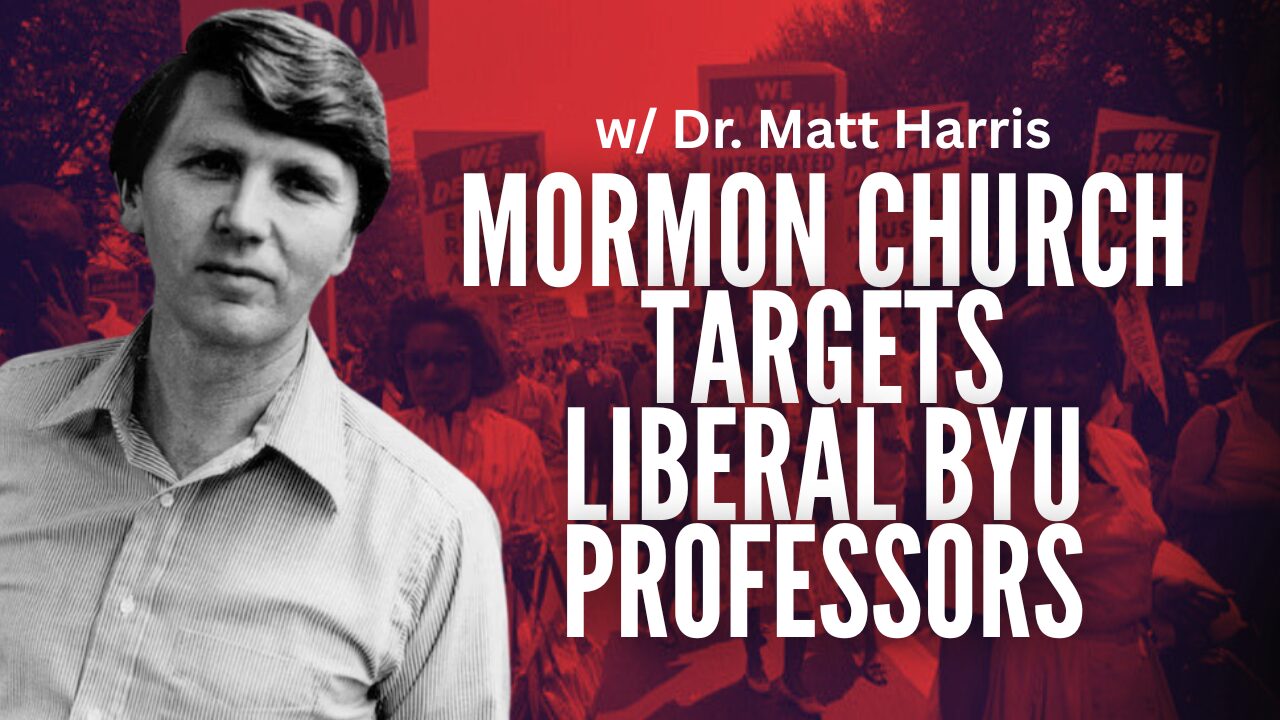
Thumbnail Credits: Main image of Eugene England from the England Family; Image of equal rights protestors from the Library of Congress
Originally published on mormonstories.org.
Transcript
Machine-generated and lightly edited. Click any timestamp to jump the audio to that moment. The audio is authoritative; please check it before quoting.
Introduction to the Series and the Book
John Dehlin Hi everyone. This is Dr. John Dehlin of Mormon Stories podcast. I want to thank you for joining us today on this epic 17 part series featuring Dr. Matthew Harris and his amazing book, Second Class Black Mormons and the Struggle for Racial Equality. This series has been groundbreaking. We've never had the response so far that we've had in terms of people really valuing our in depth coverage of this groundbreaking book that's talking about the Mormon Church's priesthood and temple ban against black people and then the dynamics, the inner workings, the political machinations of how the sausage gets made in terms of lifting the priesthood ban in the aftermath. So we have some good news and bad news about this series. The good news is thanks to the generous donations of those who have been watching it so far, we've been able to, I believe, more than generously compensate Dr. Harris for his contributions. That's the good news. The bad news is, you know, because we made the promise that 100% of the donations would go to Matt, we have not received any compensation for about the $20,000 of production costs that we incurred to produce this series and that that sort of imbalance would make it so we wouldn't be able to produce series like this going forward. So if you value this series, if you want to see the Open Stories foundation also be compensated for its production cost for this series, and if you want to see series like this with Matt and with other people continue, we kind of need you to step up and donate to cover our production costs. And it's really easy to do that. All you have to do is go to MormonStories.org donate or go to MormonStories.org and click on the donate button and you can do a one time donation, a recurring donation, and if you want to, you can type Second Class Saints or Matt Harris in the description and that will hopefully allow us to cover our production costs for this epic series. Regardless, we want to thank Dr. Matt Harris for his generosity in doing this series. We want to thank all of you who have supported us. Please go buy this book, Second Class Black Mormons and the Struggle for Racial Equality. And again, if you're wanting, if you're grateful for this series and you haven't donated and you want to see it continue, please please donate to Mormon Stories Podcast. Thanks again to everyone who donated to make this series possible. Thanks to Matt and we hope you enjoy this next episode in the series. Take care. Hello everyone and welcome to another edition of Mormon Stories Podcast. I'm your host, John Dehlin. It's July 22nd, 2024 and today we are going to be talking about again episode 15 in this series on the amazing Amazon Times best selling book in multiple categories for various briefs of slots of time. Second Class Black Mormons and the Struggle for racial equality by Dr. Matthew Harris. Again, this is probably going to end up being a 17 part series on Matt's amazing book on the Mormon Church's priesthood and temple ban on Black people through 1978 and then from that point forward changes that the Mormon Church has and hasn't made around racist doctrine and theology and practices. Today we are going to be covering chapter nine and we're going to be talking about all sorts of really cool things. We're going to be talking about Ezra Benson, what happens regarding race and racism as he becomes prophet of the Mormon Church, I believe in 1985. We're going to be talking about the Mormon Church and many of its members opposing a Martin Luther King Day being approved in states like Utah and Arizona. We're going to be talking about an epic battle between Bruce R. McConkie, his book Mormon Doctrine and former BYU professor and UVU professor, the late Eugene England. It's a really, a really important story that we're going to be talking about various attempts, well, various ways that Mormon Church leaders and scholars continued to advance racist doctrine and theology around the quote, curse and the ban etc at byu. And then we're gonna move to talking about feeble attempts for the church, I might say, to try and slowly start repositioning its rhetoric and the way it talks about race and the priesthood and people of color and why or why not. The church was hesitant to apologize when many other churches were. And then we're going to be talking about Gordon B. Hinckley when he takes over, how he dealt with talking about the priesthood ban. And then we're going to end with the discussion of several black Latter Day Saints and how they joined the church. A couple famous ones like Thorough Bailey, Utah Jazz basketball player and Gladys Knight, the famous singer from Gladys Knight and the Pips and Eldridge Cleaver, a very famous act, black activists. We're going to talk about all of them and their experiences as Mormons. So that's kind of what we're talking about today. And we have Julia joining us. Hey Julia, thanks for being here.
Julia Yeah, of course.
John Dehlin And of course we have Matt back. Hey Matt.
Matt Harris Hey John. Hey Julia.
John Dehlin I will, I'll say one last thing and that's just that this entire series is funded by you. Hopefully We've had about 60, 65 of you donate to the series. We're paying Matt to. To participate in this. And in spite of the fact that tens of thousands of you have watched and listened, we've only had about 60 or 70 people actually donate. We want to pay Matt all the way through fully for his participation. So please go to donorbox.org Matt Harris and donate 100 bucks, 500 bucks, whatever you can afford. 10 bucks to this series. 100% of your donations to that link will go to Matt, and that will make sure that Matt's rewarded. And then finally, Matt, we were excited to announce last episode that your book appeared number one in Christianity or maybe number two in Christianity on Amazon last week, and then number one in history and number one in Mormonism. So, again, so exciting to see your book get positive responses worldwide.
Matt Harris Yeah, me too. I was. I kind of figured it would be popular in the Mormon community just because this is a story that hasn't been told in its full complexity and detail like this. But I was shocked that it would be number one in history for a period. And also this is history overall. So throughout the world in different genres and subfields of history. And also I was shocked that I rose as high as number two on Christianity. I think the Catholic Bible was beating me. So anyway, what that tells me is that people outside of the LDS tradition are interested in this topic. So I'm pleased that this is finding a broad audience.
John Dehlin Yeah, us too. Us too. All right, well, let's start. And maybe the best place to start with our discussion of Chapter 9 is our good old buddy Ezra Tap Benson becoming Michael, my cousin. You're, you know, somebody who, who you've wrote, written a few books on. He becomes president of the Mormon Church in 1985. And maybe it's worth mentioning that we've done several hours of episodes in Ezra Tap Benson. So, you know, there are all sorts of reasons why it's interesting that. That he becomes president and prophet. So let's have you start there, Matt.
Ezra Taft Benson's Far-Right Political Ties
Matt Harris Yeah. So, Benson, we've been talking about previous episodes that there has been racial residue that, that that lingered after the revelation, or as I put it, debris in the streets. The brethren had never repudiated past teachings that had fueled the ban. They just simply noted in 1978, with official declaration number two, that black men can hold the priesthood if they're worthy, and black families could be sealed in the temple if they're worthy. But it didn't really address the. All of these teachings, and they didn't want to address them because they didn't want to get in the business of correcting or repudiating the teachings of their predecessors. And Ezra Taft Benson was one of them. And he had long taught that black people were from the seed of Cain. But his views on black people went much more deeply than that. He was involved in political racism by targeting Dr. King and other civil rights activists, calling them communists, and essentially demonizing efforts to get black people the right to vote, to get them the right to have the same privileges that white and brown folk have in the United States.
John Dehlin States.
Matt Harris And so not to say that brown people didn't experience racism, because they did for sure. But anyway, Dr. King became the target of Ezra Taft Benson's criticisms. And much of his views on race were informed by the John Birch Society, which is the most extreme anti communist organization of the day. Benson, this is sort of a brief overview, but Benson had wanted to align the church with the Birch Society. And there were so many criticisms by some liberal to moderate Latter Day Saints. They criticized Elder Benson's sermons that were intensely right wing, both in general conference at byu, during devotional assemblies, and also during their stake and ward conferences that he would visit. And so they complained to the first Presidency that, you know, he's politicizing our pews. We should be hearing about Jesus Christ and him crucified. And instead we're getting these political diatribes against the Supreme Court, the liberal Democratic president, Lyndon Johnson. And so anyway, the church tames Ezra Taft Benson and Benson, Spencer W. Kimball calls him in and he just said, this is in the 1970s. He said, Elder Benson, your job as a representative of Jesus Christ is more significant than anything you can say politically. Your words are divisive to the church. Stop. And Elder Benson didn't feel like that he ought to stop just because the church present had different political views than him, at least regarding the Burch Society. And so Benson kept talking about these views. And by 1980, Ezra Taft Benson wanted to align the church with Ronald Reagan and the Republican Party. And so many Latter Day Saints were upset by this. They were absolutely fearful that he would do this. Just like the Immoral Majority. A group of evangelicals had linked themselves with Ronald Reagan and got Reagan elected in 1980 through their aggressive politicking. Benson wanted to do the same thing because as a the Latter Day Saints could form a coalition like the Moral Majority. They could affect public policy like the Moral Majority. So that's what Benson had in mind. And the brethren recognized that if you align the church with right wing causes, or any cause for that matter, whether it's right or left, it would do damage to the church and stifle missionary efforts. And two examples that his colleagues had shared with him, and that is this is by the 70s, when he was poised to become the church president, they said, if you're demonizing black people, I'm paraphrasing, if you're demonizing black people and demonizing the civil rights movement, demonizing the NAACP and Dr. King, these iconic figures, you're going to harm our missionary efforts in sub Saharan Africa. Those folks do pay attention what's going on here. So you can't do that. If you're going to criticize liberalism and socialism and communism, you're going to make it very difficult for us to do missionary work in those countries that prize liberalism and, and socialism and communism, they have to be saved too. They too need to hear the gospel. And so that's the context upon which Spencer Kimball will call Benson in private and rebuke him. You can't demonize black people. You can't demonize liberalism, socialism and communism, which Benson saw as inextricably linked, which of course is not true. You could be a liberal and not be a communist. It's just nonsense. But anyway, that was the fear of Ezra Taft Benson when he took the reins of the church presidency in 19, when Kimball died in 1985. And and so they were really fearful that his right wing extremism would come back and haunt the church. And as I've written in my book on Ezra Taft Benson, and as I've said on a podcast with Mormon stories in 2020, when my Benson book came out, the church had reined in Benson and he didn't change his views politically. That's a misnomer. That somehow was church president. He never uttered the Birch line anymore. His views had changed, God had softened him. None of that is true. What had changed him was his own moderate colleagues, Tom Monson and Gordon Hinckley, his counselors in the first presidency. And then, oddly enough, a theological conservative, Boyd K. Packer, also joined in with Presidents Monson and Hinckley to rein in Benson. And they told him that extremist rhetoric is harming the church. Stop. And so that's what happened. But Benson instead used surrogates to continue to talk about right wing extremism. And one of the surrogates he used was a general authority named Berlin Anderson, an old Bircher. And without going into details about that, Verland Anderson too was reined in by Gordon Hinckley. So the church is trying to modernize in the 1980s, and they're trying to make the gospel appeal to as wide a group of people in the world as possible. And you can't do that unless you present a modern image. You can't do that if you're aligned with a right wing cause or maybe a left wing cause, although in this case, it was right wing politics that was affecting the church. So that's Gordon Hinckley. That was his genius as a first presidency counselor to Ezra Dab Benson and also Tom Monson's. They reign in Benson, and they basically tell him to curb his politics, even though he still believes these views. And the best piece of evidence I can give you is when he was ordained the president, the first thing he did was he contacted the Burt Society, and he said, please send my counselors, Tom Monson, Gordon Hinckley, and my secretary, Arthur Haycock, Birch literature. I'll pay for it. Bill me. And about a week later, about a week later, the Birch person that received that letter from President Benson, he told me in an interview. So I'm. I've interviewed this guy. He was still alive probably six, seven years ago. He was a former Birch president as well. Anyway, knew Benson well, and his name is John McManus. And McManus told me, he said that Hinckley, Monson, and Haycock all wrote him back and said, do not send us this garbage. And so the church president, from the get go, had issues with his two counselors and his secretary as it related to the Burt Society. None of them wanted that stuff, or as they put it, garbage. And the Burt Society president, when I interviewed him, he asked me, he said, why would they do that? And I said, it's simple. The church is trying to move away from that, that extremism. And no offense, Mr. McManus, but that's how people at headquarters had viewed the Birch Society in the late 1980s. And then McManus thought for a moment and he said, you know, this is sort of making sense to me now, because when, when Ezra Taft Benson was the president, I visited him at least two or three times at his office at church headquarters. And he said, I regretted that as a good Catholic, I never got a picture with him at church headquarters. I should have got a picture with the president. And he also laughed when he said, I bet I'm the only Catholic in the entire world that I can get an easy meeting with the President. He always invited me when I contacted him, and he said he always made it feel as though that he had nothing else or better to do than talk to me about Burt's politics, even though I knew he was busy running a global church. So anyway, McManus was happy to meet him, but he said that it made sense to me that what you're telling me, Matt, that the church has tried to move away from the Burt Society because every time I went to the headquarters, I always got a chilly reception. And I said, yeah, that's exactly right. It probably wasn't you personally. You're a nice human being. It's what you represent. That's why they didn't want you there. And they're trying to move the church president in a different direction. And of course you're keeping them back in this direction that they're not happy with. So that's the politics going on. People are really upset about Benson. They're worried that he would appoint his son, Reed Benson into the quorum of the 12. There are rumors afloat that the first opening that occurs, this would be Kimball's opening because Kimball died. That created a new person for the new church president to call, and he wanted to call his son Reid. And without going into details that, I will just simply tell you that enough people in the quorum of the 12 did not want Reed Benson in as an apostle and they protested. And so again, the church is trying
John Dehlin to move away from this stuff just really quickly. Since part of the fun of this series is just to get tap your brain on other issues that aren't in the book. Can I ask you a question?
How Apostles Are Called and Succession
Matt Harris Yeah.
John Dehlin How do apostles. Do you. Do you have any insight into how apostles are or aren't chosen? Oh, you know, Brigham Young chose his son. We know. I guess, you know, Bruce R. McConkie was Joseph Fielding Smith's son in law. But I'm just curious if you could just tell us what you know about how Mormon apostles get chosen and how nepotism may or may not play into that, or is that, you know, not appropriate for today's episode? I'm just curious.
Matt Harris Oh, no, that's fine. Let's do it. Let's do it. So this is all personality driven, right? In the church. You, you as a president, you have the prerogative to choose who the new apostle may mean. And for those of you who are not Latter Day Saints, or you may not be familiar with how Mormons choose their presidents, it's a. It's based on seniority in the quorum of the 12. And so when the church president or prophet dies, there is not a vote. It's simply the most senior apostle. And in Mormon corridors, it's essentially not to be, you know, facetious about it, but it's essentially the apostle who outlives the other apostles. It's the most senior apostle who becomes the president. So in this case, if Russell Nelson died tomorrow, no one's going to doubt who his successor will be. It's already the next in line in seniority, and that's Dallin H. Oaks. And if Oakes were to die three days later, it would be pretty clear who his successor would be. So it's just based on seniority. And, you know, you can play a guessing game. If you call in somebody to the quorum of the 12 when they're in their 30s and they have relatively good health and they have good genes, then there's a good chance that they will be the church president one day, albeit in their 80s, maybe. But anyway, that's how it works. And so how do you choose people into the quorum of the 12? And usually it's kind of strange. The most significant thing that a church president gets to do when he is first called is to call someone new into the quorum of the 12 to replace the church president who had just passed. And so this is what I'm about to tell you is a little. It's open. This is not privy to my knowledge. The church has talked about this publicly. And so when there's an opening in the 12, the church president will tell the apostles, you know, we have an opening, submit three names with a justification why you think that they ought to be in the 12.
Julia All 15. Or I mean, all surviving 14.
Matt Harris All 14, yeah. So we call them the top 15. But really what that means is that the quorum of the 12 apostles. So this is pattern after the biblical 12 apostles, and then you have the three additional apostles in the first presidency. So this would be the church president who's also ordained as an apostle. So he's the most senior apostle as the church president prophet. And then his two counselors are not the most senior. They're just simply the two people that the president chose because he liked them personally, had a relationship with them, or thought that there was some kind of way they could really help the church based on their life's experiences and their skills. So, and then when the president dies, the first presidency is dissolved, and those two counselors go back into their place of seniority in the quorum of the 12. And so that's how it works. The new president, who is called as a senior apostle, he can choose two new counselors if he wants, or he can retain the two old counselors. Typically in church history, the new president will retain the old counselors, although in this case, we've talked about it in one of these episodes, that did not happen with Hubie Brown. They dropped him from the governing First Presidency because of his activism on the race issue. And Hugh Brown went back into his place of seniority in the quorum of the 12, which wasn't very high up there because he wasn't ordained as an apostle until the age of 78. So there was really no chance that Hugh Brown ever had becoming the church president, much to the chagrin of liberals. So that's how it works. And John, you asked the question, you know, how do we know who gets called? Well, I gave you a procedural thing that they each submit three names, they have justifications, and then the president can pray about who he ought to call. It doesn't mean he tallies up, you know, that somebody's name got the most votes. That's not really how it works. Although the President's careful to. To notice those things. You know, who among the 12, who do they support the most? And when I was going through the Kimball papers and when President Kimball was ordained The Prophet in 1973, I saw it all. You know, this is on this. It's not open to the public today, so you wouldn't be able to see what I'm about to tell you. But President Kimball had taken a note and a tally of each of the members of the 12 had presented and their rationales. I can tell you exactly who Bruce McConkey and Hugh Brown and everybody else nominated when there was an opening in. In 74, when Harold Lee died, who was Spencer Kimball's predecessor as church president? And weirdly enough, Kimball chose L. Tom Perry, who did not get the most votes or the most support among the 12, weirdly enough, Neal Maxwell and James Faust were nominated for openings in the 12 in 1974, but they didn't get called in until 1977 and 1981, respectively. So that's how it happens. And you choose people that you like personally. And one of the things, John, to your question that they often prize the most is loyalty. Is this person loyal? Or there's a term that I'm going to say that I don't want to go down a rabbit hole, but the term they often use is church broke. Will you privilege the church in your life above everything else, including that of your family? And church broke is not a term they usually use in public, but that's one they use in private. And Loyalty is prized the most. And somebody who obviously is a strong believer in the gospel and the church is mission as they see it. And, you know, we have to be remiss, too, that depending on the personality, that there is a sense of entitlement. Joseph F. Smith, when he was the church president in the early 20th century, he called in at least two of his sons and I think one nephew, maybe or two. But anyway, there were charges of nepotism with Joseph F. Smith in the early 20th century, and Joseph F. Smith just brushed it all aside and he said, we have the blood of prophets flowing in our veins. And that was his way of utilizing privilege. The late Russell M. Ballard, who just passed away, what, a year ago, maybe he said that in public. And Russell M. Ballard, for your listeners who may not know he comes from a Smith bloodline, he's used that word, you know, we've got blood in our veins and therefore we're entitled to leadership. That is a sore subject, I might tell you, among some leaders of the church, they don't think that the Smith's relatives or offspring have any sort of entitlement just because of their surname or their bloodline. But yet that's how the Smiths have perceived that. When we get to this topic later in the hour and we talk about Joseph Fielding McConkey, I want to come back to Bloodlines, because he certainly believed that for himself anyway. So, John, I hope that answers your question.
John Dehlin That's great. Did you have a question on that, Julia?
Julia No, I'm just curious to see how was Benson's son a strong candidate for being called.
John Dehlin Or do we know?
Julia Yeah, or do we know?
Matt Harris Well, when you say strong, I mean, I don't know what you mean by that.
Julia I was he tallied up because I guess there's like 40 names that could be going around.
Matt Harris Yeah, I don't. So I haven't seen those first pregnancy minutes. I wish I could, but I can speculate that I would say absolutely not, Julia, because Reed Benson had worked for the John Birch society in the 1960s, and when the Burt Society came under heavy attack or assault or criticism from church members and outsiders, Reed Benson recognized that he couldn't do any good in the church as long as he stayed with the Burt Society. So his father, Ezra Taft, got Reed on the religion faculty at byu, and he would frequently talk about the freedom issue in class. Whenever you heard the word freedom issue, that was a buzzword for Bert's politics. And even Reed Benson knew that he was on perilous ground because they didn't want to politicize the religion department. Cleon Skousden was already on the religion department. And in the 1970s, a very young church Commissioner of Education and a very young BYU religion dean named Jeff Holland. They had to rein in this well established, respected Mormon writer and teacher, Cleon Skousen. And Holland. I've seen the letters and I can only imagine Holland was terrified as a young 30s man having to tell Skousen, who is a lot older, that stop what you're doing. You can't politicize your religion classes. You can't have him read political tracts when you're teaching the New Testament or the Book of Mormon. And so that's what Holland had to do. And he had to call in support from people above him because Skousen was such a towering presence on campus. I didn't realize the person. Hold on to Sec. The person he called in was Harold Lee, who was the church president at the time.
John Dehlin For some reason it never occurred to me that Jeff Holland was a professor or a dean at byu. I just remember him coming in as president when I was there. I didn't realize he was faculty or a dean.
Matt Harris No, John, he was on the fast track for leadership from the get go. And one of the things that I just finished reading that I would recommend to everybody listening, especially you, John, since you have an deep interest in church history, is Mike Quinn's memoir where Quinn is a little bit younger. Quinn was born in 44 and I think Holland was born in 42 or 43. So Holland was just a year or two ahead of Quinn. But they followed a similar trajectory. They had both worked for the church and Quinn had worked in the church archives with Leonard Arrington. And Jeff Holland had taught institute for a short period and they had both gone to Yale and Jeff Holland went to Yale handful of years before Mike Quinn did. Quinn wasn't there until the mid-70s. And when Quinn went to Yale, he was always compared to Holland in the local ward there. And so Holland was articulate, he was intelligent. And so when he finished his PhD, Jeff Holland, they did something that no young, newly minted PhD should ever do, and that is be named the dean for a lot of reasons, right? You're, you're a dean because of your experience, your wisdom, and you're having to take on to do things that especially to deal with senior personalities like Cleon Skousen that, you know, if he doesn't have your respect, it's going to be hard for you to do what you need to do. But Holland had to call in the big guns. And that's why when he had to chastise Cleon Skousen and say, look, you are not to politicize your classrooms with right wing bird stuff. Stop it. And Skousden pushed back and Holland had to bring in the big guns. And he brought in Harold Lee. And he said, I have a letter. He said, dear Brother Skousen, President Lee wants to meet with you at his office at church headquarters. And Lee wasn't happy either. I mean, this is a theological conservative who is really, really worried about the politicization of the church with right wing Birch politics. And so Lee stuck to his guns and really, he's the one that really put it to Skousen. And then Kimball will continue with, with Skousen, too. When Skousen. In the late 1970s, when my father was a bishop in Arizona, this is before we moved to Maine when I was 10. Anyway, my father was a bishop and President Kimball sent out a circular letter to be read in Utah, Idaho and Arizona, where the Bert's Latter Day Saints had a strong presence. And the letter simply said that Cleon Skousen, you are not to use your Freedom Institute at our church meeting houses. And the Freedom Institute was just a, it was just another name for the Birch Society. It was the same sort of teachings. They just wanted to call it something new because the Birchers had a bad name by that point. So Skousen had gotten himself in trouble with the Brethren for using LDS meeting houses much in the same way that Benson and his son Reed had done in the 60s. And so my father read that letter to his, his parishioners over the pulpit, as did countless other bishops throughout Utah and Idaho. So that's what's going on at church headquarters. They're trying to move away from the difficulty of right wing politics that Benson and Skousen represented anyway, so. But Jeff Holland was put in for fast track right away. He was the dean in the 1970s. And then he was, as you mentioned, John, he was the BYU president in the 1980s. And then they released him as BYU president. They called him into the first quorum of the 70, I think in the late 80s. And then he was in that position for just a few years before he was elevated to the Quorum of the Twelve Apostles, which is where he is today.
John Dehlin Got it. Excellent. Okay, let us know. This has been great. One of the things I have to mention about Eztar Benson before we jump into the Martin Luther King Day situation, is Spence W. Kimmel calling him onto the carpet for comments he made about dead prophets. Do you want to. Should we go there or should we go somewhere else real quick?
Benson's Controversial 1980 BYU Address
Matt Harris No, that's fine. I can be happy to talk about that. So In February of 1980, Ezra Taft Benson gave an extremely controversial address at Brigham Young University. And keep in mind the context of all of this address, which is what I've been saying. They're trying to move away from the brethren are trying to move away from right wing politics. They're trying to move away from incendiary rhetoric calling King a communist, trying to move away from, you know, calling liberals, you know, communists and all of that, because they're afraid they won't be able to spread the gospel in northern European countries that love their liberalism and socialism. So they're trying to get away from that. And Benson had been told by several people, beginning with David O. McKay, Harold Lee, Spencer Kimball, leave your politics alone and just focus on Jesus Christ and him crucified, which was, you know, the main mission that the apostles are supposed to preach. And so in 1980, February, he gave this talk where this is the last talk that he will give publicly before he absolutely gets reined in and does not say another word about right wing politics for the rest of his life. He hints at it a little bit as the church president. He'll talk about Gaddy and Roberts and secret combinations just sort of in passing. But I have never found a talk that, that Benson had given after 1980 in which he's really aggressive in his politics. But in 1980, it's called, gave this talk called 14 Fundamentals and following the the Prophet. And I don't have it in front of me, so I'll just paraphrase a couple of points, but one point he said is that prophets don't have to say thus saith the Lord to have any kind of credibility with their prophecy. And if your listeners don't know the context of that statement, that's fascinating. One, Hugh Brown, his nemesis, the man who had been pushing for the church to support civil rights, the man who had been pushing for the church to lift the ban, this liberal Canadian who was David O. McKay's counselor in the first presidency. Brown gave a talk in 1955 and he talks about how prophets, it's called Profile of a Prophet. It's an interesting talk we're listening to. And in the Profile of Prophet, this widely popular talk he gave, Brown said that prophets speak in the name of the Lord Jesus Christ, and they say thus saith the Lord. Well, Benson got in a Little Dig in 1980, five years after Brown had died, saying, you don't have to say thus saith the Lord in order to prophesy. That was a direct stab at Brown. And then the thing that got him in trouble the most. Two things that got him in trouble the most. One, he said that the prophet could speak for the church even in political or civic affairs. And that sent shockwaves throughout the church to its liberal members who were fearful that Benson was setting himself up to be the next church president and he would align the church with the Republican Party and his good friend Ronald Reagan. So that's the context by which he said that the church can speak for God or the prophet could speak for the church in political affairs. They see Benson lining the church with the Republican Party much in the same way that the Moral Majority and the evangelical right had done. And the last thing that got him into a lot of trouble was he said that today's the current church prophet is more important than a dead prophet. And that was rightly viewed as an affront to his predecessors in the church presidency. And that was all also rightly viewed as a way for the soon to be next prophet to promote himself and his authority. And a number of people just were horrified at this. So they complained to President Kimball after the talk. This would have been in February and March of 1980. There were dozens of letters that came into President Kimball's to his office. And I've seen these letters. I've gone through his papers, and they're really interesting letters, and they're complaining about, you know, Benson and the political overtones and undertones of that address. And so President Kimball called in Benson and he said, look, we've talked about this. I told you to leave this stuff alone, the politics. And by this point, Kimball was so angry with him because he had told him repeatedly over the previous six years to leave it alone, including saying to the members that you can't be a good Latter Day Saint if you're a good. If you're a Democrat. That infuriated Kimball, too. So he called him in and he said, I want you to apologize to your brother in the quorum of the 12 at our next meeting on Thursday in the temple. And Benson is absolutely nervous. He. I can only speculate why he's nervous, but he's really, really nervous about having to apologize. So he apologizes to the quorum of the 12 in. In a quorum meeting in the. In the temple. And President Kimball was not impressed with the apology. So he told Elder Benson, he said, I want you to come back the following week and publicize or apologize to all of the general authorities, including the Presiding Bishopric and in the quorum of 70. And I mean, he's humiliating Benson, absolutely humiliating him. And if that's not bad enough, he had Benson write a public apology that would be promoted publicly, that is that Latter Day Saints outside of leadership in Salt Lake could read the apology. And I've seen the apology. I have a copy of the apology I found in the church archives. However, there's no evidence that that apology was ever issued publicly. And I doubt that it was because I would have heard about it. So for reasons I can't explain, that that public apology that Benson was asked to write, that frankly, maybe a church lawyer had written, I were a betting man, it was never given publicly.
John Dehlin You. You kind of said that. M. You would have to speculate, like I. If E. Benson was president of the quorum of the 12 at that point, next in line to be prophet. I'm thinking of like when Boy K. Packer was president of the quorum of the 12. I don't think he had a lot of fear, or at least I don't perceive that he did. What? What in the world could Esdev Benson have had to fear knowing that he was next in line to be prophet?
Matt Harris Well, that's a good question. I have to always tell people this is based on personality, right? Just because somebody's administration happened one way doesn't mean that the next administration will happen that way. Boyd Packer is an interesting person. He is a very, very strong willed personality. You see things that Packer did that no other apostle would do. And what I mean by that is in the 1970s, for example, when Elder Benson or Elder Packer was a newly called apostle, he had usurped the authority of his senior colleagues in the Quorum time and time again. And let me give you just one example, because I don't want to. We need to move on to other things. But one example would be the church historian's office in the 1970s, which, when Leonard Arrington and his colleagues were there, they were trying to write. They were trying this very delicate. What's the right word? They were walking a very fine line between trying to write an honest and transparent history of the church, warts and all, but also, of course, writing history to let people know that they thought that God was behind the church and was at the helm of the church. So really trying to satisfy two masters, on the one hand, their secular colleagues at universities who would read the church history they would write and on the other hand, having to satisfy the people who signed their paychecks, the apostles, and so who were very concerned about writing or producing a faithful church history. So that was the delicate balance that Arrington and his colleagues were having to walk. And Howard W. Hunter, the apostle, who had more seniority by a long shot over Packer, he was in charge of the church historians department. And he was wonderful. He was very open and accessible to the archives. And he told Leonard Arrington, you know, whatever you need, you'll get access to, just clear it by me. And Elder Packer, as a junior member of the 12th, took it upon himself to say, you know, not you're what you're doing. Arrington is not right. And Arrington's response is, well, gee, that's interesting. I have the support of Elder Hunter and I also have the support of President Kimball. And so. But Packer wouldn't let up. And Hunter, to the day he died, he had strong, strong feelings against Boyd Packer, because that's how he was. And so the question you asked, John, was, how does Benson deal with all of this? He's the president and Benson. There were people in the quorum that were very strong willed, including Boyd Packer. And Gordon Hinckley was a strong will. And Tom Monson, too. You see Tom Monson in public and he's this nice guy baking bread and bringing it to the widows. I mean, I'm not making fun of that. I think that's. That's theology in action, right? But he's a tiger behind closed doors. And I've talked to several people, both his colleagues in church leadership and businessmen who had been at meetings with Tom Monson as it dealt with the business matter that overlapped with their business and the church. And Monson was nobody to be trifled with. He was nobody's fool, even though he was a nice man and had a sensitivity towards widows and poor people. Hinckley, too, was very independent. One of the people I interviewed years ago who was in a meeting with Kimball, or, excuse me, Hinckley, he said that. He said, Gordon Hinckley always had a sharp pencil when we were at our meetings. And I said, what does that mean, sharp pencil? He said, whenever we were talking about facts and figures on a balance sheet, he went over it with a fine tooth comb. And he was never afraid to push back and exert his influence. And I can tell you more stories about them. But Packer, too, even though he's conservative theologically, he hated the right wing politics. He hated The Burt Society. So these three very headstrong men, they ganged up on President Benson and they said, stop. And it worked because President Benson is not uttering his birth stuff in public when he's the church president. And, and I know that's hard for people to hear. It really is hard, because he's the president. He can do whatever he wants. But, you know, one of the things that the church prizes itself on is harmony. And you can't have the church president going rogue if 99% of the rest of the Quorum is against you. And so this is a compliment to President Benson. He hears this, and as I mentioned, he has some of his underlings doing some of the work for him. That becomes an issue with Gordon Hinckley when Hinckley finds out about it. Another story for another day. But. But Benson does. He does curb himself. And I mean, you know, there's nothing, there's not a lot they could have done to President Benson if he gave a talk in General conference talking about, you know, how evil the government was and all of that, and maybe didn't feel the need to because of Ronald Reagan being the president. But anyway, so that's what's going on here is he's been reined in by senior leaders of the Quorum, and even Dallin Oaks is a junior member. I don't want to go into too much detail about this because I just don't feel like I can. But I will just simply say that even Oaks, as the most junior member of the Quorum, who had a long history with Ezra Taft Benson when he was, when Oaks was the president of byu and of course, Benson was on the board of trustees. And Benson tried to get Oaks to unilaterally hire a Bircher in the political science faculty. Guy named Richard Vetterle, one of my old teachers at byu and Oakes and the dean resented it. They told Benson, we're not going to hire Dick Vetterle because the faculty do not support it and the dean doesn't support it. He's a right wing guy, doesn't really have the proper academic credentials. And weirdly enough, Benson got his way. Dallin Oaks as president and Martin Hickman the dean, they stood their ground for at least two different hiring cycles in which they opposed Dick Vetterle. But by 1979, I have the board minutes on this. Really fascinating to read. By 1979, Ezra Taft Benson, who's the president of the quorum of the 12 at the time, he's also on the board. He dug his heels in and he said, we're going to hire Vetterly. And they had to hire him. And what's interesting about it is the guy that they passed up was a guy who would go on to be a distinguished professor in the government department at Harvard. And this is Roger Porter. And so Benson didn't want Roger Porter because he perceived him as being too snitty, because he went to Harvard for one of his degrees and he went to Oxford, I think, for another one. And as Benson put it, he's too liberal. And so they hired Vetterly instead, which is just comical to me that they missed out on a guy who went on to have a distinguished career at Harvard.
John Dehlin And if I could just give my personal experience, I did political science at byu. And yeah, Vetterly was kind of viewed as a, this is just my experience. He was kind of viewed as a joke and not as a serious scholar. People took his class when they just wanted to avoid something difficult and they viewed him as some sort of favorable appointment who really didn't belong there. And that, that, that was true in the late 80s and early 90s.
Matt Harris Well, I didn't know about his reputation, so I took him for only one reason. And I took him because he taught a class on the Constitution. And I was interested in taking all of the classes that the BYU political science people taught on the Constitution. So Dick Vetterly taught a class and I didn't know anything about him. And anyway, so I had him. And he was probably in his early 60s, at the tail end of his career, maybe late 50s, I don't remember. But he got hired late in life and he, he was really tense. So finally a couple of us asked him, you know, you just look tense, what's wrong? And he said he was up for tenure. And yeah, he said, I have some, I have some strong political views that maybe some of you in class will pick up on or something like that or have picked up on. But I'm afraid that may come back and bite me. And we had no idea what he meant. We knew he was conservative, but looking back, you know, now, knowing what I know now, I can see why he was nervous. Because A, he was not wanted by the faculty, he was a political appointment from Ezra Benson, and B, he, he wasn't even a good conservative scholar. He was this right wing, I'm going to say right wing hack.
John Dehlin Yeah.
Matt Harris And when he got tenure, he was smart enough to align himself with an established scholar named Gary Bryner. And they co wrote a book called In Search of the Republic. And it was published by a decent academic publisher, Roman in Littlefield. And that book got him tenure. But anyway, he was really nervous that he wouldn't get tenure based on his Birch affiliation.
John Dehlin Fascinating.
The Church and the Martin Luther King Holiday
Matt Harris Okay, so back to Benson. How about that?
John Dehlin Let's do Martin Luther King Day, which would seem very non controversial by today's standards, but I was at BYU when all that was going down.
Matt Harris Okay, so Benson, so, so when Benson's the President, with all the context we've been talking about, the church is trying to move away from right wing extremism. The, the federal holiday to honor Martin Luther King is before the church and the state of Utah in the 1980s. It was proposed as late as 1969 or as early as 1969, just after Dr. King was assassinated. And it really didn't kick into high gear until the late 70s, early 80s, where there became a groundswell of support nationally to honor the late civil rights leader. And as one can imagine, and as one should not be surprised, there were a number of extremely conservative senators in the United States Senate who opposed it, including a man named Jesse Helms, Strom Thurman, who was a person that Benson decided to run with for the presidency in the 60s. And so they oppose it and they're calling him a communist. And you know, all that garbage that some of these folks have been saying about Dr. King for a very long time. And by 1983, Ronald Reagan recognizes that Dr. King is a significant historical figure who needs to be honored. So kudos to President Reagan. So he signs it into law in 83. And this presents a huge challenge for, for the state of Utah, dominated by conservative Mormon lawmakers. And throughout the 1980s, as the MLK federal holiday is picking up steam across the country, one by one, more states are honoring the holiday. They're giving their employees off from work with paid time and all of that. And in the 1980s, the Utah, they just don't support it at all. He's an adulter, he's a communist, he's a womanizer. And so here's where it gets really interesting is that Gordon Hinckley, who's a counselor in the first presidency, recognizes the damage that President Benson has caused with his past views on King that he's no longer stating in public, but his past views from the 60s that are still out in circulation and that are still held among a large group of Latter Day Saints in the United States, particularly in the Intermountain West. And Gordon Hinckley decides to pay for a big chunk to bring Rosa Parks in to Speak to the state legislature. That's really an interesting thing. One of Gordon Hinckley's friends told me this. And so Hinckley uses church funds to pay to bring in Rosa Parks in January or February of 1986. I think it was February of 1986. To bring him in to speak to or her. And to speak to the legislature about honoring her late husband. And it was interesting when she spoke about his accomplishments. And it wasn't just in the black community. She was talking about what he had done for white and brown people and how he believed in racial equality for everybody. And yet these lawmakers were so deeply immersed in right wing extremism, all they could think about was that he was an adulterer and a communist. And they just couldn't bring themselves to support it in 1986. And anyway, I know we'll flesh this out, but I will just tell you that. That Gordon Hinckley is very, very sensitive to this. And in the 1990s, Gordon Hinckley will lead an effort to get the state of Utah to honor the King Holiday. Let me tell you just one anecdote that's not in my book. The Hinckley one, when he paid for it was not my book either. Gordon Hinckley decided to speak to the NAACP in 1998. This is a first for a Mormon church president. This is an extraordinary thing because of what Benson had said about the NAACP calling him essentially satanic and communist and all of that. And so Hinckley's trying to make it right with the black community, with civil rights groups. So he accepts their invitation to speak in 1998. And as he's given this really remarkable talk to the NAACP in which he's touting up the church's efforts in sub Saharan Africa with. Which is one of the reasons why the NAACP brought him in, because of his global work with black people. He's talking about all people are his friends and neighbors. He respects all races and ethnicities equally. I mean, it's a wonderful talk. And they give him this big award. Well, in the pew that day was Darius Gray, an early member of the Genesis group. We talked about Gray in earlier episodes. Darius Gray was sitting next to a general authority, and he leans over next to the general authorities, said, why are we. This is 1998. Why are we still opposing the King Holiday? This, what a waste. Why are we even making this an issue? We're one of the last states in the union to do this. And so the general authority went to Hinckley and said something that Gray had probably told Hinckley on his own. Why is the church opposing or the state of Utah opposing the MLK holiday? President Hinckley, you know and I know that when the state of Utah poses the MLK holiday, everybody anticipates that it's the church opposing the holiday too. And that might not be a wrong assumption if the church remains silent on this historic holiday and the fact that most of the members of the legislature are white Mormon men. So the, the General Authority shared this with the church president. And the president immediately did two things that turned the knob so quickly. Number one, he told his counselor, James Faust. He said, jim. That was his name, Jim, contact ksl, all of the radio outlets under our direction, that is the LDS own, and let them know, start running favorable news stories on the MLK holiday. Notice what he didn't say. Let them know the church now supports this. He didn't say that. He said, run favorable news stories on Dr. King and the holiday. And the second thing he did was President Hinckley. He went to his colleagues on the Hill. These are people who are paid lobbyists. And he said, he said, let the lawmakers know that we, the church, supports the MLK holiday. So between those two things, Jim Faust going to the news outlets and saying run favorable stories on the holiday and Dr. King and then having the church's paid lobbyist tell the lawmakers on the Hill that it's time to support the MLK holiday, that's what happened. And almost overnight, the good men and women who had been pushing and working so hard in Utah to get the state to honor this holiday, it all of their efforts came to this culmination in matter of moments, it seems like when the fact is it had been, you know, 15, 20 years in the making by so many Utahns, both in the church and out of the church, pushing for the state to honor this. And the state to this day in 2000, became one of the last states to honor the Martin Luther King federal holiday. Before that, they called it Human Rights Day, which was a huge affront to Dr. King's legacy by refusing to acknowledge it in his honor. So that's what's going on in private, John, is there's a lot of stuff moving pieces with the civil rights thing. And there was a big issue in Arizona, too, in the late 1980s. There was a Birch Society Mormon governor named Evan Mecham. And anybody who lives in the Arizona in the 80s, we'll know who Evan Mecham was. He was a controversial figure. Ezra Taft Benson Loved him. They were close friends. Skousen was a close friend. They were all Birchers. And when Mecham was elected the Governor, Benson went, went, flew into his swearing in ceremony and gave him a special blessing in the Mesa Temple in which, you know, he blessed him, whatever, I don't have the transcript, but blessed him to, you know, be an effective governor. And probably, I'm sure there were political overtones in it. And one of the first things that Mecum did was that he rescinded the federal holiday in Arizona. So we're not going to honor this. And the Arizona Saints, at least some of them went nuts. They went ballistic. They were upset about it. And then some of the conservative Latter Day Saints were upset too. And without going into all the details, I, I talk about this, but as a political brouhaha in Arizona because of the, the fallout from Governor Mecham, this Bircher governor rescinding the holiday when it became that the church may support it in Arizona, there were a number of Latter Day Saint Birchers who wrote to President Benson when he was the president in Salt Lake. And I'll quote from one and this one Bircher, a guy named Sanders, he reminded Benson that you had once called King a liar, adulterer and thief and also the Antichrist. These are quotes from my book. Then he says here Brother Lyons, Brother Lyons was a public relations person in Mesa for the church. Here Brother Lyons would have us believe that the church obviously supports the prostituted moderates and liberals who united in collective wisdom to force upon us a tax paid holiday honoring the master deceiver of the ages. Sanders demanded to know the true position of the church. In other words, this local PR guy from Mesa saying, hey, the church supports the Martin Luther King federal holiday. And this Bertram who was in that area said that can't be in, writes the church president riding him of all the horrible things he had once said about Martin Luther King. And he wanted Benson to, to weigh into this. And he had no idea that Benson's health was precipitously declining at this point. And secondly, the church is trying to leave all of this garbage in its rearview mirror and he, they can't. So you can't just move along without repudiating any of this. And that's what they're trying to do.
John Dehlin I have a quick question, Matt, and I think you're going to feel like this is an obvious question to answer, but for people with Mormon sensibilities, I think it's a fair and important question. I, I've been a huge fan of Martin Luther King Jr. For a long, long time. And I was surprised when I read a biography to about him that the FBI literally had audio recordings of him being with other women. And it was really disturbing and it was hard for me to hear that at the time. Just feeling like it dashed my, at the time it dashed my respect for him in some ways because I had this idealized version of him. Do you want to address if somebody were to say, well of course Mormon leaders oppose Martin Luther King Jr. He was an adulterer and Mormon churches against adultery, so why would they want a state or federal why would they want to acknowledge a state or a federal holiday when the church is against adultery? Would you mind just addressing that? Even though I know it might seem like a shocking question?
Matt Harris Go. No, it's a great question. It's a really good question. I teach civil rights, I'm immersed in Dr. King, I've written about Dr. King and he's long been a hero of mine. To answer your question, I want to give you a little historiography, if I can. Historiography is just a fancy word for what historians have said over the years about King and what other people have said. So when the holiday was first announced, and I'm going to be brief, but I want to give you a big picture for a moment. When it was first announced in the late 60s, conservative folks said he's an adulterer and they've been hearing about his various affairs. And you're absolutely right, John. The FBI had taped him illegally and they had once been given permission from the Attorney general Robert Kennedy, but then that was warrant that they gave ran out and Hoover kept doing it anyway illegally. And so they taped him. They had women in his room. I'm not, please don't misunderstand me. I'm not condoning his behavior. I'm just telling you why he did it. He had so much stress in his life. The man lived in constant fear that he would have a bullet in his brain every time he spoke, that somebody would snipe him and kill him. And he often predicted that he would die from a gunshot, which ultimately proved prophetic. And so the man was human, as you can imagine, with the wife and young children. So he self medicated occasionally through cigarettes, through booze and through women. Not condoning it. I'm just telling you that's what he did. And so J. Edgar Hoover taped him in an effort to destroy him and thought, I've got the goods on him. I've got him having sex with women and I've got an audio tape of all of this, and I'm going to send it to him. And if he doesn't commit suicide, this is what the note says. Hoover says, end your life or I'm going to share this with Coretta. I mean, this is the kind of human being we're dealing with in J. Edgar hoover. And so Dr. King did not capitulate to Hoover's disgusting demand. And even though he was flawed, so many people focused on the flaw in his marriage and with his God, as opposed to the larger issue at stake here, which was human dignity for everybody, not just black people, but for white and brown people as well, and not just the ability to vote or to go to a food counter and to eat next to the white person. It also meant economic equality, allowing people to live with a measure of dignity because they could pay their bills and send their kids to Little League practice that cost money or music lessons. And so anyway, had some liberal ideas. He was not a communist as his. As Hoover had demonized him and also as the Birchers. He hated communism. He's a Baptist minister. Communism is not religious. It is secular and materialistic in aim. That is not Dr. King. Anybody who has a rudimentary knowledge of his sermons and who he was as a person, realize that he was not a secular human being. He was a. He was a biblical prophet, in my view, through and through. Anyway. So the right wing folks in this country were so fixated on his adulterous liaisons, and they use that, they weaponize that against him. And it wasn't until the 1980s where liberal scholars had seen the evidence and they started to write about, yeah, it's true, it's true, he did have extramarital relationships. And so what we see today in the literature is we see a full coming forward where people can acknowledge his tremendous flaws as a human being, but also, especially if you're religious, also recognize that God could use him for a much higher purpose, even as a flawed person. And I would imagine these are the same things people are saying, religious people are saying about Trump today. Right. Recognizing he's an adulterer and that, you know, they think that God spared him for some bigger purpose. And I can't believe I just compared Donald Trump and King in the same sentence. But anyway, so that's, I hope that answers your question. That's what's going on here in the right wing are picking up on the adultery stuff a lot, and they're just fixated on it.
John Dehlin And I'll just add that there's a bit of a double standard there. Yes, I've read about fdr. FDR had a mistress. At least one. Eleanor Roosevelt had at least a couple likely extramarital relationships. Jfk. I remember reading one book about JFK where like every time JFK had a cold sore, another secretary in the White House would have a cold sore. Like, I just think that's just not an argument you could really use to discredit somebody or you're going to be discrediting almost everyone. And I'm sure Julia's thinking about Joseph Smith.
Julia Oh, well, for sure. There's so many other people too.
Matt Harris Well, I think, I mean, the racism is what separates Dr. King. Right. Like you said, John, they're not making an issue of FDR's adultery or just John F. Kennedy's adultery. So the fact is Hoover's making an issue of the. Of King because he's a powerful black man who commands a very important message. Civil rights.
John Dehlin Yeah.
Matt Harris Racial equality. And Hoover is trying to destroy King by any means necessary and including surreptitiously taping him. So there's that racist component that's at the core of all this because if it were a white person doing this, I don't think Hoover would have been doing what he was doing.
John Dehlin Yeah. All right, let's keep going. This is great.
Black Latter-day Saints Respond to Benson's Presidency
Matt Harris All right. So now the black Latter Day Saints, you can imagine in the church in the 1980s when the church president is the president and they're not, they're not happy that the saints in Utah are denying the Martin Luther King holiday. Utah becomes a laughingstock. More and more of the state throughout the 80s and into the 90s supports the MLK holiday. And here's Utah stuck in the mud. And they finally, as I noted, call it Human Rights Day. And one Latter Day Saint, Catherine Stokes, she's been a long standing member for many years. She, I think had lived in Chicago for a while, which is where she converted. And then at some point, I think in, I don't know, the 70s or 80s, she moved to Salt Lake City, which is where she is today. She's probably in her 80s today. Met her a couple of times. She's a delightful woman. Catherine Stokes couldn't believe that the church or the state would not support the MLK holiday. She said, quote, Martin's message was the same message as Jesus Christ. For some reason, people don't seem to recognize it. And then another person, black Latter Day Saint named Chester Hawkins, he blamed the John Burch Society for the state's refusal to honor The King Holiday. He also blamed Benson and he said, quote, the black people knew of about Benson and the Burt Society, they thought that they had had enough of that bunch. That's interesting, linking Benson with the Burt Society and that. Not that Chester Lee Hawkins speaks for all black Latter Day Saints, but that's what he said, that we in the black community thought we had enough of that bunch. Hawkins didn't think it was fair to blame the entire church on Benson's racism, but he acknowledged that, quote, so many people got the impression that the John Birch Society was running the church. Close quote. And for your listeners of a younger generation, you wouldn't know how much of an issue the Birch Society was for so many years, for probably three decades or more. If you were in the church in the 1960s, 70s and into the 80s, and especially if you lived around Utah, Idaho, Arizona and parts in Southern California, you would recognize how many members were aligned with this ultra conservative, anti communist organization and how Ezra Taft Benson and Reed Benson and Cleon Skousen and some other conservative folks in the church had tried to promote that alliance for so many years. It was really thick. And I've got Birchers in my own family. My, my father's sisters and one or two of his brothers were all Birchers. And so people have asked me, you know, what drew you to do two Benson books? And that's the short answer is I have this stuff in my own family. And I grew up as a kid wondering, you know, who is this John Birch person and what does he have to do with the church? But to my family, my father's relatives, the church and the Birch Society were indistinguishable. One was the other.
John Dehlin Right.
Matt Harris All right, so that's what's going on in the 80s and for black Latter Day Saints, that the opposition to the MLK holiday seemed to be a touchstone for the church's opposition to civil rights in the 60s. And I want to just stress something that's really critical here. For Chester Hawkins to go on record in the 80s and talk about Benson and the Birchers being racist, that's pretty important because here you have a active Latter Day Saint man criticizing the church president for his racism. And that's the person who he criticized was a BYU professor doing the oral history interview, which is my source for this. So that's, that's not insignificant that, you know, this man is finding his voice and he feels comfortable enough to, you know, blame it on the church. There's also, there's also a, an issue with McConkey in Mormon doctrine, that becomes an issue. And Elder McConkie will die in the spring of 1985 of cancer. I remember when I was in high school when this happened, and I had met Elder McConkey as a, I think it was 13 at the time. He spoke to a state conference that we had at a local high school in this auditorium in Maine. We didn't have these large ward meeting houses that you would see in the, in the west, so they had to rent out this, this audio, this studio or not studio, auditorium at the local high school. And I remember talking, being asked to talk, and I was terrified to talk just because there would be a lot of people there, as opposed to my tiny little branch where, you know, 40, 50 people and we all knew each other, which wasn't a big deal. But to have all of these people there was a little terrifying. And then when my dad told me, he said, oh yeah, and there'll be an apostle from Salt Lake there. I said, okay. I had no idea who the apostle was. It was Bruce McConkie. And I remember sitting next to McConkey on the stand and I remember shaking his hand. And his, his hands are huge. He was a tall man, he's six foot five. And I remember his hands were huge and he wore these gigantic wingtips, shoes. And so that's what a 13 year old kid remembered about McConkey. And so I spoke and I was, I remember being, you know, nervous and I finished and after the sermon was over, you know, McConkey was gracious to me. He said, oh, that was really good. And I'm thinking, I don't believe you believe that, but, but you're being nice to me. Thank you. So he was really nice and kind and cordial, and I had no idea, you know, how authoritarian he was at the time. But when he died in 1985, it was the opportunity for Latter Day Saints to come forward and to talk about Mormon doctrine and to talk about him essentially as a person. And as is most of the time in history, you know, people are more than one dimensional. You know, there's a side to us that the public doesn't typically see. And that was the case of Elder McConkey. He had a wonderful, delightful sense of humor in private, but you would never see that sense of humor over the pulpit. And that was by design. He thought that his modus operandi as an apostle was to insert himself into some Old Testament narrative where he would stand with his scriptures with his hand out and he would call the Saints to Repentance and even pound the pulpit if needed to be. But yet the Saints didn't respond to that. A number of them didn't anyway. And they would send him hate mail. They would say, you know, you Spoke to Matilda McConkey, you spoke to my state conference last weekend, and I resent the way that you lectured us. And they would use the word like sanctimonious and pious. I mean, whoever thinks that says that the Saints are just a bunch of sheep that follow. Not true. Latter Day Saints have stiff backbones and loud voices and sometimes you might not always hear that. But I'm telling you, when you read their letters to church officers, you see a side to the Saints that you don't typically see. Well, they wrote him hate mail. And that's a word that his son used in his father's memoir. He said, the saint sent my father hate melon. Having read some of this mail, I concur. Well, when he died in 85, it was now open season in Elder McConkey. It was a way for people to come forward and define their traction and to criticize the apostle. There was a mixed race man named George Rickford from England. He had black, African and European ancestry. And Rickford tells the story that when the missionaries first came over to his home to convert him, this would have been the early 70s. He they read a passage from Mormon doctrine. One can't imagine that this would ever happen today. You would read, you know, from Mormon doctrine, but they were reading from Mormon doctrine in the early 70s, and they read a passage from Mormon doctrine called Negroes. And this is what Rickford said about it. This is a biracial man of black, African and European ancestry. Light skinned man. I've seen a picture of him. And the elders knew that he had black African ancestry, so he couldn't hold the priesthood. And as they're reading the Negro section to him very slowly, Rickford recalled, as if through a thick fog, it dawned upon me what they were trying with such embarrassment and sadness to say, George, they seemed to say, you'd be more than welcome to join our church, but there is no possibility of you ever holding the priesthood. Rickford exploded in anger. Words like discrimination, prejudice, bigotry flowed from me. He angrily recalled. How could they call themselves the Church of Jesus Christ and subscribe to such teachings? In an impulsive moment, Rickford threw the missionaries out of his house and told them never to come back. And Rickford joined the church later. That's another whole story for a different day. He did join the church he. And he became a seminary institute teacher teaching Mormon youth Mormon theology for his entire career. And so he obviously had a change of heart, but he recognized even then in the early 70s, that how offensive and racist this book was. One of the most moving stories for me in this entire book, frankly, deals with an African American convert named Annette Reed, who, like many black converts, became acquainted with Mormon doctrine after they joined the church. Rickford was different. The missionaries took it upon themselves to share Mormon doctrine with him before he got baptized. But most would learn about this book afterwards, including Annette Reid. And Reid had had a similar reaction that most Mormons, black saints would have, and that is they get baptized, they feel the Holy Spirit touching their life. They like the. The reception that they receive at church. They're, I guess you would say, quote, they're on a spiritual high. And then all of a sudden, they come across this deeply offensive and racist book comparing their. Their skin to biblical counterfeiters. And so Annette Reed was just so bothered by the racism, and soon that she would experience racism at church where people would talk about the ban with her, and they would say that, oh, God lifted the ban, but you're still cursed, and, you know, stuff like that. And so, fairly or unfairly, Annette Reed, this young black convert, I think she was from Texas, she decided that she would tell Apostle McConkey how she felt about his awful book the first chance she got. And the first opportunity emerged when she was called to serve in the Salt Lake City mission in the early 1980s. So a couple of three years after the ban had been lifted, and there was a state conference in her area, and Elder McConkey was the presiding authority. And as is often the case at state conferences, they have a dinner on Saturday night before the stake meeting on Saturday night. So there'd be a sermon on Saturday night from the visiting authority, and then there would be another one the next morning to the church at large. Usually Saturday night was to the leaders of the church. Well, at that Saturday sermon beforehand, they had dinner, and Reed was sat. She got. Somebody had put her next to Elder McConkey. And she resolved at dinner, in front of people around her at the dinner table, that she was going to tell the apostle how she felt about his book. And I thought, oh, my, that's really, really gutsy. And so she started. She was thinking about what she wanted to say to him, and then she said that she had a sudden and swift change of heart. She couldn't go through with it. I could just sense the weariness from him, and I just Couldn't be angry with him, she later explained. And then after dinner, when Elder mcconkey began his sermon, all of the emotions she had been experiencing came roaring back with stunning intensity. I write in my book. This is Reed's words. All these years, I've been building up this animosity. And now she could no longer conceal her pain. After the conference had ended, she decided to confront Elder McConkey through a letter. This would allow her to confront her emotions, to conceal the resentment she felt while softening it with small doses of tact and affection. In the letter, she included a poem she called see me as I am, which mirrored the same anguish tone as Ralph Ellison's invisible man, the famous book he published in 1952, lamenting that white southerners saw him only as a disadvantaged black man. With Ellison's penetrating words looming over her, Reid implored the apostle to see her first and foremost as a human being, not as a black person, not as someone whom God had cursed, but as a sister in the gospel, a fellow traveler in the body of Christ. The apostle, tired and beleaguered from years of travel and perhaps already debilitated from the cancer that would ultimately claim his life, wrote Reid a tender response. I really loved your scene the other night, and I'm grateful for the letter you wrote, McConkie began. Then, in a rare moment of vulnerability and openness, Mormonism's foremost theologian confessed to the troubled missionary that he had to repent for some things that he had said about black people. Mcconkie never gave specifics, and Reid never asked, but his letter soothed her anguished heart. Just when her anxiety over Mormon racial teachings had threatened to consume her. Boy, I wish I had that letter that she wrote. I wish I had. McConkey's response. I tried to find Annette Reed. I couldn't find her to interview her. I'm not even certain she's still alive. But she would have been a wonderful person to interview because she's. She's talking about. She's mirroring the trope in this wonderful African American writer, Ralph Ellison. And he talks about how white people see him as invisible. They don't see him as a human being. They just. And if they do see him, they see him as somebody who. Who's disadvantaged, who is shut off from all of the privileges that white southerners get. And so Annette Reid follows that same tone, and she tells the apostle, she said, look, quit seeing me as somebody who's bearing this curse. Quit seeing my skin color. See me as a sister in the Gospel, just like you would see other people in the gospel of any race or ethnicity, and most importantly, see me as a fellow traveler in the body of Christ. And Malconki could never. He never changed his views, even though he recognized that some of the things he had said about black people to this young missionary was wrong and apologized and, as he put it, repented for it. But he never, ever changed anything in Mormon doctrine when it was a new printing came out in 1979, a year after the revelation. And he kept talking about that God had favored lineages, and he even referred to black people being the seat of Cain in General Conference as late as 1981 in one of his sermons. And so, you know, McConkie just never got it that that sort of language was so harmful and hurtful to people. And up until his last published book in 1985, it actually, it's called A New Witness for the Articles of Faith, and it was published after he passed away. But he talked about McConkie racial hierarchies in this last published book. And of course, a racial hierarchy meant that God had favorite lineages, that white people from the lineage of Ephraim were God's privileged lineage, and that black and brown people had a lesser place in God's lineage hierarchy. And McConkie just never understood also the theological paradox in which he would talk about that all were likened to God quoting this famous Book of Mormon scripture, but yet holding this idea of racial hierarchies. If that's not a paradox, I don't know what is. But that's what Elder McConkie had taught to the day he died in 1985.
Julia Yeah. Yeah. After reading this story, I was really hopeful that he changed his views, at least privately. But then you immediately followed up with, well, he, you know, he never changed Mormon doctrine. And then he wrote this new book, it was published after he died that continued on these racist teachings. And like, dang it, like, he didn't actually change his mind.
Matt Harris Yeah, you. You want people to change. I. I wanted that so badly, Julia. And Latter Day Saints. And this is into the church today. I see this often. I see it in manuals. I see it among some of the church leaders, general authorities, and they'll frequently quote Elder McConkey's famous sermon in 1978 that he gave to the BYU devotional or the BYU religion faculty and Church Seminary Institute personnel. And he. This was three months after. There were two months after the revelation. It's called Eller Likened to God. And of course, the quote is famous because it becomes a new branding thing for the church. After the ban's been lifted, we're going to really emphasize that all are alike into God. And So you want McConkey to move into a new direction. And in that address he says, forget everything I've said. And so a lot of Latter Day Saints in the church today, and even general authorities, they'll say, oh, forget what I said about black being cursed and less valiant and all of that. He's repudiating it in 1978. That's not true because he continued teaching it up until the day he died. As I noted when he said, forget everything I said, the context to that statement is critical. What he said was that black people would never ever receive the priesthood or go to the temple in mortality when he was alive. And that's when he said, I was wrong. That's what he's referring to, not the theological rationale that had fueled the ban for so many years. So that's really critical. And one of his good friends at the BYU religion dean and also one of my former teachers at byu, a guy named Robert J. Matthews, and he wrote Robert J. Matthews in 1981, or, excuse me, 1986. So the day, the year after Elder McConkie died, Robert J. Matthew said that, that Elder McConkey had never reputed any of his teachings about black people. He still believed them, and he still believed that the ban was divine. He's saying this in a private letter to another BYU religion faculty or another faculty member at byu. So one of his friends is acknowledging the wrongness of that interpretation, that forget everything. It applies to all the things he ever taught about race. That is not true. And so McConkie had gone to his grave having taught these things. And as we'll talk more in just a moment, there's this. Well, maybe we'll do it now, John, if you want to go to byu,
John Dehlin yeah, let's do it.
Matt Harris So the Black Saints, black and mixed race Latter Day Saints, are pushing back on Mormon doctrine, how much it harms them. One black Latter Day Saint said, quote, the stigma still goes on. This is an interview he had given just after McConkie had died. And they just couldn't believe that Mormon doctrine was even a thing. I mean, why is the church publishing such racism? And at byu, it became a thing too. And, you know, it's really, really important to recognize that if you are a teacher at byu, one of the most. One of the lines that you should never, ever cross is criticizing the leaders because you will be out of a job so quickly if you do that, that's one of the things that is the basis of your appointment is that you cannot criticize the church or its leaders. Those are two things that was true in the 80s, it's true today. And so maybe it is a good thing, right? Subsidized by the church, the tithes of the church butter their bread and pay their salaries. So you know, the church has a right to put those strictures in place. Well, anyway, a liberal faculty member named Jean England was hired in 1977 to teach at BYU. And I'm sort of laughing. There's a picture of Gene England next to Elder McConkie and England is an interesting guy. He was a co founder of dialogue in 1966 when he was a graduate student in English literature at Stanford University. And as a young Mormon liberal, England was frustrated, as were other Mormon liberals, that there just wasn't an outlet for them to explore the richness of Mormon theology in Mormon history. And they just didn't have the BYU Studies Journal at conservative byu they weren't going to publish anything that would be liberal or speculative. And they didn't have sunstone yet. They do today, which is liberal, but they didn't have sunstone back in the 60s. And so they didn't have anything. And so Jean England teamed up with a young faculty member of African History, a guy named Gus Johnson who would later teach at BYU African History. So Johnson in, in England co founded Dialogue and they were, they were, I mean they stipulated right away what Dialogue was. It's going to be a liberal outlet, a faithful but liberal outlet for Latter Day Saints. And you know, Harold Lee and Ezra Taft Benson and others, when they heard the word liberal, they flew to the moon. And Harold Lee in particular a Benson too. They thought liberals were evil. And Harold Lee said in a church setting more than once he said liberals are apostates. And his colleague Hubie Brown, who's a liberal, a self identified liberal, it's not me as a scholar saying, hey, he's got liberal views, he's a liberal. Hubie Brown identified as a liberal. In fact, in 1968, 69, when Hubie Brown's in his 80s, he told his grandson, he said I'm more liberal today than I've ever been. And here you have his colleagues saying liberals are apostates. I mean that's. Those are the politics going on in the quorum in the 1960s. So anyway, so England founds the journal, co founds it and they're careful about what they publish and they know that they're being watched in Salt Lake. And so by the 1970s, when England applies for a job at BYU, he's really worried. He writes one general authority, Marion Hinks. He said, hey, look, I'm no longer associated with Dialogue. I had the good sense to give that up a year or two back. But is that going to come back and bite me? Are they going to not hire me now that I'm finished my PhD and I need a job? And frankly, BYU didn't want to hire him at first because of his liberal views and also because England had founded Dialogue. And so he took a job in Minnesota at a liberal arts school there. And finally by 77, he applied again and they got him on the faculty. And Hanks, or England, told Marion Hanks in a letter, he said, I think I might be a little bit too liberal for this place. Which is a dramatic understatement for those of you who know Gene England. He was a feminist. He was a political liberal. He was. I'd like to think today, if he were alive, that he would be in favor of lbgtq. He hated the ban. He thought it was racist. I mean, you know, any kind of marker from the 70s that one could apply to, to one's Mormon liberalism, England would have passed. He was an anti war critic, he was an activist. I mean, he was not the kind of person that BYU wanted, but yet, yet somehow they hired him. He was also a student of Lowell Bennion, who was also a huge liberal. And Bennion was the mentor to not just England, but of course, dozens and dozens of other Mormon liberals. So they hire him in 77, and almost immediately Gene England shows that he's way too liberal for this conservative university. He gave a talk in 1979 called the Lord's University. And in this talk, he. It's a provocative talk. In this talk, he said he speculates that God is advancing in knowledge and power. Now think about this for a minute. God is advancing in knowledge and power. It's an extraordinary statement because really what you're saying is God wasn't always God. God wasn't always omniscient. And to England's defense, if I could defend him for, you know, one nanosecond, he's just quoting from Brigham Young and some other church leaders. He's not, he's not making this up himself as he's walking his dog at night. He's just quoting from other early leaders. And anyway, so this, this, this sermon was given to the, I think the BYU Honors Club or Something, it wasn't a devotional assembly, so it had a limited audience. And so Bruce McConkey's son heard about this talk, and Joseph Fieldy McConkie is his name. He was on the religion faculty, and he decided to debate Eugene England over this and other issues. And England unwisely accepted thinking that it's a university. This is what we do. We debate, we advance new knowledge, we take feedback. And the reason why I say unwisely is because England never considered the politics at Play. Joseph Fielding's McConkie's father is the Church's foremost theologian, and he's also an authoritarian. You can't really debate an authoritarian because they don't play by the same rules. And so Joseph Fielding McConkey, who is like his father, he stood up at the debate and he began his remarks by saying, I have the blood of prophets flowing through me. And what he's referring to, of course, is his father's prophetic bloodline or apostolic bloodline. He's referring to his grandfather's prophetic bloodline, Joseph Fielding Smith, and then he's referring to all the other Smiths who was ordained a church apostle and prophet. So, you know, when you're appealing to authorities, you began a secular, what should have been a secular debate. You know, you've lost the debate if you're invoking your ancestors and their prophetic bloodline. Eugene Inglis should have just said right then and there, whoops, think I made a mistake. It's time to go home. But anyway, so he, he did stay and he just got hammered. And basically he was Philly McConkey was just invoking his father the whole time. And what's England supposed to do? Because if you criticize Joseph Philly McConkey's argument, you're criticizing the Church's foremost theologian who happens to be an apostle. That's, that's. No, no, can't do that. And so England was naive when it came to these kinds of politics. And anyway, so the word the talk gets Back to Elder McConkie. And Elder McConkie gave a devotional assembly address and he titled it the Seven Deadly Heresies. And in front of 20 plus thousand people, he rebukes Jean England. Unreasonable, believable. Could have done it in private, could have done it in a letter, could have done it on the phone. But ways to do it before a devotional assembly of 20 plus thousand people. He doesn't mention England's name in the assembly, but by this point, the Lord's University was a topic of interest. Across campus, it was publicized in the daily universe. The student newspaper people were talking about it. They talked about the debate between Joseph Fieldy McConkie and England. And so they knew exactly who the apostle was talking about when he says, as One of his seven deadly heresies was that McConkey denied that God is progressing in knowledge and power, learning new truths. And so, you know, to be accused of heresy when you're at this very conservative institution with very strict boundaries in what you can and can't say, I mean, that's. That's. That's rough. And England, I don't want to be critical of England. I admire him immensely. But having read his papers and his. It just, It's. It never ceases to amaze me how naive he was with politics and where the landmines were. And to England's credit, though, he was hopeful and he was an optimist. He always thought if he could just sit in the same room with somebody, somebody that. A critic, maybe we can reason together. And maybe I won't convince you, but you'll see where I'm coming from, that I'm on strong ground. And in England's case, you know, I'm on strong ground because I'm invoking Brigham Young and John Taylor and other church presidents. But he didn't realize he's dealing with an authoritarian. And for an authoritarian apostle, invoking prior leaders was irrelevant. And so England made another mistake when he decided to revise parts of his address called the Lord's University. And he said it to Apostle McConkey, and he said, hey, I'm going to publish this. I just want to get your feedback.
Joseph Fielding McConkie and Eugene England's Conflict
Julia Do you know what he. Do you know what he revised? Did he change that part about God being progressing?
Matt Harris He softens it just a tiny bit. Not a whole lot. It's hard for me to know if he was wanting Elder McConkey's feedback. I don't think he was wanting his feedback as much as he was just saying, just be aware. I've softened it a little bit. I'm going to publish it. I think it was just a. I want you to hear it from me first. Gene would often send general authorities his writings, sometimes before they were published and sometimes, oftentimes after they were published, because he wanted people to hear, hey, this is the work I'm doing, and, you know, you should hear it from me. And it's, you know, my testimony is strong. He'd always write in the letter, you know, bear his testimony and all this stuff. And then he would accompany the letter with the article he wrote that would essentially criticize some of the church officers. So, so England's heart was in the right place, but didn't recognize the brethren, didn't want to be corrected, especially Elder McConkie. And so Elder McConkie read the revised essay and he wrote him back the most authoritarian letter I think I've ever seen from a church apostle. And I'll just read part of it. This is what I write. The apostle responded back with a bombastic 10 page single space letter rebuking Gene England for teaching false doctrine. McConkey said, this is what McConkey writes. This may be the most important letter that you will ever receive. And then McConkey said that he held the specter of judgment over England. And then McConkey went on to remind England that it was his province to teach what the doctrine is. And. Excuse me, read that again. McConkey reminded England that it was his meaning. McConkey's province to teach what the doctrine is. And it is your province to echo what I say or remain silent. I mean, you know, I don't want people to think I'm being so critical today, but I can't imagine President Kimball or President hinckley or President McKay or any number of church leaders ever saying such things to somebody. And I'm here to tell you they've reproved a lot of Latter Day Saints over the years who probably needed to be reproved. Their, their behavior needed to be corrected and all of that. But to do it in such a bombastic, arrogant way, it is just off the charts. And so different, obviously, leadership styles, you know, among different leaders. But McConkey was an authoritarian and Elder Packer was an authoritarian. Not surprisingly, two were close friends. So England has been wounded by this. This letter leaks, by the way. And yeah, it leaks.
Julia 10 page letter. You've read it?
Matt Harris Oh, I have it. Oh yeah.
Julia 10 pages review.
Matt Harris Yeah. Single spaced. Yeah, it's. It's brutal. And it leaks in the Mormon. On the Mormon underground, there's this. Mormon underground is just simply a nice way of saying that Latter Day Saints, when they see things that are supposed to be confidential and private, they share. And it's true. And I'm just here to tell you there is a Mormon underground today. I have people who will occasionally send me things and I get, I'm mad at that. I don't want you to send me something that's unethical and I hit delete. I just won't do that. That's not how I operate. And if you got the stuff in good faith and whatever, and you want to share it with me, and you have permission, then that's great. Thank you. But if it's somehow taken surreptitiously or something, I just. I can't do that. Well, anyway, in the olden days, before the Internet, there was a. There was an underground. You know, what they would do is they would get a letter like this, and they would go to Kinko's and make copies, and then they would mail their friends copies of the letters, and they would say things like, don't say where this came from. I can't tell you how many times I've seen these kinds of letters in the files of people who work for the church, religion faculty whose papers are at the U or BYU or elsewhere or CES people, or just people in general in the church who have deposits that scholars can see. So that happens. A lot happened with Larry Nelson. There was a huge underground with his letters to the Brethren, and so it happens here. And Elder McConkey accused Jean England of leaking these letters. And Gene England vehemently denied it. It was. It was leaked by somebody else. You can go on his website. These are all on Gene England's website. If you just punch in Gene England, you'll see. I think these letters, I didn't get them from his website. I got him from his archive at the University of Utah. But anyway, I think they're out in the open. They're not secret. People can read these letters. So that's what Elder McConkey does, you know, teach. I teach what the doctrine is, not you. Your job is just to echo what I say or remain silent. And when McConkey died in 85, it was payback time for England. And England gave this address at Sunstone in 1986. And Sunstone is another liberal gathering. In addition to Dialogue, which just publishes a journal, Sunstone, they do podcast today now, too, but back in the day, it was just the journal. Sunstone is a liberal gathering that I think. I think began in the 1970s, and they do a conference every year in July. And now they do, I think, a few conferences around the world, but they're big ones in Salt Lake City and the end of July in Salt Lake. And then they also have a magazine that they publish poetry, do some historical and theological writings they publish. And so Gene England decided that he was going to basically go after the apostle at Sunstone. And that's pretty gutsy, considering his employment. He's a professor of English literature at byu. And just because the apostle is gone doesn't mean that he's now fair game. And so, as I write in my book, a year after the apostle died, the professor returned fire. In a controversial 1986 address, England excoriated McConkey's anti black teachings. Unfazed by potential repercussions, England branded Mormon racial teachings, quote, racist and unscriptural. And he took, he went after two people, went after Brigham Young and Bruce McConkie. And one of the things he said about Brigham Young that he criticized in his 1986 conference paper was he said that Brigham Young was wrong when he said that interracial mixing with blacks was, would bring death to black people. Now, I mean, it's just crazy. We've talked about this in private previous episodes that Brigham Young had invoked blood Adam or blood, the blood atonement, as it's called, that if interracial marriages occurred in the mid 19th century when young lived, that it was such a grievous sin that the black and white person who were involved in this interracial marriage would have to shed their own blood, so essentially commit suicide in order to atone for this grievous sin. And so England's criticizing that. And he also scoffed about how Elder McConkey had stigmatized black people by claiming, quote, that dark skin or black ancestry is a sign of a mistake in the pre existence. Close quote. So he's saying this and in the audience, if any of you guys have been to Sunstone or your listeners, you'll know that it's a very broad and diverse audience. There are liberal members of the church there like Gene England. The. Gene England's a believer. He believes in Joseph Smith, the Restoration claims, the Book of Mormon. He is a believer through and through. I want your listeners to know this. And so you get liberal people like him there. You get people who used to be affiliated with the church, but for whatever reason, no longer are. No longer. And then you get people who weirdly enough, live in the area and have been fascinated by Mormons. They're not lds. They have no intentions of ever being lds, but they show up. And then today you get different restorationist groups that come, who claim their, their lineage, theological lineage, through Joseph Smith. You get polygamist groups coming to these Sunstone conferences today, which is a recent thing, in the last, say, I don't know, 10 or 15 years. So it's a liberal group of scholars. And England gives this address. And England, it gets back to people at BYU, including a man I just mentioned, Elder McConkey's. Close friend, who's Robert J. Matthews, the religion dean. And Matthews reads this address and he's horrified that a BYU faculty would criticize not just Elder McConkie, but other church leaders. And Elder McConkey or Robert J. Matthews was not only friends with Elder McConkey, but he was a huge devotee of Makaki. He frequently, excuse me, he frequently cited Elder McConkey in his own writings. And Matthews was part of a McConkey faction on the by religion faculty. And Joseph Philly McConkey obviously was part of that faction, a guy named Robert Millet, who would succeed Matthews as the religion dean. He was part of the faction. And there were others that were McConkey acolytes. Whatever McConkie said, they hung on his every word. And not every religion faculty member did, but a number of them from the 80s were in that faction. And so when word got back that this English professor was criticizing Elder McConkie, Robert J. Matthews, McConkey's close friend, went on the offensive. And let me just say a quick word about Robert Matthews, because I knew him pretty well. I was a student of his. I had him in a class called the Joseph Smith Translation of the Bible. At the time, he was the church's foremost authority on the Joseph smith translation. Elder McConkie and other leaders never took Joseph Smith's inspired translation, what's the right Word? Seriously. They, for a lot of reasons, they didn't take the Joseph Smith translation that the prophet had made of the Bible. And the church didn't want to use it for different reasons. Not least, they wanted to separate themselves from the Reorganized Church of Jesus Christ of Latter Day Saints in Independence, Missouri who did take it seriously. And anyway, it was Matthews in his work on the JST with the folks in Independence, Missouri that got McConkey and others to see that, hey, look, there's more to this translation than meets the eye. We as a church should take it seriously. And so Matthews won over McConkey on the JST and some other people because of his stellar work. And Matthews was an in house PhD from BYU. He'd studied with some conservative people on the faculty, and he wasn't really exposed to anything that one would get from a divinity school at a place outside of Utah or a religious studies faculty department. So he was very much in house and he was a nice man. I knew him, I liked him personally. I had several encounters with him in the most pleasant ways. But he definitely was not nimble enough intellectually to even accommodate the speculative theology of Jean England, I mean, if you were to tell Robert J. Matthews that God was constantly progressing in knowledge, I mean, that's a theological speculation that somebody like Matthews could never entertain. He just didn't have the capacious mind required of someone to entertain that speculative theology. And Matthews, the theology that he was interested in was not the theology England was interested in, which was leaders from the 19th century, John Taylor and Brigham Young and others. He was more interested in maintaining and keeping alive Elder McConkey's writings, his close friend. So Matthews writes this pointed letter and essentially accuses England of heresy. And these are not light words because if you're undermining the Lord's anointed and you're doing it publicly, that's even worse. Your job's on the line. And so what. What happened was England recognized that. That Robert J. Matthews was sharpening his knives. They were creating a paper trail to come after his employment. And so Gene England turned to another colleague on the faculty, a guy named Richard Lloyd Anderson, who was one of the, to this day, is one of the nicest people I've ever met at byu. Just an. I mean, when you talk about, you know, the Book of Mormon, describing Christianity as somebody's willing to bear burdens and to make your. Your burdens lighter, I mean, that's Richard Lloyd Anderson, just legendary for the Christian man that he was and the kindnesses that he had always shown people of all stripes across campus, including me. And anyway, so England purposely sought out this kind and gently Christian scholar in Richard Lloyd Anderson. And he said, can you read my talk? And am I going off the rails here? Do you see what, what Matthew sees? And Richard Lloyd Anderson wrote a defense of Gene England, and they submitted that to Matthews. And I don't have any proof for this, but I'm almost certain that England would have lost his job then in 86, had it not been for Richard Lloyd Anderson coming to his defense. And I saw all of this when Richard Lloyd Anderson's papers became available at BYU just to. A couple of years ago. This. I think they're closed off now. So I got. I was fortunate that I got in to see them before they were closed off, but.
Institutional Pressure Against Criticizing Church Leaders
Julia Wow.
Matt Harris Anyway, so, so, so England's under the. On the hot seat and he's targeted Elder McConkey. He did it in a. In a brash way. And I want to summarize England by saying this, that England had written several pieces, both in Dialogue and in Sunstone, in which he's really pushing this motif that the church needs to recognize that it can't keep teaching that. This less valiant stuff and the fact that black people are cursed if they truly believe that all are alike into God. And if they want to globalize itself into sub Saharan nations in Africa. And so England's trying to push the church and the university to seek its better angels. And he's getting tremendous pushback by the McConkey faction from the religion faculty. All right, there's one other episode that maybe we can talk about. If you guys have any questions or comments you want to make. There's a theological war going on on campus.
Julia Yeah, I just like the quote here, right after this story that you tell with Dallin H. Oaks and you quote him. And this is 18 or, I mean, 1970, 1985. Is that right when he first says it, where he says it does not matter if the criticism is true. And I. I had heard that quote. And we have this clip here. Are we ready to show that?
John Dehlin Yeah.
Julia So this is from. This is from a documentary from 2007.
Matt Harris It's wrong to criticize leaders of the church, even if the criticism is true.
John Dehlin I always have to note the grin that he has when he says that. He just seems very proud of himself for that quote.
Julia Yeah. When I read this in your book, I was like, oh, wait, he said this a few times where he's like, even if the criticism is true, we shouldn't do it. But, like, this is a thing that he's carried on. And I just thought that was really interesting. And then, of course, that's why. Why they're getting upset at Eugene's talk is because he's criticizing Brigham Young and he's criticizing Bruce Overconkie. So it makes sense. But, like, I just didn't realize because it's problematic to me. And anyway, it just makes. Anyway, do you have more to add about that?
Matt Harris Yeah, I do. So there's a couple things going on in the 80s. I mean, I'm a historian, so your listeners are like, oh, great, more context. But context is always critical to these kinds of statements. And there's a couple of things going on here. There's Eugene England in the background, who's criticizing leaders. Julia, as you noted, and as I note in my book. And then there's also a new book that had just come out that is setting the Church on Fire. And it's a book on Emma Hell Smith, the prophet's wife.
John Dehlin And this is Mormon Enigma.
Matt Harris This is Mormon Enigma. Valerie Tippets, correct me on their names. Linda Newell and Valerie Tippetts are the two authors who co write this. And just your readers should. If you're interested in Emma Smith's life, she's a remarkable woman. Definitely would recommend the book. But it really, really made the brethren in Salt Lake uneasy for a couple of reasons. Number one, they thought that it took away from Joseph Smith's prophetic mission by just focusing on the wife. And one of the criticisms that Oakes had that in others as well, is that there wasn't enough Joseph Smith in the book, which is kind of crazy. He's. He's there, of course. He's the husband. He'd have to be there. But, you know, you wouldn't devote an entire chapter or two or three chapters on the prophet's religious teachings if it's a book about his wife. So that part, that criticism, in my view, was never a solid one. And the second one, and probably even more critical, was, you know, you're seeing a side of Emma and by extension, her husband that they don't want the church to see. And you see a side of her temper, his temper. You see a side of polygamy. You see a lot of different sides that the church is not willing to be transparent about. And these women are just following the archival record. This is like I do in my book. And they're trying to be respectful, and they're trying to be. It's not a critical book of the. They're not trying to be critical of the church. They're just trying to write an honest history. And this is the mid-1980s. And Elder Oaks, and there was another apostle, might have an Elder Maxwell, I think, too. They sent a letter to in Arizona where Valerie Tippetts lived and worshiped. She taught at the University of Northern Arizona. She's now deceased, but she lived in Flagstaff. And they told her local leaders that she is not to talk about this book anywhere in public. Which is crazy, because Emma Smith is this heroic figure in church history. In my opinion, she's a significant figure that's overlooked. And here we have a major scholarly biography based on significant archival documents from the church archives in Salt Lake City. And Elder Oaks and Elder Maxwell are telling the stake president and the local bishops that these two women are off limits. They're not to talk about their book. And they say the same thing in Salt Lake. And the idea would be they're saying things that are true, but it's not helpful in moving the church forward. It's not helpful in building testimony. And of course, these women would say, that's your job, not mine. My job is not to proselytize people. My job as a historian, or is just to tell the historical record as honestly, fairly insensitively as I can. But yet that's how they feel at the time in the mid-80s, is that they feel like it's casting a shadow on the Lord's anointed. And that's where you get Elder oaks saying in 1985 for the first time that you can't, you shouldn't criticize the brethren who've been called of God. It doesn't even matter if the criticism is true. And then the clip you showed Julius from 2008, 7 in which he says the same thing. And I want to say one other thing about Elder Oaks before we move on is that is when Elder Oaks was called into the quorum of the 12 in 1985 to replace, I think it was to replace Elder McConkey. He was told that it was his job to maintain the doctrinal purity of the church. And as I understand that, that he was supposed to follow in Elder McConkie's shoes in trying to make maintain the church's doctrine was pure. I didn't take that to mean that he was supposed to be a prolific author like Elder McConkie, but he was simply supposed to maintain the doctrine of the church. And so when you get historians like the Mormon Enigma, authors writing this very honest look at Emma and her husband, that was just too honest because it simply said that they were flawed individuals and this is not a good way to build testimony. And that's why they're pushing back on this. And Elder Oaks was given that same mandate when he was called into the 12. And if you follow his life and his ministry up until this current day, you can see that happening in the sermons he gives. If you've ever asked yourself, you know, why did Tom Monson always give certain sermons about baking loaves of bread and bringing him to the widow or widows, it's because he didn't have the same call that Oakes and other people have. Each member of the 12 has a thing that they're locked into that they feel like God has called them to do. And it could be, you know, Ezra Jaff Benson spreading the earth with the Book of Mormon. It could be Russell Nelson and Gordon Hinckley building temples. Depends on what it is. But Elder Oaks's was to maintain doctrinal purity, and that meant not speaking ill of the Lord's anointed.
John Dehlin Got it. All right. Well, should we talk about Stephen Epperson a little bit and how he plays into all this. And then the fate of Epperson in England. This is something that I didn't know about. I could list off a lot of people fired from byu, you know, for bad reasons, but I would never have listed Stephen Epperson. So that your book helped introduce me to a new hero. So let's, let's talk about that if you want. Matt.
Steve Epperson and the Targeting of BYU Faculty
Matt Harris Yeah, so Steve Epperson is a. A teacher of mine. You can see him in this video here. And he's aged nicely. I knew him in the early 90s. He had just published this book called Mormons and Jews, Early Mormon Theologies of Israel. And because of this publication from Signature Books, the folks in the history department decided they wanted to invite him to apply to a faculty position in American religious history. And he was. He had impeccable credentials. He had a bachelor's degree from Brown University, an Ivy League school in religious studies. He had a master's of divinity degree from the University of Chicago School of Divinity, and then he had a PhD from Temple University, a really good school in Philadelphia, in religious studies. And when he finished his PhD, he took a job working for one of the church museums. It wasn't the archive, it was the church art museum or something, I think, but he was working for the church. And that's when BYU came calling and they said, hey, we read your book on early Mormon Jewish theologies. We would invite you to apply. So he applied. And anyone who's been around, Steve, knows how incredibly intelligent he is and very articulate. And so they hired him. And when they hired him, the religion department, the McConkey faction in particular, they recognized how open he was and liberal and sort of like Gene England, his contemporary, and they read his book on Jewish theology, and they didn't like it. It was heresy of the first order, because the argument that he put forth on Jewish theology in Mormon theology, that is Mormon conceptions of Jewish theology, and how the role of Jews and the Jewish people, the Jewish nation, would play out in the winding up scene in eschatology, as it's called, they thought that it contradicted other church leaders. And I'm going to say this as an aside, just real quick, whenever I hear these contradictions, Whether it's Bruce McConkie thinking that England's not teaching theology the proper doctrine, or whether it's the McConkie faction, the religion department, upset that Epperson's advancing a new argument that they think is heretical, what they're really saying is it contradicts the leaders that I find that we should privilege whether it's Bruce McConkey or anybody else, rarely does anybody write about something in Mormon theology that's not grounded in the teachings of prior church presidents. But really, that's what it is. It's always a discussion about
Julia that.
Matt Harris You're not privileging the right authorities. And so that's, you know, what it boils down to. So the religion people were upset that Steve Epperson was hired and they read his book. And what happens is, is that BYU studies people, they. This is the journal at byu. It's a conservative journal that had been in place since 1959. It's always been a conservative outlet for. For BYU faculty to publish scholarship that would be conservative in nature. That is to say, it doesn't criticize the church or its leaders or its teachings. And BYU studies, like any other journal, is very uneven. Some of the stuff you read in there is just garbage. And you're like, oh, my goodness, I can't believe they published this. And then there are other things that you read in there that are. That's really, really good in solid scholarship. And if one goes through my notes in my book, you can see that I, you know what articles that I've seen that are worthwhile through the years, the ones that I quote. Anyway, so BYU studies, they invited Epperson to review Joseph Fielding McConkey and Robert Millett's book called Our Destiny and Our Destiny. I'm going to read the subtitle. It's called Our the Call and Election of the House of Israel. And the leader at the BYU Quarterly reached out to Steve Epperson for a couple of reasons. Number one, he was schooled in Jewish theology. He was schooled in Mormon theology. He was the perfect person to do it. And secondly, I'm certain that the editor of BYU at the time, guy named Jack Welch, who was a law professor at byu. I haven't talked to Welch about this, but I'm certain that Welch knew that Epperson, not just because of his credentials, but because he was fiercely independent, erudite, that he would be the best person to review this book. And so they invited this young assistant, untenured professor to review the book. And oh, my goodness, it was something that Epperson never should have done, because in the book, Epperson goes after the lineage theology that Joseph Fieldy McConkey and his co author Millet, our offering, and by extension, Bruce McConkey. And so to critique them is to critique the apostle. Epperson never should have agreed to this, in my opinion. And so they went after they invited him to do it. And he did it. And now Epperson is, he's my teacher. I, I've been to his house at dinner. I've admired him for so many years. And I never thought, strangely enough, I think he'd grown up in the church. If I recall, he'd served a mission, married in the temple, you know, sort of traditional up and coming. But he never, in my opinion, was one to really adhere to the conservative Mormon norms, you know, about what to do or not to do. And I guess what I mean by that is that he goes after younger McConkie and Millett pretty aggressively, not realizing that it could get him into trouble. And the, he did have, Steve did have the, the sense not to criticize Elder McConkey like Gene England did. So there was that. But, but again, Criticizing the younger McConkie and Millet, the two of the guys that were the biggest leaders of the McConkey faction over in the religion department. I mean, you're going after Elder McConkie because when you go after their lineage theology and our destiny, they're quoting Elder McConkie. So he writes this really aggressive and fair scholarly critique of this book. It is not a good book. And so what he. I'm going to read part of the critique. He, he scolded Millet McConkie for their dogmatic priestly writing style. I mean, that's, that's pretty aggressive. Their dogmatic priestly writing style, their authoritative pronouncements and their anti Jewish theology. He's criticizing two religion faculty members, two respected religion faculty members for producing anti Jewish theology. He also quotes or scolds them for quoting from a white supremacist named William J. Cameron, whose weekly publication of columns in the 1920s and 30s contained this is Steve Epperson, contains some of the most vile and anti Semitism ever to be published in this country. And then Epperson writes that Cameron's writings became the Bible of the Germans and the anti Semites, including Adolf Hitler. So I'm going to just summarize what's going on here. Here you have a faculty member, a junior faculty member, untenured in the history department, criticizing a book published by Bookcraft, an LDS affiliated publishing company of Robert Millett and Joseph Fieldy McConkey, two of the most prominent religion faculty on campus. And he's telling them that they're anti Jewish, basically anti Semitic. They're quoting from a white supremacist whose writings were extolled by Hitler. I mean, he goes after him and he told me later in an email, he Said, matt, I'll be honest. I thought it was some real weird shit. And, you know, I couldn't pass up the opportunity to use that quote in my book with Epperson's permission. And he gave me his journal entries. Being the historical purist that I am, I said, steve, I don't. Not interested in having your memories, you know, 40 years, 25, 30 years after the fact. What did you say in your diaries in 1994 when this is all going down? He said, I'll send him to you. I'm thinking, great. And so he sent me his journal diaries, and he said, this is from his diary, 1994. He said he called our destiny, quote, a regressive, repulsive book, a piece of clap trap straight out of the 1920s and 30s. And then Stephen underwrites that. He hoped that his review would, quote, destroy the arguments and predicted that it would kick up a hornet's nest. End quote.
John Dehlin Wow.
Matt Harris Well, he did kick up a hornet's nest. And so what happened? This story has not been told very well because it's. It's kind of irritating to me when, you know, sometimes you. You know how it is in politics or where you try to maintain someone's privacy, but then somebody else controls the narrative. And so what's happening here is that in the newspapers, I was a student at BYU when this is all going down. So I remember it like it was yesterday. And I was friends with Steve Epperson. I had him in a graduate class, I might add. I was. I took my first master's degree at byu, and so I had him in a class in the 19th century US and so I got to know him well. And that's why when he invited me and my fellow graduate students over to his house in Salt Lake. And so what happened was, is that. Just real quick, I want to be brief on this, but what happened was that Steve was already a marked man because of his. Because of the complaints from the religion department over his book. I mean, they just hired him because of the book. And then you got. This is the history people who like the book, and then you get people in the religion department who hate the book, and he's just way too liberal for them. So they want him out, and so they want to. They're going to look for reasons to get him out. And so in the mid-1990s, there were a handful of very outspoken liberals at BYU, one of whom was named Sam Rushforth from the Biology Department, and was talking about, you know, giving lectures on population control. I mean, this is the Church that teaches that one should get married and right away and start to populate the earth. Right then you've got a faculty member at BYU who's talking about population control. That doesn't always jive. So then you've got Gene England getting arrested for anti war protests with his students. He's not just the stuff on the race, but he's got feminist ideologies that are unpopular with the board of trustees. And then you've got Steve Apperson, who's a free thinker. That's why we loved him as students. He was just such a wonderful way to see his mind work and the influence that he had on us. And anyway, so they want to get rid of those. Those liberal people. And so what they said was that they were going to enforce a policy they had in place for a long time, but it had never been enforced. And that is that you need to have a current temple recommend and you need to go to church every week. And we want proof. And I don't want to quote this as doctrine, so nobody get mad at me for saying this, but I remember as a student hearing, I don't know if it's true or not, but somebody said that Sam Rushforth hadn't been to church in very long time. And as a student at byu, I thought, oh, that's interesting that, you know, here you have a biology faculty member who's been open about not going to church. And there were liberals in the history department where I went. Some of my old teachers that I knew were not believers in the church. And sometimes they would talk about it in private, but obviously they were circumspect. And then there were some other great teachers of mine that were very open with how the church influenced them. As a scholar and thinker, Tom Alexander is a wonderful example of that. A very good Latter Day Saint man who was a bishop in the church and also a great historian. So he learned to walk that balance pretty finely. So with Epperson, when they started to enforce the recommend rule, it was a problem because Steve lived in Salt Lake and some of his family, his wife, I believe. I don't want to misspeak here, but I believe it was his wife and some of his children who started to have doubts about the church. And so what they said was that why don't we essentially practice New Testament Christianity and go to the park on Sundays and feed the homeless? If this is what religion is, then let's practice this religion. And so, Steve, what happened was there was a time every Sunday where they were supposed to go to the church at say 9am or 10am or something. It was right in the middle of his ward time. And so Steve knew that with this new policy it could be a problem, that he needed to go to church or to go to the park with his family to keep his family together and to show solidarity there. And his family wanted him there as the, to use an old term, the patriarch of the house. And. But his bishop told him, you can't go to the afternoon ward, which is what Steve had suggested. You need to go to your ward. This is where your membership records are, and you need to come to your ward. So they couldn't work out that very simple solution. Let him go to a ward in the afternoon and let him stay with his family in the morning feeding the homeless. And so he couldn't qualify for a recommend because in the end he erred with his family. And so the ostensible reason that he was let go is because he couldn't get a recommend. And that is simply not true. He was already on their radar for being too liberal. The Brethren who comprised the board had been listening to the McConkie faction and they just thought he was too much of a free thinking radical for what they wanted in a faculty member. This could have been an easy solution. I mean, he was doing what he needed to do to keep his employment, but his local leaders wouldn't budge. And I'm convinced I don't have proof of this, Steve could probably tell you, but certainly it was higher up. People in Salt Lake, the Brethren in Salt Lake were, were talking to his bishops and stake presidents and saying, look, don't, don't compromise with him. You know, they wanted him out. And that's. So what happened was he had a third year review. He didn't pass his 30 review, as I recall. And so again, I was there when all this is going down. And it was obviously very stressful for his family because he felt like it was pitting his family against his church, both of which he loved. And it was just a really unfortunate situation. So. And when you have a tenure track job and you lose it, they're hard to come by. And so Steve ultimately ended up landed on his feet. He became a Unitarian minister and he ran a congregation in Western Canada for a number of years and he just retired a year or two ago. And so he's a wonderful man and a wonderful influence in my early life, and I just have nothing but praise for him.
Julia So can I ask, you say. This is probably an obvious answer, but you say that he shouldn't have done this review. Like, I felt really proud of him for it because he's sticking up for the right things. But I guess it's just. Is it just because of his job or. Or because, I mean, he lost his job? Is that what you mean when you say he shouldn't?
Matt Harris Yeah. So what I said, what I meant by he shouldn't have done it is that. And have Steve on your program and you can. You can just ask him and let him speak for himself. I do not want to speak for him. But as an outsider and as a scholar of this. This era and as someone who lived through it, which is always tricky, right? A scholar has to sort of. Who was on the inside of the house and has to move to the outside of the house to see what's going on on the inside. Sometimes it's tricky. But that's why I rely on documents and journals and diaries. I don't want to rely on my memory. But the reason why it was tricky, I think Steve would agree with this, is because he was being asked to critique the book of the two most prominent people on campus and the fact that they both were close friends of Elder McConkey and the fact that you could do justice to this terrible book. I mean, to write an honest review of this terrible book and not get pushback. I mean, BYU is not like other universities. At my university, if. If my colleague wrote a book across campus and I reviewed it in a journal, it was a critical book, it would probably be an uncouth thing to do because we both work at the same university. But if I wrote it in such a way that it was above board and I played by the strictures of scholarship, and I didn't lob any ad hominems, I just focused on the argument itself, extolling its merits or criticizing its weaknesses, that'd be fair. My colleague may not want to see me at lunch, but it would be fair game. But I wouldn't do that anyway. I would just. If somebody asked me to review my colleague's book, I would say politely say, no, I work with this person, and I don't think I could be objective. And whether pro or con, and it's not the right thing for me to do. So Epperson agreed to do it. Not that he worked with the religion department, because he didn't. BYU is a huge campus, but yet he should have recognized, in my opinion, that McConkie and Millett, reviewing their book that was published by an LDS affiliated publishing house that drew on Elder McConkie's work. He should have known that that would have come with significant risks for an untenured faculty member who was about to approach a third year review. And so to me, that was a rookie mistake that Steve made. And being the independent guy that he was, he didn't hold back. I mean, I remember reading that review when it was published in the BYU Studies Quarterly, and I was in 90 what? 94, I think. I. I was there and I was just, whoa. I mean, he's calling their writing style, you know, priestly and dogmatic. He's not wrong. Everything he said is right in that. In that review. It's just the politics of it that, you know, it should have been better left and maybe somebody outside of the BYU community reviewing it, in my opinion. But, you know, I'm sure there were more politics that go more deeply than this because the fact that BYU Studies published such an aggressive review of that book, I mean, he's calling these guys racist and anti Semitic. And for them to publish it tells you that there's deeper politics in this. Because even at byu, you know, they reviewed it and saw it and probably should have said, man, maybe we shouldn't. This is gonna. It's not good. We appreciate your honesty here, but it's a little too honest for us. But the fact that they published it tells you that the publisher at BYU Studies probably didn't think too highly of the book either. I'm just speculating on that, but that's how these things usually work in these kinds of circles.
Julia Yeah, that makes a lot of sense.
The Strengthening the Church Members Committee
Matt Harris All right, John, can I say one more thing before we move on?
John Dehlin Yeah.
Matt Harris I want to tie up England and. Yeah, England and Epperson together. So in the 1990s, England and Epperson, they both are pushed out at BYU. They're too liberal, they're too free thinking. And this happens. Epperson goes first In, I think, 96. Let's see now, Epperson would have been 97, 98, because that's when I left BYU. And that's exactly with my master's degree. Then I went on to do another master's and PhD in New York. So he was left. He was pushed out, I think just after I left. And then England was pushed out in 1998. And at this point in the early 90s, the church had, under President Benson's direction, at least he was the prophet at the time. They decided they wanted to keep an eye on free thinking, liberal professors. And so they created what's called a church members committee. And this is a Committee in Salt Lake where of church bureaucrats and their job is to monitor people like Gene England and Steve Epperson and people like Michael Quinn and others.
John Dehlin And this is the Strengthening the Church Members Committee, correct?
Matt Harris Well, yes, I said Church Members Committee. I'm sorry, this is called the Strengthening Church Members Committee. Thanks for that correction, John.
John Dehlin And on the Internet it's often referred to as the scmc, Strengthening Church Members Committee, SCM dmc. There's a lot that's been written about it. I'm just telling my viewers and listeners.
Matt Harris Yeah, no, very good. That's all good. So, yeah, it's been, this is not secret new knowledge that I'm producing at this moment. This has been talked about on the Internet. This, the brethren have acknowledged this committee. So this is not secret on anyone's part. Well, anyway, in the early 90s, they create the Strengthening the Church Members Committee and they're monitoring liberal BYU faculty like D. Michael Quinn, Jean England, Ian and Stephen Epperson. And when they would write publish an article that would be deemed out of line for a BYU faculty member, whether it's the doctrine's wrong or it's critical of a church authority or it's talking about a subject, maybe like polygamy, that they don't want to talk about, like in Quinn's case, post manifesto plural marriages in the early to mid 20th centuries. They the committee will then reach out to the bishop of end stake president of the offender and say, hey, are you aware that Stephen Eppertson just published this critical review of Elder McConkie or Jean England and of course you know the stake president, right. Who's a farmer or a doctor or an accountant, they're not reading this stuff. And so the people in Salt Lake are trying to give them a gentle nudge that hey, look, you should call them in. And in some cases, depending on who the bishop or stake president was and how they interpret these things, you know, you should hold a church court on them. They're out of line or in others just, you know, call them in and see where their heart's at, you know, and why did they publish this article and what was their intention? What was their motive? And so it really depends on who your leaders are. And so they start calling in people like England and others. And also there's a rule that at BYU they don't want anybody to come to BYU to speak. Even if they're a latter day Saint. They don't want them to speak if they're a feminist, if they have progressive views on race. They just don't want any of that stuff. And so they make it be known, the board of trustees, to the president of byu, that anybody who's liberal will be essentially blackballed. That's my word, not theirs. But we're going to blackball liberals from coming. And they also, they tell Latter Day Saint scholars at BYU and outside of BYU that there are three challenges that the church faces today. This is in the early 90s, feminists, intellectuals, and gay rights supporters. And those three groups of people, feminists, intellectuals, and gay rights supporters, become the enemies of the church. And they also say one last thing, that they don't want anybody at BYU or anybody employed in the church education system to speak at the Sunstone symposia or to publish in either Sunstone or Dialogue. Those become off limits. And by in the early 1990s, the Brethren are cracking down on liberal thinkers in the church by moving them out, like England and Epperson, and by forbidding what conferences their faculty can go to. And there are some faculty members who live through that who are still there today. And if you talk to them about that, obviously it's a tough thing for them. And I just want to let your listeners know where it's at today. I'm sure some of you might be curious. As I understand it, BYU faculty can publish in dialogue. It's less important about the name today than it is about the quality of the article. Whereas in the early 90s, if you published in Dialogue or went to Sunstone, it didn't matter. It was Dialogue in Sunstone, and the Brethren said those were off limits. Today you can publish in dialogue as long as the article is above board. It doesn't criticize a church teaching. It doesn't criticize one of the apostles. And so that's a good thing, in my view. You're not judging a journal just based on its name. You're looking at the particular article and judging the article on its merits.
Julia Can I ask, did you say that the Strengthening the Church Members Committee, did that start with just the faculty, or does that. Do they vet every member of the church who publishes anything? Is it just for the, the professors that they're watching?
Matt Harris No, no, it's. It's people outside of the church who have a name. I mean, I don't know this for a fact. I probably have one just because I'm writing about Elder Benson and his right wing views and how they influence the church. And obviously when I talk about President Kimball reprimanding Elder Benson on several occasions, that's just not stuff that some of the more conservative people want out. And so it wouldn't surprise me if I had that sort of file. And this book here, Second Class Saints, is a very open and transparent and honest look at the church's race teachings. And you know, so it'd be, I don't work for the church, I work at Colorado State. So there's a lot of people. Let me tell you. Another one who had a file that doesn't work for the church or BYU is Laura Thatcher Ulrich. And Laura Thatchell Ulrich is a Mormon woman who grew up in Idaho. And when she was raising her children, her husband and she decided that it was good for her to go back to school and get a graduate degree. So she did. And so she got a PhD at the University of New Hampshire. And this is when her, I think she had six kids at home at various ages. Anyway, she got her PhD and she won a Pulitzer Prize for a book that she had published in the late 80s about a. More not a Mormon, a midwife in Gardner, Maine, which is not far from where I grew up. And so she wins a Pulitzer Prize and Harvard comes calling. She, Harvard hired her and Laura based on this award winning book. But also they recognize that the woman's a genius because she published several other award winning books after. And she was elevated to the highest position that Harvard has to offer. It's more than just a full professorship with tenure. It's more than just an endowed chair that gives you an extra little bit of salary, money or research funding or a lesser teaching load. She was elevated to the university professor position, which is only given to, I don't know, don't quote me. There's maybe 15 or 20 people across the entire university from various disciplines. And what a university position means is you don't even answer to your department chair, you answer to the university president. And it essentially removes you from department politics where you're just allowed to be your genius self. Just write what you write, continue lecturing and advancing new knowledge. So that's how high she was. And in the early 90s when I was there, I learned that she was blackballed from speaking at a conference on campus. And I thought to myself, you've got to be kidding me. BYU had turned her down for an employment position before that. This is before she won the Pulitzer Prize. That was another joke among we graduate students that BYU had a chance to get a Pulitzer Prize winning author and they turned it down. And I'm sure it wasn't the faculty, it was probably the administration because she was a long standing critical voice of Mormon feminist issues from the 1970s. And so her, her teachings and writings on feminism came back to bite her when it came from for employment at byu and also when they wanted to invite her to campus after she was a Harvard professor, they turned her down because of her feminist leanings. And I remember as a graduate student we were having lunch one day with some of my graduate colleagues and one of the things that we said was that there's something seriously wrong when a woman like Laura Thatcher Ulrich, a Pulitzer Prize winning scholar at Harvard University who is the Stake Release Society president in her local unit, not good enough to come to byu. And again, some of your listeners may be thinking, you know, how does that happen? She's an active, practicing, tithe paying, temple attending Mormon who holds a significant leadership position as the Relief Society president. Her state, how could the Lord's University blackball her? It's simple. It's driven by personalities. You look at the board of trustees and who was on the board at the time. I don't have any knowledge on this because I don't have the board minutes. But I'm certain that someone like Boyd Packer, who was not kind to people who identified as a feminist scholar, I'm certain that people like him would lead the charge to keep her from campus even though she was in good standing in her local unit. And I'm certain that Elder Packer never considered the ramifications it would have on young Latter Day Saints like my colleagues. And I thinking that there's a serious issue here if she can be the Relief Society president, somebody trusts her to do that important position. But yet they distrust her from talking about a non LDS topic at church or at byu. She wasn't even coming to talk about LDS things I don't, I don't believe. But anyway, such is the nature of how these things work is you just get a personality or two who just don't like you and that's all it takes.
Julia That's so wild to me that these universities can have this or this university has such strict limit or rules or limitations on who they will let speak to them. Like this is a university with accreditation. Like it's just wild to me that they can, they can do that.
Matt Harris Some of the times you can't control it though because Julia, after, you know, to this day they don't want to invite anybody who, from the outside who would come to BYU to give a form. And a form is an academic sort of secular address. The devotional assembly would be just what it means a devotional address usually given by one of the general authorities or one of the church officers from the primary release society or a faculty member. So the devotional assemblies are every Tuesday, and students are expected to attend and faculty. And then the forms would be where they bring in outside thinkers and professors and people who've done something significant, they've written a big book or whatever, or maybe a big important diplomat. And the rules apply that if they are to come to byu, they're not to criticize the church or its teachings or its leaders. And as far as I know, this would be an interesting study for someone to undertake. But as far as I know, you know, most of the people who come with those parameters, they adhere to them, and they're not going to, you know, go to BYU and bite the hand that feeds them and who so graciously invited them to share their ideas in front of thousands of people. But one exception that I know of was in the 1970s, they invited a black person to campus. And it's important that in the late 60s and into the 70s, as I point out in my book, that they invite black people to campus because they had never invited African Americans. They didn't want them. They didn't want to let their predominantly white student body think that it was okay to learn anything from a black person. The racist was racism. Well, in the mid-70s, they invited a black person, and I don't know what he talked about. Can't remember his name, but he gave his address, and it wasn't on a religious theme. And then one of the students asked him afterwards, during the Q and A, they said, do you agree with the Mormon Church's ban on black people? What do you think about it? Now, this is a black scholar who's not lds, who didn't really have a dog in the fight. And anyway, he said, I think it's wrong. This is wrong, and it should be lifted. And I'm certain that, you know, Dallin Oaks, who would have probably been in the room that day as president, and his associates. I'm sure that they probably took a big, deep gulp because you're not supposed to criticize. But that's something that they couldn't see coming because it was just a. An unscripted question from a student.
Julia Wow,
John Dehlin Julie. I'll just add that my stake president, when he came after me, was given information by the Strengthening Church Members Committee. He was given a file, and I was told that. But also, he. He didn't know much about me, really, so he had to Rely on information given to him by a committee that had been collecting information about me. So I've got personal. Dang.
Julia So not just professors, it's everybody. That's what I had thought.
John Dehlin But like, I wasn't sure you, possibly you, Julia.
Matt Harris Well, you know, let me say something about. Yeah, if you've been, if you've had your names removed or whatever, that's. You're not a member anymore, so you're not on their list. But the issue, I think from people that I know who have been in trouble with the committee is, is when they take their grievances to public and they really try to be extremely critical. And whether they do it intentionally or not, it's how it's perceived. And so I can't speak to your case, John, obviously. But when, when church leaders think that you're out to get them and to expose something, that's when you run afoul of the committee and that's when they start to target with the church proceeding.
Julia Well, I think if you have a podcast, that kind of counts.
Matt Harris Well, it depends though. I mean, you know, I'm sure John would agree to this or disagree. But you know, John, you've had different people on your podcast over the years. Some of, I would imagine, have been critical, intensely critical of the church and they do it in such a very aggressive public way. And then others could be critical, but not really an aggressive public way. One could be targeted, one couldn't be.
John Dehlin So I did. Not to make this about me, but just because you brought it up, I don't think you could argue I was extremely critical of the church prior to 2014. What I was told it was speaking up for same sex marriage, speaking up for ordained women, and just the success of my podcast that bothered the brethren because I had worked to try and maintain a very civil and even supportive tone on the podcast before. Yeah, I was called in.
Matt Harris Yeah, you know, it's hard to say. I mean, you know, I don't know. It'd be really an interesting study if somebody got a hold of the files. It's probably not going to happen. But if you got a hold of the files and you looked at the way that the leaders had responded to the instructions from Salt Lake. I know Michael Quinn's been the late, great Michael Quinn's been open about this, that he had a great bishop, that when they instructed the bishop to call, they, meaning it was Elder Packer. When they instructed, it was Elder Packer reaching out to the local area authority. There's always this buffer. And when they, the general authority, instructed the Quinn's bishop to call him in and to take his temple recommend because he had written something about priesthood authority, that women had the priesthood in the early days of the church. It was an edited volume that got published in the early 90s. And that was what tipped him over the edge. Apparently he had written other things that made the brethren really uneasy, especially about post manifesto plural marriages. But what tipped him over the edge was this idea that women had once held the priesthood in the early days of the church and they didn't like that. And Quinn, of course, is a big name. If he was just a nobody riding in the corner without a following, they would have just brushed it aside. But since he had a big following, he was respected. He'd written several books at that point that had large audiences. Anyway, they asked his bishop to do it, and his bishop didn't feel right about it because Quinn had a testimony of the church. He bore his testimony about the prophets and all of that. And the bishop just took his temple recommend and put it in his drawer in his office at church and he said, if anybody asks, you know, just tell him that, that you're still a recommend holder. But he didn't have his recommend. So the bishop was really gracious towards Quinn and, and really, strangely enough, didn't want to do the bidding of the general authorities above him. And then that changed, of course, when there was a new bishop and the new bishop had different views about these things.
Julia Oh, I admire Quinn a lot.
Matt Harris Oh yeah, I've said it before. People should read his memoir. It's. Oh my God, it's very informative and instructive, but it's just devastating because as a, as a queer man having to live in a heterosexual church for so many years and having believed that he was told that he would be an LDS apostle one day and struggling with his sexuality and his marriage and his children, just, you know, we're caught up in that. And anyway, it's devastating really quick, Matt.
Eugene England Loses His Position at BYU
John Dehlin Wouldn't Eugene England have had tenure at BYU the equivalent of tenure, continuing status or whatever? And if so, how'd they fire him?
Matt Harris Yeah, so BYU is a private institution with its own set of rules, and they have what's called continuing status at byu. And that's, you know, depending on who you talk to at byu, you can say something like, is this the equivalent of tenure? And the answer is it's supposed to be. But what that means is, is that you can write and do whatever you want to do as a faculty member and keep Your job as long as you don't commit a felony, which doesn't happen. But really, as long as you don't criticize the church or its teachings. And that's where you get into trouble. And Epperson got into trouble because of the Jewish theology stuff. We talked about the fact that he published it with signature, which the McConkie faction on the religion department threw a big fuss about because they thought Signature Books was too critical of the church. And one religion faculty member, a guy named Steve Robinson, he once called Signature Books the Korihors Press, this Book of Mormon counterfeiter named Korihor. So to have your press called after this Book of Mormon figure, who is Kori, you know, readers of the Book of Mormon know what that meant. It wasn't a compliment. So Cor Horse Press, that was devastating. And so they, he was a marked man and they wanted him out. You just have to find reason to get him out. Epperson was easy because he didn't have continuing status. He couldn't qualify for a recommend. And so it wasn't hard to get him out. And you don't really have to have a strong paper trail for someone like that. You can just simply say, you know what? It's not working out. You're not really kind of what we had in mind or thought. You are who we thought you would be. You know, when you have continuing status, it's different. BYU to get you out. And so you, you have to prove that you've, you've crossed a line with the church, its teachings and its leaders. And with England, of course, it wasn't hard to prove that, that he had done a number of things that got him in trouble. One, he got arrested at, you know, a anti war protest with his students. I mean, that's never a good thing if you're a BYU faculty member. And he'd been criticizing the Lord's anointed and in public, that's not a good thing. And then finally with, they started to really tighten it up in the 1990s under Merrill Bateman, the president. And when those conditions, you know, occur, that's when they pushed England and Epperson out. And there were other people they pushed out too. There were some Mormon feminists that they pushed out, which is ironic because one of the women they pushed out, I think her name is Brandy Siegfried, if I recall, they hired her to teach, you know, feminism, feminist literature, and then they fired her for teaching feminist literature.
Julia Oh my gosh.
Matt Harris I mean, you know, as a student, I was there when she was there. And I'm just thinking, you know, it's. I wasn't a troublemaker at byu. I just, you know, I just. I just minded my own P's and Q's. I went to work. I studied hard. But I was an astute follower of the campus culture. I was friends with some of the faculty who got into trouble. I was never a rebel rouser. I remember, at least on. Intentionally. I was never a rebel rouser. The only thing that I did that really caught some eyeballs from people was something that was unintentional. But when I was a history student, there was an undergraduate. So I got my bachelor's and then my first master's degree at byu. And I remember I wrote a letter to the campus newspaper, just a short little piece that they published, and it said, can someone please tell me the difference between the church history department and what they do in the. That's the religion department and what they do in the Joseph Fielding Smith Institute of Church History, which was connected with the history department. In other words, why do we have two competing church history institutes on campus? Now, this is an innocent question from an undergraduate. Just somebody who was following, you know, just had an innocent question. And I had no idea that I put myself or I put a finger on a very raw nerve.
Julia Oh, wow.
Matt Harris And so the nerve that I. So I. So the letter got published. And within minutes of it being published, I got a call from the Daily Universe. Somebody from the religion department wants to talk to you. Can they have your number? And these are before cell phone days. And so I said, sure. And they never called. But the. The brouhaha was that, of course, the Religion Department, they're. The way that they interpreted history, was faith promoting and that they should only write something that's faith promoting. And the Joseph Fielding Smith people, those were the people who came over from the Church History department in Salt Lake when they essentially got all fired. They were, or they would have been fired. Benson was the president. But Gordon Hinckley said, we're going to dissolve the. The church history department here, run by PhDs, and we're going to move them to Salt Lake or to BYU with where they'll be out of the purview of Elder Benson. That's really what they were saying. And so Hinckley told Hinckley was the council in the First Presidency at the time, told Leonard Arrington, we're going to remove. Move you over to BYU because that way you at least have a job and you can continue to write what you write. But if we don't move you and shut this down. Benson's going to shut it all down. You'll be out of a job. And so that's what happened. They moved Hinckley at his direction. So really, wisdom on Hinckley's part moved the Camelot historians over to the Joseph Fielding Smith Institute. Those are the guys that were trying so hard to write an open and honest history, but to also write something that wouldn't be critical or negatively affect the church so that, you know, fine line they're having to watch or walk. And they were never wanted on the campus at BYU by the religion, church, history people because their. Their conceptions of what church history ought to be were at odds. And me as an undergrad, I had no idea that I was walking into a turf war when this happened.
Julia Wow.
John Dehlin Fascinating.
Matt Harris Yeah. Okay, so a couple of other things that maybe we should as we move forward. John. So we've been talking about, you know, a theological war on campus between Epperson and England and some others. There are other BYU faculty. There's a great faculty member named Arthur Henry King who had been knighted. So Sir Arthur Henry King. He's a Mormon convert from England and a very famous Shakespearean scholar. He hated the band, too. And in private, he would talk about the band. It was just crazy racism. Hugh Nibley didn't like the band. So there are BYU faculty members who didn't like the band. The difference between Epperson and England was they spoke up. At least England did. Talking about the race. Well, I guess Epperson didn't talk about the band, but he talked about the lineage theology that had propped up the ban. So anyway, they spoke up, others didn't. They got fired for it, and they targeted other liberal professors for other reasons. And in the meantime, the church is trying to move away from Elder McConkie, but they're really careful about this because it's Elder McConkey. He was such a towering influence. His family were fierce protectors of his legacy. And by the early 1990s, when some of the liberal faculty on BYU, like England and others, they're trying to say, let's just forget about Mormon doctrine and some of the racist things in there. We need to move on. And then you get these two prominent religion professors, Millet and younger McConkie, publishing this racist book. It's hard to move on if. If that's what's happening. And so what you see, what goes on is in 1990, just about the same time this is all playing out, the church will drop a depiction of Satan with dark Skin in the temple ceremony. That's really critical because for years they had looked at dark skin as a trope of sin. And essentially that you had drawn disfavor from God. And so they had represented Satan in the temple with. With darkness, literal darkness. They wanted a Polynesian to play Satan back in the 60s and they did. And then finally they couldn't get a Polynesian to continue in that role. Somebody with dark skin who could go to the temple and play Satan. And then they had a white religion professor named Spencer Palmer at BYU who played the Roman role. And even though he was a white man the. The temple. I'm not saying anything that hasn't been written publicly, so please understand this. I would not want to divulge things that the saints would not want to be divulged and shouldn't be divulged. But they represented. Even though there was a white guy playing the part of Satan, it was always seen that Satan had dark skin because of this idea of sin.
Race and Symbolism in Mormon Temple Practices
John Dehlin And then of course, pre1990, I don't remember that. I remember Satan being white in the temple.
Matt Harris Yeah, that's what I'm saying. Satan is by this point. So Satan was dark skinned in the 60s. They tried to find a Polynesian to play the role of dark skin. And then the Polynesian, when he recognized how he was going to be used as Satan in the temple ceremony, I mean, he recoiled in horror, like, are you kidding me? So I'm not going to do this. I don't think that my dark, beautiful brown skin should be used in this way. And so this Polynesian man pushed back. And then in his stead, they hired, or hired, they asked Spencer Palmer, the religion professor, to play the part. And Palmer had white skin. But the idea was that even though he was white skinned, the idea was in the temple ceremony that. That Satan was supposed to be a dark figure.
John Dehlin Yeah.
Matt Harris Because of this connotation to sin. And so they removed any references to Satan and dark skin. By 1990, they had redone that. And they also removed the weight of perfection from print by 1990. I wish I knew the details behind that. I don't. I just know from talking to my great friend, the late, great Kurt Bench, who runs a wonderful. Who ran a wonderful bookstore in Salt Lake called Benchmark Books. It's now being run by his son and another associate. Anyway, Kurt Bench knew more about Mormon writings than anybody. And when I was researching this book, I tried to figure out, you know, how did the way the perfection go out of Print. When did it go out of print? And he used to work for a Deseret book prior to opening benchmark books in the early 90s. And so he's the one that tracked it down for me. So they get rid of Satan with Dark Skin, they remove the Way to Perfection with and all of its racist teachings. However, Mormon doctrine is still in print. They didn't take Mormon doctrine out of print in the early 1990s. And the reason is Elder McConkie's legacy was still too fresh to roll back its teachings. So they kept it in print. And what they decided to do, rather than to repudiate McConkey or Mormon doctrine, a lot of the leaders started giving sermons about racial equality in conference. And it's really stunning because the elephant in the room would be this idea that God has favored lineages. That's something McConkie had taught for decades, and also his father in law. And so what you see in the early 1990s, as I write in my book, is that there's a number of general authorities who start to talk about that the church believes in racial equality and that God doesn't have any favored lineages. And there are several books. I mean, there's a whole spate of sermons like this. So it's almost as though they're really, really targeting Elder McConkie's teachings. Let me just give you one from general authority John Carmack, if I can find the writing real quick. So Carmack is a General Authority 70, and he says that he wrote this book called Tolerance, that Desert Book or Bookcraft published. And he said, quote, that those who believe. He says that Latter Day Saints do not believe that any nation, race or culture is a lesser breed or inferior in God's eyes. Those who believe in or teach such doctrine have no authority through either the Lord or his authorized servants. And then I write, it may be observed, quote, that there are still. Excuse me. It may be that Carmack had Apostle McConkey and his followers in mind when he observed, quote, that there are still widely held beliefs and attitudes, that certain races, cultures and nationalities are superior to others. There is no superior race or inferior race. Carmack asserted. This is a direct. I mean, I can't read this any other way. He's going up against Elder McConkey who spent his entire life talking about these, the idea that God did have favored lineages. And now you have Paul Dunn and John Carmack and a really wonderful leader named Checo Okasaki writing something similar in a book that she published called Lighten up she talks about the guy doesn't have any favored lineages. And Jim's James F. Of the first Presidency gave a sermon talking about the same thing. They're, they're, they're trying to set the record straight with Mormon doctrine in McCon. But the problem is, is that as long as Mormon doctrine is still in print, Latter Day Saints can still quote it as though it's scripture.
John Dehlin Yeah.
Matt Harris Okay. Well, a lot going on here that we should talk about. Also in 1990, Helvecchio Martins has been called in as the first black general authority in the church. This is the same guy who had, who was targeted by President Kimball back in the 70s for his faithfulness. This is the same guy who, who with his family donated so much to build the Sao Paulo temple. And he remained loyal. During the pre ban years, he became a loyal priesthood holder. After the ban was lifted, he was a bishop and a stake president. And now by 1990, the brethren rewarded him. And the person who called him into church leadership in 1990 was Counselor Thomas S. Monson. And I really wish I had any kind of evidence about how Benson felt about this because Benson just taught so many anti black theologies through the years. And by this point, Benson's health was in rapid decline. And so don't think that he was really alert and mental enough. Maybe I'm wrong on this. I need to go back and check the timeline. But anyway, Monson called him in as a general authority and as one can imagine, Martins was overwhelmed by it, didn't feel like he was worthy. And Elder Martin said something that was really interesting. He said that he resented the fact that people thought that he was the token in the church. He's our token black leader. And Elder Martins frequently pushed back on this idea that I represent, I'm the token, or that I represent, you know, the black race. That's what he said, the black race. Those are his words, not mine. And he said that. He said, whenever I have the opportunity to dispel these misperceptions, I do. I was not called by the Lord to represent any specific race, nationality or ethnic group of his children. I was called by prophecy and revelation to represent God's children, be they white, black, yellow or any other color, wherever they live on earth. And I think a lot of, a lot of Latter Day Saints, myself included, were just absolutely stunned and thrilled when he was called because it really represented the idea that the church, at least to my mind, in the early 90s, the church was trying to transcend its racial past and the Church was trying to be serious about becoming a global church by having a native Brazilian in the all white male leadership. And I remember I did back in the 90s what a lot of saints did to Elder Martins when they saw him in public. They would rush over to him to shake his hand, to tell him that they were pleased with his new calling. And I remember when he was spending some time at the missionary Training center in Provo, Utah, not sure why he was there, but it was. I think he was a general authority already. He was getting prepared for something. Maybe he was learning. I'm not sure what it was, but he was at the MTC in Provo, and I ran into him on a Saturday at a grocery store in Provo when I was a student there. And I sauntered over to him and took out my hand, and we shook hands and I thanked him for his service, and off I went. Very gracious man. Well, anyway, what do we make of the Elder Martin's call? I mean, Armin Moss said that, you know, this is just a way to correct the record from having so many white leaders. That's what Moss said. Sandra Tanner, who'd been a longtime critic of the church, said the same thing. It was just a way for. For the church to overcome its racism. And interestingly enough, the where I read Moss and Tanner on this was in the Journal of Mormon History in an article that Mark Grover, BYU professor, had written about Elder Martins and his call as a general authority. He interviewed Tanner and Moss, and he published what they said in his journal article, which is pretty impressive for his level of candor.
Early Black General Authorities and Church Leadership
John Dehlin Yeah.
Matt Harris All right, should we get to Gordon Hinckley here?
John Dehlin Yeah, let's do it. Yeah.
Matt Harris Yeah. So Gordon Hinckley is. So President Benson died in 1994, the last few years of his life, he was incapacitated with poor health. And the person running the church was Gordon Hinckley and Tom Monson during his declining health years. We talked about at the onset of today's episode how Monson, Hinckley and Packer had sort of reined in the church. President Benson with his extreme political views, that he shouldn't share them with the church body because the church is trying to globalize. And so after President Benson died in 1994, guy named Howard W. Hunter was the president for less than a year. He was in poor health. And as I mentioned a minute ago, it's based on seniority in the quorum of the 12. It's not based on your health or your age. And so Elder Hunter was called in to be the new church president. And he was in that office for less than a year. And then a vigorous and sprightly octogenarian, Gordon Hinckley, became the leader in 1995. And I'm not saying that flippantly. I mean, the man had a lot of energy for his age. And anybody who lived through that era would know this. And so Hinckley was different than his predecessors. He was skilled in public relations. Prior to his call as a. As an apostle in 1962, I think it was 61 or 62 prior to his call into the 12, he worked for the church in public relations. And he was invited to do that when he got off his mission. And so by another apostle who recognized that he had a gift for speaking and that people, you know, he was. He was sort of a personality where people were drawn to him. And so they invited him to work for the church and he did. And then because he developed so many different relationships by virtue of his church employment, that's, in my opinion, one of the reasons why he was called into the quorum of the 12. Because he recognized, or they recognized that. That Hinckley could be useful to the church with his skilled public relations abilities. Well, that translated over throughout his ministry in the quorum of the 12 and also when he became the church president in 1995. And one of the things that President Hinckley did that I've always admired him for, is that he reached out to or he accepted media invitations that media people had been trying to land for years. And frankly, no Mormon leader would go on record and talk to them. At least it was rare. I mean, Benson didn't. One of the reasons was his health. But Benson just wasn't interested in talking to the media. And Kimball did a little bit, but not a whole lot. And in the 1980s, just to provide a little context, there were evangelicals were really harping on Mormons. They're not Christian. They think that Jesus and Satan are brothers. I mean, they're putting the church and its theology in the worst possible light. They believe that people are gods in embryo and they could advance to godhood just like the God they claim to worship. I mean, all of this was heretical to the evangelical world. And so the Latter Day saints in the 19 late 70s and into the 80s were just getting hammered by evangelicals. And also there were some very critical anti Mormon productions on Mormons. One called the God Makers, that was very popular. I was on a mission in Idaho. We would go into Christian bookstores occasionally. We would See the God makers being sold there. I always thought it was odd that somebody would sell something that would tear down another faith. But I suppose that it came to me later why they would do it. You know, some of these folks felt threatened, you know, that Mormon missionaries would take away their converts. And I think that was part of it. But anyway, so Hinckley reaches out or accepts the invitations from some of these media personalities. And these are not small people. Mike Wallace, Larry King. Larry King and Mike Wallace were the two biggest media personalities in the 1990s. And Hinckley decided to accept invitations to meet with both of them. I think Larry King, he did two or three times, and Wallace, I think just once. But I remember when I was at BYU as a graduate student in the 1996, I remember going to a priesthood meeting, and I think Jeff Holland was there, Apostle Holland as the visiting speaker, and Elder Holland said that President Hinckley is really nervous. He's going to be meeting next week with Mike Wallace and you brother. And he's talking to us in the room. You, brother will be able to see it because it's going to be televised and recorded. And he's nervous because Mike Wallace is really, really good. He knows what kinds of questions to answer. And President Hinckley knows he's going to ask about difficult questions like race and finances and polygamy. He's going to ask it all. And the president had to weigh out whether it would be good for the church to go on to this and do this interview. And he decided that he would do it. And so he accepts the interview. And you can tell just watching their body language at first, that, you know, they just look comfortable with each other. Gordon Hinckley's an easy person to like. He's got a good sense of humor. He's got a sharp sense of humor as well. Mike Wallace, if he allows that side of him to be shown, he also has a good sense of humor. But you can. You can tell there was chemistry between the two of them. And they started talking and like they were old chums. And then finally, in my opinion, as I write my book, the interview just sort of changed on a dime, at least the tone. When Hinckley asked Wall or Wallace asked Hinckley about the church's race doctrine, and Hinckley, Wallace said that your church taught that the blacks had the mark of Cain.
John Dehlin Should we play the clip?
Matt Harris Yeah, yeah.
John Dehlin Did you want to set it? Do you want to say anything to set it up, or should we just play?
Matt Harris No, no, let's Just play the clip, and then I'll call him in an app after.
Gordon Hinckley Addresses Race on Camera
John Dehlin Okay. All right, here's the clip.
▶ Video Clip 1Video Clip 1 From 1830 to 1978, blacks could not become priests in the. In the Mormon Church, right? That's correct.
Video Clip 1 Why?
Video Clip 1 Because the leaders of the church at that time interpreted that doctrine that way. Church policy had it that blacks had the mark of Cain. Brigham Young said Cain slew his brother and the Lord put a mark upon him, which is the flat nose and black skin. It's behind us. Look. That's behind us. Don't worry about those little flicks of history.
Video Clip 1 Skeptics will suggest.
Video Clip 1 Well, look, if we're going to expand, we can't keep the blacks out. Pure speculation.
John Dehlin What do you think? Speculation and also flicks of history. What do you think? I want to hear your thoughts on.
Matt Harris Yeah, there's a couple things going on here that I. It's really important to know is the way that Hinckley answered this question about race is the same thing he answered about polygamy or plural marriage, and also about is it true that your church teaches that people can ascend to godhood? And so those three challenging questions Hinckley did not want anything to do with because you can't really adequately explain them in a little sound bite. And so Hinckley wants. Basically, the whole godhood question denies that we teach it, which, of course, is not true at all. The church does teach that humans could elevate themselves to godhood predicated upon their worthiness and all of that. And so he didn't do himself any favors by denying that the church, you know, believes that, because everybody knows if you go to the temple, that's something that is ingrained in the temple theology and Mormon scriptural theology. The race issue is, you know, I'm certain that maybe if he had to do it over again, he would have said something different if he would have been rehearsed about it. But you're not going to just sort of say what he said and move on and pretend like nobody noticed. And he just doesn't want to talk about it, because when this interview was taking place in the 1990s, they're still dealing with the racism in the church and the problems posed by Mormon doctrine. And Hinckley is really just focused on growing the church overseas, particularly in majority black countries like sub Saharan Africa. And the focus is not just on growing the church, but also training some of the men there and women to step into leadership roles. I mean, that's really what's occupying his focus. And here you have this veteran award winning newscaster trying to bring you back to a racist theology. You're trying to forget.
John Dehlin Get.
Matt Harris And Hinckley doesn't want to deal with it. And Hinckley gives a number of interviews in the 1990s when he's president, and he. It's very clear this makes him uncomfortable and uneasy.
John Dehlin Should we play the second interview we have? Yeah, okay, let's go ahead and just play. Play the second one. And Julie, do you want to tell us who this is or what you know about this interview?
Julia I don't know if I can pronounce his name correctly. Matt, you might be better at that. It's the German television show or TV Helmet. I don't even know how to say it. From 2002.
John Dehlin So it's a German reporter TV interview. Right. All right, let's play it.
▶ Video Clip 2Video Clip 2 Our people are very congenial, happy people who work together and have a good time and feel they belong to a great organization, love one another and enjoy life, whether they're Germans, Americans, Scandinavians, Japanese, Australians. It's the same everywhere.
Video Clip 2 Until 1978, no person of color attained
Video Clip 2 priesthood in your church. Yeah. Why it took so long time to overcome the racism, I don't know. I don't know. I can only say that.
Video Clip 2 But it's where it's here now.
Video Clip 2 We are carrying on a very substantial work in Africa, for instance. We're carrying on a very substantial work in Brazil. We're working among these people. We're developing them. We've had them among the leadership of the church, and they're able or do a great work. And we love them and appreciate them and respect them and are trying to help them.
John Dehlin So I think. I think a lot of Latter Day Saints might be surprised to hear a prophet, Syrian revelator, say he doesn't know. But, you know, that's probably unrealistic expectations. Right?
Julia Or that he's developing these people. And then he kind of says, oh, we have them in leadership. Like he's tokenizing. How do you say his name? And others like him, like. Like he's tokenizing these brethren.
Matt Harris Yeah, you know, I don't. You guys know how I operate. Now, I'm not here to be critical, but I just look at this. This as. It's unfortunate he's not truthful. As truthful as he should have been. But it's. He just doesn't want to deal with anything controversial because he recognizes that it's. He can't explain it in such a short interview. And secondly, you know, it's possible that he just doesn't feel comfortable dealing with racism anyway, that still extant. And I talk about in my book, the moment at which Gordon Hinckley recognizes racism is a problem because he does recognize it. But early on, he's in denial. And so I think there's a lot of that and some of it, too, that he just wants to. He knew that there'd be tough questions, especially for Mike Wallace, but he sort of. It was a cost benefit analysis that he thought that he could do more for the church by agreeing to this interview than any damage, that it could be done by being asked about polygamy or, you know, the church's race teachings. And Wallace, you know, he tried to push back a little bit and, you know, critics may suggest. And then, you know, Hinckley just dug his heels in and they just moved on to a different question. But, you know, I've seen Wallace in action in other settings where he just drilled down and wouldn't let the person give him any kind of flimsy answers. And. But I would say my study of Gordon Hinckley, this. All of this makes him uncomfortable. And he doesn't want to recognize that there's racism. He's. He's just not around black people. There's not, you know, other than Helvecchio Martins, there's. There's not black leadership. And even Helvecchio Martins has a different life's experience in Brazil than somebody would say in the United States as an African American. So he's just trying to move into the future and focus on making it right. And the way, if you're Gordon Hinckley to make it right. Right. Is you globalize the church in Africa, help train these folks, give them the tools they need to be their own leaders and to proselytize their own people. That's where his focus is on bring the gospel to them, build them church buildings, build them temples if they have enough numbers. But not interested in looking backwards, not interested in talking about Bruce McConkey and Mormon doctrine. Not interested in any of that stuff. The problem is, is that progressive Latter Day Saints, black, brown and white, they won't let him. And that's. That's the problem that Hinckley runs up against is that he's trying to move on, and the Saints won't let them. And one of the ones. One of the ones that really pushes on Hinckley the most is a man that I had extensive contact with, a guy named David Jackson from California, Orange County, California, born in 1942, unfortunately, David died a couple of three years ago. I was hoping he would be alive for this book. But David was a convert to the church in 1990, and when he joined the church, like a lot of black Latter Day Saints, he had never been told about the church's race teachings and. Which is, you know, really weird to me because, you know, I guess people aren't thinking about what happens when they do find out, you know, they weren't told. They're going to be upset. But anyway, the idea would be by 1990 the ban had been lifted by, you know, 12 years and it was sort of just again in the past. Let's move on. And so Jackson joined the church, had a good experience about the Saints and his local war. They loved him, welcomed he and his family. And the bishop did something that to this day just makes my head hurt. But they asked this young convert, David Jackson, they said, who was in his early 40s at this point. They said, brother Jackson, we want you to give a talk. And I think it was State Conference, State conference. Now for your listeners, this is not a ward conference where you, this big conference that you have every so often throughout the year. This is a state conference where all of the wards in your local geographical area can meet and they have just, they sort of combine their worship services and they have general authorities from Salt Lake usually come. So it's kind of a big deal. And they asked David Jackson to give a talk on the priesthood ban at State Conference. And this is two problems with this. One, he's a new convert, and two, he has no idea what the ban is. And so the other thing that went wrong was he reached out to some of his ward members and they said, he said, well, first of all, what's the band? And secondly, where do I get information on the band? Now this is 1990, before the Internet, and somebody said, hey, go to Desert Book. Here's the address where it's at, the church owns it, and go get a book called Mormon Doctrine and you'll learn all that you need to know about the band to give your, your talk. Oh, my word. Mormon Doctrine is the most deeply offensive book for, for black people that there is in the Post World War II generation, other than maybe the Way to perfection. And so he goes and he reads the Mormon doctrine stuff. It's just to remind your, your listeners. It's, it's put together like an encyclopedia that you can go to and look up alphabetically. And so he looks up Negroes. That's the term that tells you that's your first clue. It's off base, right? Still referring to black people as Negroes. And secondly, Curse of Cain is a separate subheading. So there's like five or six subheadings that he could look to where it talks about the Church's race theology. And so he starts to read Mormon doctrine. He's just absolutely flabbergasted at the racism. And so he reached out to a person that had referred him, a professor of religious studies and sociology at Washington State University, Armin Moss, who had taught at Washington State for a number of years and would later move to California himself. And Moss was the church's expert on race at the time. And so Brother Jackson said to Brother Moss, hey, hear the guy? Can you help me out with this? And so Moss sent him Jackson two things. One was a book that he had published in 1984 with Lester Bush, the same Bush that we've been talking about previous episodes. And the book was called Neither White nor Black, which was essentially a group of essays that some scholars had published talking about the racism of the church and, you know, quotes from Brigham Young and all of that. And then there was another thing that Moss had sent him. Moss was talking about the Church's racism and that it needed to be a pol, that the Church needed to apologize for it. It was an essay that Moss had written in the late 80s, and he had sent it into the Ensign magazine, which is the church's official magazine, and Moss wanted them to publish it. And Armin sent me. Marvin was a close friend of mine. Armin sent me a copy of that address, and I read it, and I'm thinking, armin, are you kidding me? This is the late 80s, and you're basically saying to the church, hey, acknowledge the racism, and B, apologize for it and publish it in the church's magazine. I mean, give me a break, Armin, come on, you know better. But, you know, I'll give it to him. He had moxie. So anyway, predictably, they rejected the article, and. But so he sent the article to David Jackson, and he. He plants a seed in David Jackson's mind that the Church's theology is incredibly racist and it needs to be apologized and retracted. And so. So MAS is trying to help this young convert, not realizing that he's making it worse. And I've shared this with Armand over the years, and I think he feels badly about that, but, you know, it was unintentional. Armin's heart was in the right place. He's trying to help out this good brother. Well, Anyway, so what happens next is David Jackson is a very determined and dogged man, and he writes a letter to President Hinckley. And in this letter, he goes after Mormon racism, and he. He goes after Mormon doctrine. It's still in print. And he writes a letter to Hinckley in addition to telling about Mormon doctrine all that, he writes President Hinckley a letter, and he says that you as the church president, you need to repudiate this racism. And he writes a. A manifesto called Official Declaration Number Three that he says Hinckley ought to read over the pulpit in General Conference. So this would be the third manifesto that. The first manifesto would be the manifesto ending polygamy, and the second manifesto would be the priesthood revelation announcement. And now the third manifesto that David Jackson is proposing is to read it over the pulpit in conference repudiating all of the church's entrenched racist teachings. And I asked David Jackson several times over the years when I interviewed him. I said, david, did you ever think that you were crossing a boundary here by telling the church president how to run the church? He said, no, I was just helping. I'm just here to help. And David said, well, why didn't he take my help? And I said to David, laughingly, I said, david, if you grew up in the church, you probably wouldn't have answered that question.
Julia Question.
Matt Harris And what I meant by that was you would realize that there is a strong culture in Mormonism that you do not you members me. You do not tell the church president how to run it. You don't do that. They don't ask for suggestions and you don't give them. And so it's likely that they were terribly offended that you had written this declaration telling the president that he ought to do this in conference and then publish it in the Mormon canon next to the first two declarations. This would be in the Pearl of great price. And so this is just not what you do. And you didn't, you know, grow up in the church. You. You joined it when you were in your early 40s. But that's why they didn't. They didn't take your. Your suggestion seriously. And so what happens is Hinckley's secretary, F. Michael Watson, wrote Jackson back and ignored the manifesto. Didn't even deal with it, you know, just didn't even give him the courtesy of saying, hey, we received it. Interesting, but no, thank you. Didn't even do that. Just ignored it.
Julia And
Matt Harris Watson said that the president, meaning Hinckley, has authorized me to tell you that we do not practice Racism. And Jackson wrote back. He's not a dummy. He wrote back and he said, I don't believe that. He said, McConkey is still in print and you've never reputed in any of this stuff, so that's still racism to me. And then Watson wrote back again and he acknowledged the letters. And he said that I'm going to share a letter with your bishop that you can go to your bishop and read. He has been instructed to not share it with you. And in the letter, the bishop read it to him. Actually, Jackson refused to do that because he just said, look, this is a letter to me and about me. Why would I go through a third party? That's ridiculous. I should be able to see the letter. And so Jackson refused to go to the bishop to hear the letter. But Jackson's home teacher, a guy named Dennis Gladwell, who was in Jackson's ward, who's a lawyer in that area, he went to read the letter from the bishop. The bishop read him a letter, and then Gladwell made a review of what was in the letter, and he shared it with Jackson. And essentially what was in the letter was that we don't believe that black people are cursed. We don't believe that they had done something in the pre existence. And as I write in my book, that it was telling that the brethren had. Hinckley had problems with Mormon doctrine, but they didn't want Jackson to know. They didn't want Jackson to have a letter saying, we've basically repudiated what Elder McConkie's taught his entire adult life. But they didn't want to go on record repudiating a church officer and didn't want to give Jackson an artifact to that effect. So they had the bishop hold on to it. And anyway, a couple more elements of the story that's really instructive. And there's a lot to the story, actually, that deserves its own treatment outside of the three pages that I devote to it in this book. But so in the meantime, Jackson tells Dennis Gladwell, his home teacher, how deeply offensive all of this race stuff is and it needs to be retracted. And at first, Gladwell didn't understand it. You know, just focus on that. You can go to the temple and work towards getting sealed in the temple and, you know, all of this. And Jackson, you know, doesn't change the fact that you tell me I can go to the temple and I believe you, I can and I will. He says, but am I still cursed? Was I still less valiant? Because Mormon doctrine says I am. And the Church president says I'm not. So Jackson recognizes that there's this clash going on between this, this late significant apostle and this church president. And so Gladwell, who recognizes the pain and the anguish that Jackson's now experiencing, and also that he couldn't recognize why the church president couldn't do something as simple as is denouncing racism over the pulpit. I mean, especially if he's doing it in private, why not do it in public for the rest of the saints to hear? And he doesn't understand the cultural politics going on here. You just don't apologize. And we'll talk about this in just a moment about where we're at in the church in apology. So Gladwell decides that he wants to be part of the solution. And so he reaches out to one of his law school friends, chums that they went to law school together at the University of utah in the 1960s. His name is Marlon Jensen. And in the 1990s, Marlon Jensen is in the. I think he's a member of the first quorum of the 70s. So he's a general authority. And he would later become the church historian. So we historians adore Marlon Jensen for his graciousness, his openness. He, he really represents, I think, the best among the general authorities in that position, that important position. So we have great affection for him. And I feel very comfortable speaking for a number of my colleagues in Mormon studies when I praise him because I know that they have praised him in both public and private. So anyway, Dennis Vladwell reaches out to his old friend Marlon Jensen, who's first quorum of the 70 general authority, and he says to Elder Jensen, let's see if we can produce a statement in which the church can repudiate maybe some of these teachings. But we're going to do it softly because we can't repudiate McConkey, sort of that it's not our right to do that and we don't want to offend President Hinckley or anybody else. And so the statement has to be just right. And so Gladwell writes the statement and the statement, they wanted to release it or hope that the church would accept the statement, to release it in time for the 20 year priesthood revelation in 1998. And so Gladwell wrote it. And I'm not going to read the entire statement here. It's in my book on page 279. But basically it talks about the revelation that Elder McConkey had this brilliance, excuse me, the brethren had this brilliant spiritual outpouring of knowledge in 1978. The revelation and that God basically lifted it. It was the right thing to do. And that basically a variety of views and statements were published which collectively focused on two possible explanations, events or choices in the pre existence and or a linkage to the curse of Cain or Ham. And then basically they go on to say in a statement that previous brethren had offered their opinion. So the statement saying that previous general authorities had called the curse of Cain a less valiant stuff, their opinion. So they're trying to minimize these very difficult race doctrines by calling them opinions because they think that this is what's going to pass muster with Gordon Hinckley. And then they focus on the brilliant outpouring of light that the Brethren received in 1978. When Hinckley, or excuse me, when David Jackson read the statement, he was just. He was repulsed because it didn't really deal with anything that was of concern to him. And so he was interested in. He wanted a public repudiation of Bruce McConkey. He wanted to public call him by name and say what he taught was wrong. And also Mormon doctrine. He also went through the church hymnals. This is the part of my book that sadly got cut. He went through the church hymnals. Anything in the church hymnals that espoused racism, he called out the church should change its hymnals. And he gave some examples to Elder Jensen. He also, David Jackson went through the scriptures and talked about how offensive it was to use the term skin of blackness or white and delights him and all of that stuff. So he went through and he just really made this massive. Document talking about all the racism in manuals and in scriptures and also extant literature like Mormon doctrine and other books that still talked about black people being cursed. So he really did his homework. And again, he didn't recognize that the politics at play here, that he was just like. He and Dennis Gladwell were like Little and Marlon Jensen. Frankly, we're like mouses crossing the. The. The ballroom floor where, you know, people could step on them and anyway, the giants could step on them. And the giants would be the senior church leadership. And so the end of the story here, what happens is as they're preparing for a repudiation of the church's race teachings in 1998, however soft that repudiation was, it got leaked to the Los Angeles Times reporter Larry Stammer. And the person who leaked it was a disaffected Latter Day Saint who got named Derek Evenson, who had got word of what Gladwell and Jackson and Jensen and Armin Moss were up to. And He, Evenson had learned about it at the Miller Echols group in Southern California. It's a group of Latter Day Saints who meet together and talk about church things. I've spoken to the group before. And so it got leaked there. And so when it got leaked, Larry Stammer wrote an article recognizing. Just like Wally Turner did in 1963 with Hugh Brown. Stammer recognized this is a story. And so he published an article titled Mormons May Disavow Its Old View on Blacks. And I remember I was in graduate school in the late 90s in New York at the time, and Elder Holland's son in law was in my ward. And I remember Elder Holland's son in law, he came to me with the Washington Post article, I had never heard of it. And he said, have you seen this? I said, no. And I read it. Mormon. Mormons May Disavow Old View on Blacks. And I said, what is going on? I asked the son in law. I don't know. I said, well, you should ask your father in law. I bet he knows. And that's how we left it. I should have followed up, you know, what did your father in law say? What? Another holiday. So anyway, it got published and it rattled church headquarters. Over 70 news outlets across the United States had picked up this story that Stammer had published. And Hinckley was furious. And the word out of Salt Lake from the PR team was we had never even heard of what Marlon Jensen and this David Jackson guy in Gladwell. We didn't even know what they were doing, much less, you know, being a part of it. And that that might be true, that might be true. I can't prove it. I've asked to interview Elder Jensen. Sadly, years ago, when I requested an interview, he turned me down. And he said something that's probably wise. He said that I made it a policy of not this is. Now that he's retired. He said he was emeritus at the age of 70. And I asked him for the interview after he had retired. He said that after I retired, I made it a policy to not go on record talking about the things that I had done. And what he's really saying was controversial things like this. And so sadly, he, he turned down the interview. And what I would have asked him was, did President Hinckley know about, about what Dennis Gladwell had written? Had it gotten to that point yet? Because the church PR person was involved in this too. And. But anyway, in 1998, when the story broke, the church said that President Hinckley had no idea that this was even going on. And that's, that could be true. So it's a, it's a not a good look for the church to basically deny that, yeah, we're not going to apologize because that's, that's what this is about. And so Larry Stammer wrote a follow up story that was published like a week later. And this is when the church goes on record saying, hey, we weren't going to apologize for anything and we had no idea about the story. So he writes a follow up retraction. And President Hinckley says in the follow up, when they interviewed him, when Stammer interviewed him, he just said that I'm focused on the church overseas, not worried about what's going on. Now whatever has happened in the past, we've made a tone for it or made amends for it is what he says. And so obviously to David Jackson, that's not true or Amin Moss for that matter, but that's what President Hinckley said. And so it's a sad story. Moss and Gladwell, both of whom I've spoken and interviewed with, they thought that David Jackson was the leaker. That when he read that statement that Gladwell had produced for the President to read at the 20 year Priesthood Revelation celebration in 1998, they thought that Jackson had leaked it because he was angry that they wouldn't go farther, further in denouncing Mormon racial theology. And of course Moss and Gladwell and Jensen, they knew that even if it did rise to the level of Gordon Hinckley's office, they knew that it wouldn't pass muster if it went after Elder McCaughey. That was a non starter. So they knew the politics at play, but David Jackson didn't. And he'd been told, but frankly just didn't understand how deep rooted that was, that members don't do this, they don't criticize church officers, particularly in public statements. So David Jackson, they thought that he was the leaker. And before Armin died, I told him, I said David Jackson was not the leaker. He did not compromise your, your operation. It was so sensitive that Gladwell had asked to be released as, as the home teacher just couldn't effectively be his spiritual counselor anymore, thinking that David Jackson had betrayed them. And again, Jackson did not. It was Derek Evenson who, who leaked it. And Evenson told me, by the way, in private that he leaked it. So Moss recognized that. I think Gladwell did. I think I told Gladwell this years ago that, and they both accepted it. But anyway, it was a bad thing at the time because when it broke, it was national news. And people like Moss had been working for a long time to get the church to repudiate its racial theology and to apologize for it. And here was their prime opportunity. They're working with a general authority who's got inside connections. This is the best chance we'll ever get. Elder Jensen can use his. His goodwill and his position to move it up the chain to the first presidency. And when it got leaked to the press, it compromised everything. And Moss was in a deep depression for a while, and so anyway. But sadly, David Jackson bore the brunt of it, thinking that he was the leaker when they weren't going as fast as he'd wanted them to go or to be as explicit as they wanted him to be in the statement. Jackson left the church over this. He and his family were nudged out when President Hinckley refused to apologize. It's a tragic story. I wonder if you guys have any questions. I wonder if we ought to just finish up today's episode with maybe three other black Latter Day Saints.
Controversy Over the Cain Statement and Internal Leaks
John Dehlin Yeah, let's do it.
Black Member Experiences and Patriarchal Blessings
Matt Harris Yeah. Let me say one last thing about David Jackson. I think that's really important. When he got his patriarchal blessing, he sent it to me. He sent me a whole. Everything I asked for him, I said, anything. Letters from President Hinckley's office, you know, all of it. I want it all, because I'm going to write about this. And, you know, and he interviewed me on the phone and, you know, had to win over his trust like everybody else, which was appropriate. And he also sent me his patriarchal blessing. And when he sent me his blessing, he. He circled something in red. It was the only thing that he circled in red that really caught my eye. And what he circled in red was that the patriarch told him this would have been a year after his baptism, so 1991. The patriarch told him that he was a rare person with a special purpose in life and that he would play an important role in the church. So he circled that he was a rare person with a special purpose in life, that he would play an important role in the church. And when I got. When he sent me the big package one day in the mail, and I. I called him up, I said, david, what. What is this? Why did you just circle this line? What did it mean to you? And he told me he put this in writing, too, because it was so important that I get this right. He said that when I read my blessing, saying that I was a special person and that I had a special, an important role to play in the church. It meant that God was calling me to expose the root of the church's black doctrine to the public. Those are Jackson's words. To expose the root of the church's black doctrine to the public. So he thinks that he's being called to do all of this. And of course, you know, the brethren in Sal Lake don't feel the same way. All right, so Jackson leaves the church over this. His life in the church was very short. He had very difficult encounters with the church leadership, not understanding church culture and. But there are other people in the church who process the band in different ways. One of whom was Gladys Knight, the award winning Grammy artist who joined the church at the behest of her daughter in law and son. They were already Latter Day Saints, I think, in the Las Vegas, Nevada area, if I'm not mistaken. And Gladys Knight, when she was joining the church or thinking about joining the church, she knew about the race stuff, but really it was never a. So she joined late 90s. It was never a big thing for her because she thought that it didn't affect her life and that of her husband who also joined with her. And she recognized that her son, a black man, and his wife, that they didn't have an issue with it. And so she. But she was asked about it in interviews and she said, quote, we have to just stop judging what others look like. The more you get into the gospel, she insisted, the more you can get rid of that. Now it's time for people of color to come to his church. His church, capital H. It's just our time. And I want to say something about this. I hope I'm not speaking out of turn today. My sister sang with her choir. Gladys and I had a choir that was comprised of Latter Day Saints and of different black, white, brown, Latter Day Saints. They had to go through an audition. They had to pass muster. Gladys Knight's not going to lead a choir where these folks can't sing. And so my sister, who is a singer and a very accomplished musician, had. She's told me about the process of having to audition and how nervous it was for her and others. You know, singing in front of Gladys Knight, that'd be something. And the purpose of the choir was, I think it was called Saints Unified, if I recall. And it was, it was really, it was a missionary opportunity. It was to put on sort of firesides with this choir at local meeting houses throughout the country and particularly in the south where my sister lives. And, but the brethren were nervous at first. I mean they didn't, when she approached them with the idea, they, they were nervous, they didn't know what they would get. And so at first that the idea was, and I hope I'm not speaking out of turn here or misremembering something because I want to be crooked if I am. But there was, there always had to be a general authority at one of her productions. And you know, this is my interpretation, so, so nobody's told me this, please understand this. But they're worried about what she's going to say or her husband. And they want to make sure that if this is a church sponsored event, we've got to make sure that church teachings are remaining as they should. And so I'm certain that they're worried about the priesthood ban or maybe any offhand comments to that or something about race in the contemporary church. So the general authorities always had to be at her firesides. And I asked my sister one day, said, when did that stop? And she said, well, I don't know when it stopped, she said, but it did stop. And thereafter they had maybe the stake president or maybe a bishop, but it was a nice way of saying, you know, when the general authorities would report back to Salt Lake, yeah, yeah, she's safe, she's safe and we can trust her. And she's not going to, you know, embarrass the church. In fact, she's going to help the church with her beautiful singing and her testimonies of the church and the gospel and all of this. So there was an element of trust that the leaders in Salt Lake had to, you know, have to let her do these firesides on her own. And when they had sat through a number of them and recognized how beautiful the music was and the testimonies that they shared about the church and the theology, then they moved on. So that was Gladys Knight. Never had a real issue that I've seen or read about her race. Thorough Bailey was another high profile black Latter Day Saint I write about in my book. And that is that Thorl Bailey was, had been played for the Utah Jazz for a big chunk of his career in the NBA. And a number of Utahns had tried to proselytize him. And he later joked that they gave him 70 copies, he must have received 70 copies of the Book of Mormon from eager Latter Day Saints. And he married a white woman named Cindy. And it was really, really challenging because everywhere he went people wanted to know, you know, why would this white woman marry this black man? And at the time he wasn't even lds. And one of the people that were most upset by the marriage was Cindy's parents, who grew up in a day and age in the church where they learned from various Mormon apostles like Bruce McConkie and Joseph Fielding Smith that interracial marriage was one wrong. It was wrong to taint the bloodlines, as they once taught between black and white people. And anyway, this whole idea on pure bloodlines, and if you have these interracial marriages, it'll affect that. So they were opposed to the marriage, they were opposed to the relationship. And Thorold Bailey struggled with the ban. He reached out to a number of Latter Day Saints around him, including a former mission president that he got to know and asked about the ban. And finally he recognized that he wouldn't understand intellectually why the band happened. But he did say that if he trusted God, God would answer his questions about the band. That's sort of the experience, the spiritual experience that Bailey got, or at least the one he tells. And so he joined the church with his wife's gentle encouragement. She knew that she couldn't rush it. And over time his in laws had changed and gradually accepted him and ultimately apologized for the way they had once treated him. And to this day, Gladys Knight and Thorold Bailey remain the church's most prominent celebrity. Black Mormons. And they both done, in my opinion, a lot of good for the church in breaking down racial barriers. And then the last guy I want to just mention today is, is probably to your listeners would be a complete oddity in somebody who would convert to Mormonism. And that's former Black Panther Eldridge Cleaver, who is the same guy in the 1960s who is part of a very aggressive movement to embrace black rights, civil rights for black people. When I say aggressive, I'm just merely contrasting this with Dr. King's tactics and views. Anyway, so Eldridge cleaver in the 19 late 70s decided to leave the fiery Marxism of his youth behind. And he became a conservative Bible toting Christian, as he put it. And he joined a bunch of different religions in the 1970s. Clearly he's searching. And then in California he came across some Latter Day Saints who ultimately put him in touch with Kleon Skousen of all people. This is the same guy who opposed civil rights, the same guy who demonized Dr. King as a communist. The same guy who would vehemently oppose the state of Utah naming a federal holiday after Dr. King. Well, Eldridge Cleaver met Cleon Skousen and Skousen is a very likable guy. He's very personable guy. He's a magnificent public speaker, in my opinion, after hearing him speak several times in my life. And so he became mesmerized by Cleon Skousen and also mesmerized by his ultra conservative organization called the Freeman Institute, patterned after a Book of Mormon character or name. And it was basically, as I mentioned earlier in this podcast, the Freeman Institute was, was the Birch Society
John Dehlin writ large.
Matt Harris It was just the Birch Society with a different name. They full of conspiracies about the government, about welfare programs, all of that. Well, Skousen used to have these seminars in which he would talk about freedom issues, the Constitution, the welfare state. And Cleaver bought into all of this stuff and started to speak at Cleon Skousen's Freeman Institute seminars in the early 80s. And Skousen would pay him a little bit of money to do it. So he was a hired gun. And over time, Cleaver's private life became sort of difficult and challenging. He was going through a divorce, he got involved in drugs. He didn't always make the meetings with Skousen, but nevertheless, Skousen had introduced him to the gospel, to the Mormon gospel. He became a member. I can't prove this, but I'm told that that went all the way up to Ezra Taft Benson, who would have been a president of the quorum of the 12 at the time. Benson took a serious issue in Cleaver's candidacy for baptism. And if I recall, Benson may have even interviewed him. I can't prove that, but I've heard that from a reliable source, which wouldn't shock me because Skousen and Benson were close friends anyway, so Cleaver became a Mormon. And he, he wasn't in the church very long. He quit attending after he accused two LDS people of stealing a $350,000 from a fund he was raising to run for the U.S. senate. And I have no idea about those allegations and frankly don't care, but Eldridge Cleaver accused them of doing that, and that's sort of what led him out of the church. And by the 1990s, when Mormon historian Newell Bringhurst, a very close friend of mine, was doing some research on Eldridge Cleaver's introduction to the church and his baptism, he sent Cleaver several letters. They had this exchange. And Bringhurst asked Cleaver, he said, what do you know about Mormon racial teachings? And that's interesting because Bringhurst, of course, had written a lot at that point about Mormon racial teachings. And Cleaver wrote back and he said, not much. I would like to learn some more. Maybe I could learn some more at church. Which is kind of comical because the church does not want to talk about its past racial teachings. But anyway, that's what Cleaver told Bringhurst. And Cleaver never got the chance. He died. His health was in decline. He died just a short while after he corresponded with Bringhurst. And what I think these stories reveal about David Jackson and Eldridge Cleaver and Gladys Knight and Thorold Bailey is that black Latter Day Saints had processed the ban in different ways. And nobody had ever pushed for the change that David Jackson did by writing the church president these letters and asking him to read a memo or a declaration and conference and then working in a different setting with the general authority to produce an apology at the 20 year anniversary. So nobody had ever done that. But what it really means is that the black Latter Day Saints never felt comfortable with the ban, even though they had different levels of tolerance and resistance. And they recognized that there was a problem in the church, that they were being told that they could enjoy all of the privileges that the church had to offer, including the temple. They were told that all were likened to God, but they were continually reminded at church by white members in particular that they had descended from a lesser lineage owing to some deed or sin they had committed before they came to earth, before they were born. And so there was this inherent tension going on that they were supposed to be equal, but yet they had done something in the pre existence that made them different from everybody else. And these folks picked up on this and they pushed back. And so really, as we close this discussion today and as we move into the next episode, which is where we'll pick up on the 21st century, the year 2000 forward. But as we close today, what it means as the church approaches this new millennium is it means that the church is going to have to come to grips with this inherent tension between this idea that all are alike unto God and that there are lesser lineages from a pre earth life. And there's a number of Latter Day Saints, beginning with David Jackson and others, who will start to push the brethren to own Mormon racial teachings, repudiate them and apologize for them. And that's what Gordon Hinckley is up against as the new century commences.
The Church's Disavowal of Racism and Its Limits
John Dehlin Beautiful. Beautiful. Well, I know I kind of joked with you, Matt, after chapter seven, I think I'm like, I can't imagine I'm going to enjoy 8, 9, and 10 because 1 through 7 were too good. But I thoroughly enjoyed chapter 9, even though I lived some of it inside of the first. It's kind of the first chapter that was kind of in my teen or adult memory because I, I remember when Estab Benson was called as prophet. I, I was at BYU when the Martin Luther King stuff was going on. But it was still very fun and informative. I enjoyed the whole chapter. So great work as always, Matt. Julie, any, any final words or thoughts?
Julia Oh, no, I loved everything. So the thing that got that. I know we are running out of time, but the thing that I love the most or. Well, I don't know how to word this, but you said it. You point out in the, in the early 1990s, other churches were apologizing for their racism. And I put a little heart next to that because I love this idea. But it also strikes me that, that the Mormon Church did not issue anything like that. And I wasn't sure if you could have a quick couple of minutes to talk about that.
Matt Harris Yeah, thanks for that, Julia. I'm glad you bring this up. So one of the things I try to do in my book is to place the Latter Day Saint experience within a larger sphere. And with so talking about Latter Day Saints and race, I'm also concerned about, you know, what are the Catholics doing? What are the Protestants doing? And I talked about this earlier on with race and civil rights and other places in the book. But in the 1990s, the Baptists and the Presbyterians and evangelicals, a number of different religious groups are apologizing for their past racist theologies. Past meaning the 60s and before. And so they produce statements, those groups I just mentioned, they produce statements in which they apologize and they ask forgiveness from their black parishioners. And it's an extraordinary time in the 90s where people would come to grips with the theologies they had once taught. And the Saints, Latter Day Saints tragically don't do this. And as I note in my book, there's a couple of reasons why they don't apologize. One is that they feel that if they apologize that it would undermine and weaken their prophetic authority, that if they're wrong on this, what else do they wrong on? And so it's just not something they do. And the other thing that is really important, that if you apologize about a past teaching, you're really, you're chastising a former leader who had once taught that. And as I wrote note in my book that and I don't mean this to be rude or snarky. So please don't misunderstand this. But I said there's another reason why they wouldn't apologize. The first presidency in the Quorum of the twelve Apostles function like a big family. Some of the brethren are close with each other, some clash, but at the end of the day, they're still family. They protect their own. And they have this idea that, you know, they're. They're. When they produce new doctrine of policy, that they need to be harmonious, they need to be unified. And even though they're not always unified in their private meetings, as one can imagine, I mean, especially with a very difficult personality like Elder Packer usurping the rights privileges of a senior apostle, as I noted earlier, they want to present the idea that they're always unified and harmonious when they're not. And so they do function like a family, and they want to protect their family, just like any of us would protect our family today, even if we had a controversial person in our family, whether they were a brother, sister, home, uncle, aunt, nephew, whatever. And that's how it happens here. And so I think the motives are in the right place. But sometimes it comes across in a difficult way when. If everybody else is apologizing for their race teachings, why can't, you know, this church? And they just refuse to do it because they're afraid that it would cast the church and its leaders in a negative light.
Julia Because I know the church today, they say they disavow, which means to deny any responsibility for, or support for. So they can do that, but they can't apologize. And I just think that's interesting. And I do like the things that you point out about the family or that they would lose their prophetic. The image that they have. But it just is really sad to me. Like, I really wish. I think it could help them a lot if they. If they had done this in the. In the 90s or whenever this was, and if they could do that now, I think that could really help. But.
Matt Harris Well, I think when we. When we get to the epilogue here in a future episode that will. I think the apology comes up again. And I want to share more about that in the epilogue. And we'll talk about the big fear in the 21st century of apologizing. And of course, that's LBGTQ perfect.
Closing Reflections and What Comes Next
John Dehlin All right, well, I want to encourage everybody to go buy this book, Second Class Black Mormons and the Struggle for Racial Equality by Matthew Harris. Let's make it New York Times bestseller for the entire year of 2024. I also want to just ask everyone, please remind you that only 60 or 70 of you have donated to this series. And if you enjoyed this series and if you want to thank Matt personally for his support for his research and for his scholarship and for his generosity, please buy the book. But also Please go to donorbox.org/Matt Harris, donate to this series. We're probably like, I don't know, we need about 10 more. We need about five, I don't know, a little bit more support. So please sign up and support this. Matt, any final words before we go?
Matt Harris Yeah. So let me just tell you what's coming next. Wet your whistle. So we're getting to the last chapter in the epilogue. Those are the two things we have left. In chapter 10 we go. I take the story forward from 2000 to 2013, and one of the things that we'll talk about is more about President Hinckley and how he deals with the racial fallout from Mormon doctrine. This is the decade where Mormon doctrine will be removed from print. It's also the decade where the church will finally come up close and personal with its past racial teachings when they produce a document disavowing and repudiating them on the church website. I also want to talk about what it's like writing contemporary history with people who are still alive. I think your listeners might find that fascinating.
John Dehlin All right. All right. Well, thanks again, Matt. We'll see you next time. Thanks, Julia. And thanks, everyone, for joining us today on Mormon stories. It's been great. And we'll see you all again very soon. Bye, everybody.
Transcript © 2026 John P. Dehlin. All rights reserved. Brief quotations are welcome with attribution and a link to mormonstories.org; all other use requires written permission.